
“Working, thinking, fighting, bleeding... - almost forgetful”
Impossible Poiesis and the Counterrevolutionary Amnesia of ‘Marxist’(-)Feminism

Another thing we say about women, alas, is that they are always forgetful. We even call them birdbrains[2] - T. Sankara
In 1871, as Marx penned the quoted portion of the title above, a torrent of working class blood washing over Paris streets had yet to fully exhaust itself. Subsequent generations of the world’s laboring women and men then continued to work and think and fight. In 1987, as Thomas Sankara criticized man’s tendency to misattribute absent-mindedness to women, he too was but a few months away from being shot in cold blood. Presumptions made in contemporary society about prehistoric ‘gender’ dynamics are not necessarily the reason for any of these failures, and the ‘forgetting’ wrought by these historical processes already took place long ago. Marx could look in immediate hindsight at a cataclysmic loss of “La Commune” already in the making. While Sankara, whose entire nation had known some measure of anti-imperialist victory, was still unable to foresee his own impending doom. What both Marx and Sankara share in common, despite being disjointed in time and space, is the perspective that ‘revolutionaries’ are always at risk. This hazard is in misinterpreting or mislaying events and fraying at the edges of historical oblivion. Where then does responsibility rest in holding together the threads of a recent and present with the distant past?
Whether the earliest human societal organization was Communistic and ‘matriarchal’ or not, cultural and political struggles inherited from long ago still linger. A persistent process of misremembering this exact sequence in anthropological time must be at least as important as the spinning of its yarns, archaeological retrievals and opposite-facing textualizations. Walter Benjamin asserts that for Marxists, articulating and intervening in history doesn’t actually mean portraying “’the way it really was.’ For historical materialism, it means to seize hold of a memory as it flashes up at a moment of danger, danger which threatens both the tradition and its recipients. The danger of allowing themselves to be the tools of the ruling class. The tradition must always be won anew from conformism. The Messiah will also come as the conqueror of the Antichrist, not only as a redeemer.”[3] In the primitive, ancient, domestic and industrial spheres, workers have taken on immense burden and missed many victories. Though as of yet unable to attain ‘salvation’ in the West, the international working class socialist movement’s noble fighting lineage still insists upon collective struggle, and dutifully defies the howling nightmarish weight upon the individual.
“It is the same with the cult of the female as with the cult of nature.”[4]
Class Coincidence
J.J. Bachofen writes during the 1860s that in bygone times,
“[t]he telluric-feminine principle extends further than the male-political one. It defines the [People] according to their material existence, in which the brotherhood originating from the mother is contained.”[5]
Bachofen also wrote a message to Nietzsche in the mid-1870s urging him to, “stay away from everything that is outdated.”[6] This academic obsession with ‘matriarchy’ and its relation to ‘feminism’ has itself oscillated or vacillated in and out of fashionable status for over 150 years. According to Darmangeat and Grosjean, since the period in which Bachofen’s book was released in 1861, for both
“[f]eminists or anti-feminists, no one has resisted the temptation to justify their present choices by assertions about a distant past that they did not hesitate to reconstitute at their convenience.”[7]
Over the same time period, theorists and practitioners of scientific socialism also cooperated in constructing material bulwarks against what is alleged to be an evil and eternally immovable ‘patriarchy.’
In 1934, to celebrate the 50th anniversary of Engels’ “Origin of the Family,” major figures in Soviet anthropology had collected and published archival material including letters sent by J.J. Bachofen to Lewis Morgan from the early 1880s. In one of these letters, Bachofen offers Morgan his view of why ‘mother-right’ became so controversial in academic and cultural discourse.
“[Mainstream scholars] propose to make antiquity intelligible by treating it from the point of view of the popular ideas of our day. They see only themselves in the works of the past. Hence their stupidity, which expresses itself in the rejection of all traditions that do not permit themselves to be treated in this way. To understand a cast of mind different from ours is a difficult task: to take barbarism in itself, forgetting everything that concerns our so-called civilization, is considered a sign of a reactionary tendency, both social and political. What is the final result of such vanity? Nothing else than a deplorable and distorted idea of the beginning of human development.”[8]
The Soviet Party Alexander Busygin warned of the rising fascist danger:
“[t]he class enemy is fighting fiercely on the theoretical front. All branches of knowledge studying primitive society have been mobilized in the service of fascist racial theory. It is a matter of honor for Soviet scientists to sharpen and expand the theoretical weapons of the proletariat and, together with it, utterly defeat the enemy in this area as well.”[9]
Less than 10 years before the Soviets published Bachofen’s letters, Nazi academic Alfred Bäumler wrote of Bachofen’s relationship to Nietzsche stating that after Nietzsche declared himself an enemy of Christianity, Bachofen cut ties with him completely.[10] Bäumler also asserts that Bachofen sees a matriarchal prehistory
“mixed with religion and sensuality… [where] the woman is able at times to soar higher than the man… [for Bachofen] [b]eginning and end, myth and history, are one.”[11]
Whereas the late 20th century ‘feminist’ writer Adrienne Rich characterizes this area of study as “a springboard into feminist desire,”[12] Bachofen, importantly here, was seen to have “endowed the feminine with an independent religious and political authority separated from a western civil law.”[13]
Marx in 1868 wrote to Engels stating that
“[i]t’s the same in human history as in paleontology. Things that are right under one’s nose are, in principle, unseen, even by the most distinguished minds, due to a certain judicial blindness. Later, when the time has dawned, one is surprised that what is unseen still shows its traces everywhere… [instead of looking to Romantic and Medieval periods, another tendency which] corresponds to the socialist trend, although [such] scholars have no idea that they are connected with it—is to look beyond the Middle Ages into the primeval times of every people. They are then surprised to find the newest in the oldest.”[14]
This is however not so much of a surprise once such sources are consulted, since it was Bachofen who wrote that
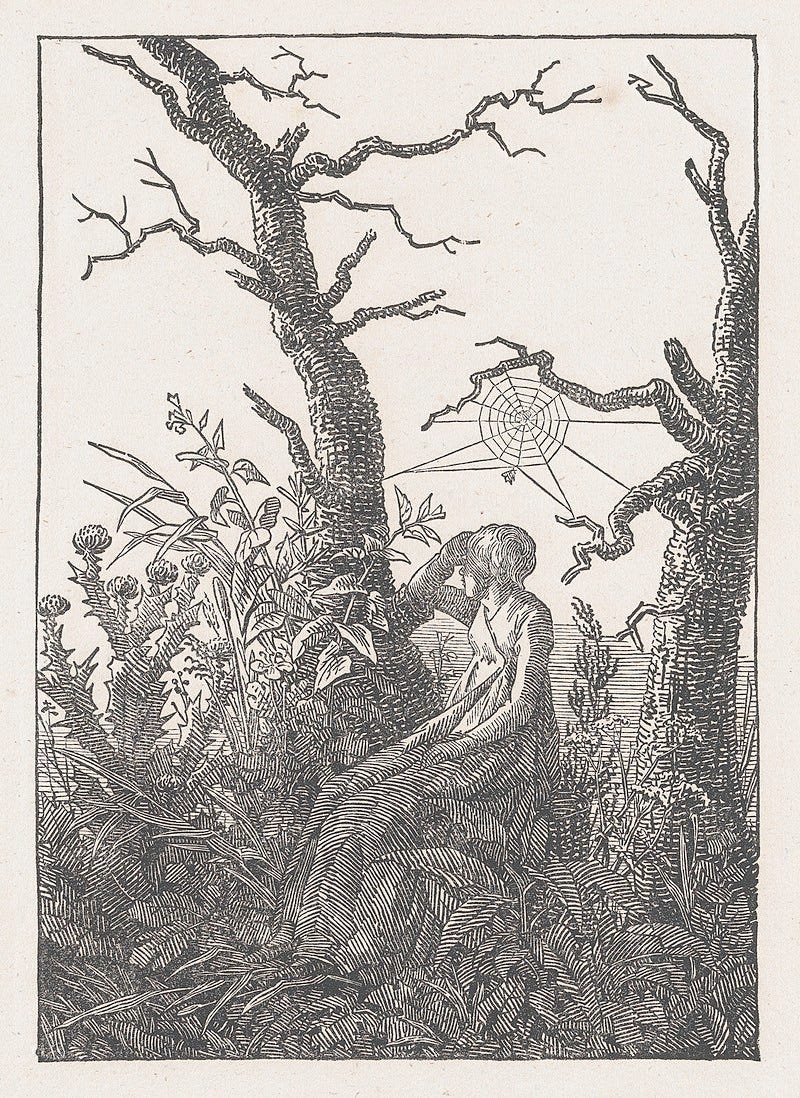
“[t]he end of state development resembles the beginning of human existence. Primal equality ultimately returns. The maternal-material principle of existence opens and closes the cycle of human things. Birds are the oldest birth of the primordial egg, their avian freedom the original state, just as all self-born primal mothers are conceived of in bird form.”[15]
‘Matriarchy’ as a historiographical loadbearing column caused the pederastic National Socialist movement to bristle. Other reactionary ‘intellectuals’ in Weimar Germany clumsily attempted to incorporate or skirt around it. Conservative elitist Berta Eckstein-Diener wrote “Amazons are not simply sporty, bob-haired feminists… Amazonentum is… a heroic means of forming the female world view and keeping it pure in the face of male assaults.”[16] The openly gay anti-Jewish German mystic Alfred Schuler wrote in the 1920s,
“Women should be free; they are often more worthy of it than men... But as far as so-called education is concerned, I am very much against it. The less women learn, the more valuable they are; then they know everything from within themselves.”[17]
In a notable Heidegger lecture from 1943, Heraclitus’ ‘primordial’ connection to the goddess worship in Ephesus is deftly highlighted. Heidegger refers to an anecdote in which Heraclitus is calling attention to divinities inside the “Backofen” (bread-baking oven). Heidegger asks
“is it concern for the monstrous and for one’s own goddess, one’s own [polis] when someone plays ‘dice’ with children in the goddess’s temple precinct?... Who is Artemis? It would be presumptuous to think we could answer this question through a few observations from mythology. The necessary and only possible answer here has the nature of a responsibility that contains the historical decision as to whether or not we are able to preserve the essence of this goddess...”[18]
Heraclitus is said here to offer a “characteristically obscure affirmation of the feminine realm.... [since] the domestic-feminine sphere... [as] distinct from the public-masculine sphere [shows] that the feminine is also divine.”[19] Heidegger’s veiled handling of Bachofen’s ‘prismatic’ but vastly ambiguous erudition also allows us to cut across and yet firmly delineate several antagonistic political, artistic and philosophical groupings. These antagonisms are, or may also be, emphasized and distinguished along economic, ideological and sensual lines regarding the property question. Nevertheless, David Pan argues against the “spurious view that fascist theories of myth advocated a return to mythic structures and the idea of myth is thus fascist ideological terrain.”[20] The simple fact that “patriarchy never found its female Bachofen,”[21] testifies to peculiarities within feminism and Marxism as separate concerns.
A few years after Marx had published The Civil War in France, and both he and Engels concluded their activity in the First International, Lewis Morgan published his now allegedly-surpassed anthropological work Ancient Society. Over this same period of the 1870s, labor movements acquired new proportions across the industrial world, and the seeds of what would become Bolshevik victory to bear fruit decades later were already being planted in the East. A particular tone of ‘radicalism’ in American reformist and ‘progressive’ politics also displayed many of the same features still apparent today. For Marxism in active theoretical becoming during the 1870s, it is Engels here who gives a description of its continuously edifying view of change standing on scientific legs, with Hegelianism,
“the history of mankind no longer appeared as a wild whirl of senseless deeds of violence, all equally condemnable at the judgment-seat of mature philosophic reason and which are best forgotten as quickly as possible, but as the process of evolution of man himself…”
Coupled with the most recent discoveries of scientific Materialism,
“new facts made imperative a new examination of all past history. Then it was seen that all past history, with the exception of its primitive stages, was the history of class struggles; that these warring classes of society are always the products of the modes of production and of exchange—in a word, of the economic conditions of their time. It was now the task of the intellect to follow the gradual march of this process through all its devious ways, and to trace out the inner law running through all its apparently accidental phenomena.”[22]
Habits and histories therefore are often easier to forget about than they are to be completely rid of.
L. Morgan’s own insights, in a manner not unlike Bachofen, also contributed problematic assertions for the ‘practice’ of academic or radical ‘Feminism’ more than a century later. In a seminal ‘Marxist-Feminist’ writing from the 1960s, M. Benston claims in a footnote,
“[m]odern anthropology disputes this [matriarchal] dominance but provides evidence for a more nearly equal position of women in the matrilineal societies used by Engels as examples. The arguments in this work of Engels do not require the former dominance of women but merely their former equality, and so the conclusions remain unchanged.”[23]
Which conclusions or changes are being proposed here? Today, there is both tentative movement and an apparently unshakable stagnation in cultural or gender theoretical discourse on the topic of historically dispelled ‘matriarchy.’ Different explanations since the 1960s have also been reached in archaeology and population studies investigating the Neolithic period. Moreover, Marx and Engels themselves had arrived at such topics from a still more considered approach. In addition to the unavoidable fact that many historically powerful working class fighters were born female, a predicted ‘restoration’ in history undertaken by the social revolution coheres as far more than logographic or quantitative signifier. Nevertheless, it was C. Fourier himself who observed as early as 1808 that “[i]n short, the extension of women’s privileges is the general principle of all social progress.”[24] The term ‘Feminism’ as understood in contemporary political context does not predate Marx or Marxism, though its coining is erroneously attributed to Fourier.[25] Could one at any time possibly become the other?
F. Engels in The Origin of the Family, Private Property and the State (1884), in addition to exploring other questions, establishes a kind of core thesis: Women’s oppression arose with class society. Over more than 2,500 years, developing relations of production and property in the Western European world transformed ancient kinship structures, steadily replacing aspects of remaining matriarchal systems (”mother-right”) with a private property-bound ‘patriarchal’ control to secure and pass on inheritance along the male line. Much ink and spleen are spewed in contesting this assertion as well. In either case, Western European processes of capital accumulation intensified the ongoing historical dissolution of long-standing family and village life and relegated average women to either dull domestic drudgery or industrial wage slavery or both. Engels was so grateful to the vast groundwork that Bachofen had laid, that he wrote to Kautsky in 1884 asking if the
“Old Bachofen”[26] would receive an inscribed copy of Engels’ new book. Second International Marxists such as C. Kelles-Krauz argued in the early 1900s that Bachofen’s research had been guided “by the ironic dialectic of history as if by a priestess of thought, [and] unearthed from beneath the layer of the bourgeois Renaissance the precious elements of a new, powerfully revolutionary Renaissance – the Renaissance of the communist spirit.”[27]
Kelles-Krauz also indicated that the ‘matriarchal’ lens of Bachofen provides a historical allowance enabling Marxists to analyze the “feminist aspect,”[28] at least from the perspective of development of the family and specific contemporary ‘survivals’ from that period. It has also been suggested that Walter Benjamin refers to Bachofen’s treatment of ‘matriarchy’ when drawing the reader to consider “mythical Mothers… a past that can be all the more spellbinding because it is not [one’s] own, not private,”[29] yet both for ‘primal’ and later matriarchal images of the past, “the fact that it is now forgotten does not mean that it does not extend into the present.”[30] Scholar Joseph Mali also argues that Benjamin attempted “to save Bachofen… from the clutches of German fascism,”[31] while Fromm claims that Bachofen’s matriarchal conjectures are “a sweeping and profound philosophy of history, in many ways similar to those of Hegel and particularly Marx.”[32] Benjamin adds however that this ‘myth’ becomes “blurred during those periods in which mothers themselves become agents of the class that risks the life of their sons for its commercial interests.”[33]
Engels forwards the claim that the:
“first class antithesis which appears in history coincides with the development of the antagonism between man and woman in monogamian marriage, and the first class oppression with that of the female sex by the male.”[34]
Compare this with Lewis Morgan, who writes that in ‘advancing’ from various stages of savagery to or beyond ‘barbarism’, these primitive “habits and modes of life divided the people socially into two great classes, male and female.”[35] Nevertheless, for the historically necessary extimacy and presumable bareknuckle inequality of such a foundational social arrangement, Marx and Engels assert the primitive household formation as being “naturally evolved” and “communistic”[36] rather than in all cases initially ‘antagonistic’ in essence. Importantly for all subsequent major debates in Western ‘radical’ discourse regarding ‘household labor,’ Marx also writes
“the evolution of products into commodities arises through exchange between different communities, not between the members of the same community. It holds not only for this primitive condition, but also for subsequent conditions, based on slavery and serfdom…”[37]
What occurred then that caused such ‘coincidental’ antagonisms between sexes to unfold, and to what extent were these apparently senseless causes forgotten or stricken from the record? Two years after Morgan’s Ancient Society had explored ‘survivals’ within this historical existence of a ‘mother-right’, August Bebel also claimed,
“with increasing division of labor there resulted not only a diversity of occupations, but a diversity of possessions as well. Fishing, hunting, cattle-breeding and agriculture, and the manufacture of tools and implements, necessitated special knowledge, and these became the special province of the men. Man took the lead along these lines of development and accordingly became master and owner of these new sources of wealth.”[38]
Bebel additionally tries to demonstrate that, “[a]s a result of this subjugation, woman came to be regarded as an inferior being and to be despised. The matriarchate implied communism and equality of all.”[39] If a matriarchate for Bebel also implies ‘equality of all,’ what has been contested by Benston and overturned by ‘modern day anthropology’ since the 1870s?
In Mesoamerica, West Eurasia and the far East, archaeological traces and findings gathered up to the present day may point to some form of ‘matriarchate’ thousands of years ago. At Çatalhöyük, in present day Turkey, recently discovered matriarchal or matrilineal DNA patterns and woman-focused grave goods distribution suggest that
“7th millennium B.C…. social organisation and symbolism stand in stark contrast with the predominantly male-focused societies that emerged in West Eurasia in subsequent millennia.”[40]
The earliest known examples of woven textiles[41] also come from Çatalhöyük. In ancient Persia,
“Women were in charge of cooking, making earthen ware, as well as looking after the fire, their children and their homes. They were also in charge of tribal affairs. Family relations followed the female line…. Not only women held positions of economic and social leadership, but were solely in charge of the spiritual affairs of their tribes.”[42]
In each case, women’s relatively heavy labor burden in this respect undoubtedly was seen as being in direct connection with and a complement to their important social standing. In Neolithic China, a site at “Fujia” associated with the Dawenkou culture reveals a high probability of matrilineal descent which may “suggest that its social dynamics resemble those of modern matrilineal societies with a lower degree of heritable resources and private properties.”[43] Mesoamerican recollections associated higher female social status directly to participation in the production of textiles. For instance, a young Nahua woman would be told: “It is not your destiny, it is not your fate, to offer [for sale] in people’s doorways, greens, firewood, strings of chiles, slabs of rock salt, for you are a noblewoman. [Thus], see to the spindle, the batten.”[44]
Perhaps as an exception in the ancient non-Greek world, Abrahamic traditions highlight a development of class and inheritance alongside a higher labor-centered status for women. Bebel claims that in the ancient past,
“Mosaic law [was] framed in a manner destined to prevent the Jews from developing beyond the stage of an agricultural society, because their lawmakers feared that it might bring about the downfall of their democratic, communistic organization... For the same reasons, moreover, the Jews were kept at a distance from the sea, which is favorable to commerce, colonization and the acquirement of wealth.”[45]
Elsewhere, Bebel states “The Jews are the sworn enemies of Malthusianism.”[46] But for various distinctions between family or village and the development of individual property on this point, Lafargue argues “[a]mong the Jews and Semitic peoples there was no private property in land,”[47] or else he and Bebel do not appear to disagree here.
Lafargue in 1886 wrote that
“[c]ivilization often works against nature, making pregnancy difficult, childbirth laborious and painful, and suckling dangerous, often impossible: thus, it weakens maternal love in women. The savage woman loves her child above all else; she nurses it for two years, never hitting it; the child, which the mother protects from the brutalities of men, clings to her, as chicks flee beneath the wings of a hen at the slightest danger. Woman, therefore, was destined by nature to carry the totem of the clan.”[48]
So both the cult of woman and the cult of nature alternatively have taken on various meanings and been supplanted as a consequence of different modes of human economic practical development or development of the family rather than the other way around. Lafargue points out that still in the Basque culture, “[t]he husband… is his wife’s head servant.”[49] Is this also the ‘equality’ implied later by Benston? Marx and Engels go into some detail on this development of woman’s subjugation having taken on a peculiar intensity in Western Europe, yet elsewhere:
[T]he unity can extend to the communality of labor itself, which can be a formal system, as in Mexico, Peru especially, among the ancient Celts, and some Indian tribes. Furthermore, the communality within the tribal system can appear more like the unity being represented by a head of the tribal family or as the relationship between the fathers of the family. This then leads to either a more despotic or democratic form of this community. The communal conditions of actual appropriation through labor, water pipes (very important among Asian peoples), means of communication, etc., then appear as the work of the higher unity.[50]
Peoples whose women have to work much harder than we would consider proper often have far more real respect for women than our Europeans have for theirs. The social status of the lady of civilisation, surrounded by sham homage and estranged from all real work, is infinitely lower than that of the hard-working woman of barbarism, who was regarded among her people as a real lady (LADY, frowa, Frau=mistress) and was such by the nature of her position.[51]
For Marxists then, the primitive communist household is said to have prevailed where the division of labor between sexes emerged out of a long and difficult “natural” process. Bachofen describes the transition from a “telluric” age of ‘hetaerism’ to a form of primeval Communism which “even seemed to him inseparable from gynecocracy.”[52] Such a transition can be seen to have already taken place through a usefully abstract example given by Marx,
“the women of the family spinning and the men weaving, say for the requirements of the family – yarn and linen were social products, and spinning and weaving social labour within the framework of the family.”[53]
To this extent, a ‘natural’ division of labor exists between, but not within, the sexes. Stalin himself wrote in 1906 of that time long ago “under the matriarchate, when women were regarded as the masters of production.”[54] The WWII ‘Night Witch’ female aviator M. Raskova recounts once when
“Comrade Stalin took the floor. He spoke quietly, but so clearly that everyone could hear him. He spoke simply and with remarkable wit. He recalled the time of matriarchy, explained what matriarchy was, how it came about that women were more thrifty than men, that women began to cultivate crops while men only hunted, and that women turned out to be more important than men. Then he spoke of the plight of women throughout the centuries that followed. He talks about how women were oppressed, deprived of their rights to a simple human existence.”[55]
The period being referred to here is not yet the period in which man has become ‘bourgeois’ and woman ‘proletarian.’
A view of ancient China as containing such a primeval communistic form in historical practice was pointed out by Marx himself where he notes, “this communism, based on natural growth (although itself formed through a long historical process), was also the original form in China can be seen, for example, in Abel, etc.”[56] Alternatively, the rise of a Greek gens and forms of patriarchal private property saw an almost complete reversal of these once integrally wefted communal ‘circles’ of unity between manufacturing and agriculture. A glaring example of such historical rupture also appears in reconfigurations of the myth of Athena by which Lafargue shows these tropes being originally adapted to “a savage tribe, war loving and ferocious, who sent colonies from Africa to Greece and Asia Minor.”[57] Lafargue argues that myths themselves both transmit and ‘forget’ the old, all while retaining suggestions of the obvious. In Roman myth too, “Jupiter carried off Metis to assimilate her cunning, her prudence and her wisdom, for her name in the Greek language has these diverse meanings.”[58] He continues:
The epithet Tritogeneia meant that Athena was thrice-born – for she belonged originally to the group of antique self-born goddesses – but, in the course of time, when her savage adorers reached the stage of development in which the matriarchal family was constituted, she was endowed with a mother, who bore different names, according to the people who worshipped Athena; and at last, when on earth, and afterwards in heaven, man had become the ruling power in the family, she consented, to the great joy of the gods, to recognise the authority of Zeus, who went through the ludicrous ceremony of giving her birth[59]
Lafargue’s treatment of the ‘myth’ of Adam and Eve also examines essentially economic questions, stating that moderns must first see that
“[m]yths are neither inventions of deceivers nor idle fantasies; they are rather one of the most naive and spontaneous forms of human existence. Only then will we come to know the childhood of humanity when we are able to unravel the meaning they had for primitive people.”[60]
Bebel observes “the ancient cults continued to dominate the minds for centuries; only their deeper meaning was gradually lost.”[61] For these late 19th century able-bodied Western European cis-heterosexual males’ sake, if ‘matriarchal’ historical assumptions were passed down merely as a patchwork of myths, Pomeroy admits how “we are haunted by the question of whether women could have participated in their creation.”[62] What about in the creation of class antagonism itself? These blatant degradations of ‘hetaerism,’ as Engels shows, later transformed “to monogamy… brought about essentially by the women.”[63] Only after the shifting from a homogenizing polyamory and ‘group marriage’ to pairing, family “had been affected by the women could the men introduce strict monogamy.”[64] Or rather, monogamous restrictions that only applied to women. Somewhere between asserting ‘goddess’ worship as grounds either for subjugation or ‘veneration’ and identifying a nearly forgotten labor-centered high status for women in the archaeological record, Paul Lafargue’s insights do resemble Thomas Sankara’s:
The superior position in the family and society, which man conquered by brute force, at the same time as it forced him into a cerebral activity to which he was little accustomed, placed at his disposal means of intellectual development, constantly increasing. The woman, tamed, according to the Greek expression, enclosed in the narrow circle of the family, from which direction was taken away, and having little or no contact with the outside world, saw on the contrary the means of development which she had enjoyed reduced to almost nothing and to complete her enslavement she was forbidden the intellectual culture given to man. If… the female brain continued to evolve, it is because the intelligence of the woman benefited from the progress made by the male brain; for one sex transmits to the other the qualities which it has acquired[65]
What then were the immediate or more general causes of matriarchy’s overthrow in the materialist sense? Lafargue here gives two seemingly contradictory reasons:
Unquestionably it was the desire to shake off this feminine ascendancy and to satisfy this feeling of animosity which led man to wrest from woman the control of the family[66]
Collective property, if not the sole cause, was, at all events, the pre-eminent cause of the overthrow of the matriarchate by the patriarchate[67]
Is collective property therefore some hyper-masculine dissident ‘feeling of animosity?’ Is the socialist revolution, or ‘progress,’ merely a relict of man’s undifferentiated and unchanging or ineffably gender-based desire to ‘overthrow’ matriarchy? This is unlikely, although there is power in the assertion made that with the rise of slavery and animal husbandry, there would also develop both private property and a ‘royal’ womanhood. What was customarily household labor for household consumption became also a warped and senseless self in Western Europe, since “the ceaseless weaving acquires a magical quality, as though the women were designing the fate of men.”[68] According to Lafargue, “Man… was thus obliged to begin deifying woman… ‘Zeus himself can not escape destiny,” but eventually, “the idea that woman had no soul became so rooted so firmly in the ancient world…”[69] that a change to worship of a household patriarch and feeding of the dead also persisted into early Christianity. Although Lafargue asserts St. Augustine justified this saying “the faithful carried food to the tombs of the martyrs, but he adds that they ate it on the spot or distributed it to the poor.”[70] To this extent, it is also argued by one ‘marxist’-Feminist that it’s no accident “Mary’s cult as Theotokos… was established at… Ephesus, the site of… the temple of Artemis… like Mary, both a virgin and a great mother.”[71] Bachofen also claims “[v]irginity and motherhood are closely connected, while hetaerism denies both.”[72]
Bebel puts forward several arguments suggesting that the development of “Iron tools”[73] or fishing and domestication of animals also accelerated and multiplied this factor of force and overthrowing of ‘mother-right.’ Soviet anthropological studies suggested that in ‘barbaric’ societies beyond the historical frontier of Western and Greek societies such as
“[a]mong the Scythians, women participate in war on an equal basis with men, not inferior to them in courage, and in certain eras the bravest women stood at the head of government among this people. Among the Ethiopians, women bear arms and are obliged to serve in the army for a certain period. Finally, even among the Gauls, women compete in courage with men Pomponius Mela (1st century) reports that among the Ixamat women do the same as men, and are not even free from military service; the men of this people fight on foot and shoot from a bow, the women are on horseback, but do not use weapons, but lassos, with which they strangle enemies, and until they kill the enemy, they retain their virginity.”[74]
Indispensable if easily forgotten, a “critical knowledge of the evolution of the idea of property,”[75] and its resulting societal or communal questions must be posed over this or that specific perspective or individually traumatic manifestation. Soviet scholar Mark Kosven in the late 1940s wrote that while
“[h]umanity also has its own constant, organic, universal path of development. At the same time, we are far from affirming a unilinear, uniform evolutionary development of all peoples… [and matriarchy] turns out to be distinct and unique in each individual society.”[76]
To what forces did these various kinds of ‘matriarchate’ ultimately succumb in history? In short, the movement from ‘hordes’ to clan and village life involved the movement into a technologically primitive form of Communism that itself at various times resulted in a geographical sprawl and perhaps to varying degrees the “slave trades facilitated the adoption of matrilineal kinship.”[77] Kosven also mentions the many interweaving and overlapping processes whereby “[m]atriarchy, disintegrating and transitioning to patriarchy, leaves behind a number of relics, representing changing, dying elements of the forms and relationships that existed in full force under matriarchy.”[78] This too eventually led to a paternal kinship alongside and then again to the exclusion of ‘mother-right.’ Marx here argues that,
“[i]t is impossible to overestimate the influence of property in the civilization of mankind. It was the power that brought the Aryan and Semitic nations out of barbarism into civilization.”[79]
Woman’s pre-eminence in the ancient gens and clan or within these middle and ‘upper stages of barbarism’ must also have come with a proposition. The receding forests and transition to settled agriculture brought along vast changes in the division of labor. ‘Surplus production’ outside the family/village, though still miniscule in comparison to the age of industrial capitalism, led also to a ‘surplus’ of domesticity in each ‘ascending’ phase of civilization. Engels charges that we presently “know nothing as to how and when this revolution was effected among the civilised peoples. It falls entirely within prehistoric times.”[80] Though it is obvious that to exchange ‘something’ for nothing then was among the listed prices of avoiding manual labor and winning the chance to become a “superintendent of female slaves”[81] in the emerging changes to the prevailing order. In Ancient Greece, this reached ridiculous and debauched proportions, “that one had first to become a [‘reputable’ prostitute] in order to become a woman is the strongest indictment of the Athenian family.”[82] Eventually, Marx claims, women’s inculcated inferiority “came to be accepted as a fact by the women themselves.”[83] Olive Schreiner, at one-time a close friend of Marx’s daughter Eleanor, rather unceremoniously deems this kind of degradation as “sex-parasitism.”[84] Arguing that, as use of metal tool-making, beasts of burden, settled agriculture and private property all expanded and lowered the socially-required labor time for certain strata,
“the need for [female] physical labor having gone, and mental industry not having taken its place, [woman] bedecked and scented her person, or had it bedecked and scented for her, she lay upon her sofa, or drove or was carried out in her vehicle, and, loaded with jewels, she sought by dissipations and amusements to fill up the inordinate blank left by the lack of productive activity.”[85]
Marx insists that
“Struggle for… Possession of the most desirable territories, localization of tribes in fixed areas, vu. in fortified cities, with… increase the population. Advanced martial arts.... These changes indicate the approach of civilization.”[86]
Idleness alongside ‘veneration’ may have been mythically consensual for one group or one generation, but the control of slaves, or control of alluvial plains and granaries, long-distance trading routes, waterworks and underdeveloped forms of manufacture themselves all break down and reassert themselves upon corresponding changes in relations of production and social dislocations in wealth’s movability/fixity. This also becomes the “control” and sale of women, just as much as it may have once involved women also participating in the maintenance of communal property for many generations prior. Expansion of production among the prehistoric Greeks and Roman gens must also, at some point, have produced a metal-working and highly disruptive contingent among the barbaric ‘outcasts’ as well. Morgan quotes a missionary’s description of the American Seneca’s tribal lifeways:
“[t]he stores were in common; but woe to the luckless husband or lover who was too shiftless to do his share of the providing… he might at any time be ordered to pick up his blanket, and budge… The house would be too hot for him… The original nomination of the chiefs always rested with [women].”[87]
Woman was a slave, and woman controlled slaves. Man was a slave, and man controlled slaves. Iron smelting and domestication of large beasts of burden however are what those groups such as the Iroquois lacked. One may reasonably infer that among geographical areas where metal tool-making and animal husbandry, coupled with this expansion of a ‘kóryos’ of socially outcast youth roving the countryside, a growing risk of ‘barbarity’ outside, or ‘sex-parasitism’ within the polity, could only be kept at bay at the expense of ‘communal life.’ In Europe, this meant the end of locally maintained stores or pastures in common and the formation of patriarchal inheritance both of land and the labor needed to work it. Marx explains:
For now slavery too had been invented. The slave was of no value to the barbarian of the lower stage. It was for this reason that the American Indians treated their vanquished foes quite differently from the way they were treated in the upper stage. The men were either killed or adopted as brothers by the tribe of the victors. The women were either taken in marriage or likewise just adopted along with their surviving children. Human labour power at this stage yielded no noticeable surplus as yet over the cost of its maintenance. With the introduction of cattle breeding, of metalworking, of weaving and, finally, of field cultivation, this changed. Just as the once so easily obtainable wives had now acquired an exchange value and were bought, so it happened with labour power, especially after the herds had finally been converted into family possessions. The family did not multiply as rapidly as the cattle. More people were required to mind them; the captives taken in war were useful for just this purpose, and, furthermore, they could be bred like the cattle themselves[88]
Lafargue continues to say that:
So it may be said that humanity, since it emerged from communism of the clan to live under the system of private property, has been developed by the efforts of one sex alone and that its evolution has been retarded through the obstacles interposed by the other sex. Man by systematically depriving woman of the means of development, material and intellectual, has made of her a force retarding human progress... this has been retarded ever since humanity entered into the period of civilization and private property, because then woman, constrained and confined in her development, cannot contribute to it in so effective a way[89]
Bebel deems this more or less rapid change from different kinds of clan and communal property to patriarchal private property as the West’s “first great revolution.”[90] Engels also explains this was the:
[F]irst form of the family to be based, not on natural, but on economic conditions – on the victory of private property over primitive, naturally developed common ownership… Monogamous marriage was a great historical advance; nevertheless, together with slavery and private wealth, it opens the period that has lasted until today in which every step forward is also relatively a step backward, in which prosperity and development for some is won through the misery and frustration of others[91]
Engels further demonstrates that the mistreatment by Telemachus[92] of his own mother exemplifies this close association between women and textile production/unraveling so central to the Odyssey’s plot, as well as the insistence in Greek civilization upon man’s domination over women. For present day anthropology and for Marxists looking back on ancient history, though evidence may often be seen that deigns
“to assert the presence of male dominance, it is always much more difficult to define its precise degree, and equally difficult to affirm its total absence. The point is not even that, for primitive societies, sex equality – in the rigorous sense of the term, that of the disappearance of gender – was an unachievable ideal: it could not be, and never was, an ideal at all. Pre-capitalist peoples did not necessarily establish an explicit hierarchy between the sexes; the idea of the superiority of one sex over the other… while it exists in most cultures, is by no means universal. In a number of societies, the sexes are not conceived in terms of different values, and this does not prevent men from having rights that women are denied.”[93]
How then might a recovery of such history also assist us to throw on the habiliments needed to cover a hypermodern unadorned and unfilial shame? An obverse approach to these ‘survivals’ in the Russian context of communal agriculture was once highlighted by Engels when he said that the ‘Obschina’ must be looked at from a perspective “other than the Western one.”[94] But whether from within or outside such bounds, a ‘forgetting’ has already filled this gap. Walter Benjamin, turns this part of the drama toward a more monistic object:
[T]he Penelope work of recollection. Or should one call it, rather, a Penelope work of forgetting? Is not the involuntary recollection, Proust’s memoire involontaire, much closer to forgetting than what is usually called memory? And is not this work of spontaneous recollection, in which remembrance is the woof and forgetting the warf, a counterpart to Penelope’s work rather than its likeness? For here the day unravels what the night was woven. When we awake each morning, we hold in our hands, usually weakly and loosely, but a few fringes of the tapestry of lived life, as loomed for us by forgetting. However, with our purposeful activity and, even more, our purposive remembering each day unravels the web and the ornaments of forgetting[95]
Proto-‘Feminism’ and the Woman’s Industrial Revolution
altho The air of Paradise did fan the house,And Angels offic’d all; I will be gone[96]
From Medieval ‘querrelle des femmes’ polemics to the many treatises written since the European Renaissance, we recall that educated, or non-working, women in the West also had an early hand in forwarding their particular class’ ‘noble’ views on Women’s Rights. Some men too, such as Heinrich Cornelius Agrippa in the early 1500s, tried to demonstrate that due to the fact Eve had been made within the walls of Paradise and after Adam, woman was the superior sex. This despite a “tyranny of men”[97] placed upon her. Highly placed women therefore contributed early on to the cultural patterns of Women’s Rights movements to come. These women were not universally silenced, although many were made to forego the use of their husbands’ & fathers’ names in publishing things like:
That we are more witty [than men] which comes by nature, it connot better be proved, than that by our answers, men are often driven to Non plus[98] – Jane Anger
This is our Case; for Men being sensible as well of the Abilities of Mind in our Sex… began to grow Jealous, that we, who in the Infancy of the World were their Equals and Partners in Dominion, might in process of Time, by Subtlety and Stratagem, become their Superiours; and therefore began in good time to make use of Force (the Origine of Power) to compell us to a Subjection, Nature never meant; and made use of Natures liberality to them to take the benefit of her kindness from us[99] – a Lady
[W]ere the Men Philosophers in the strict sense of the term, they would be able to see that nature invincibly proves a perfect equality in our sex with their own[100] – Sophia, a person of quality
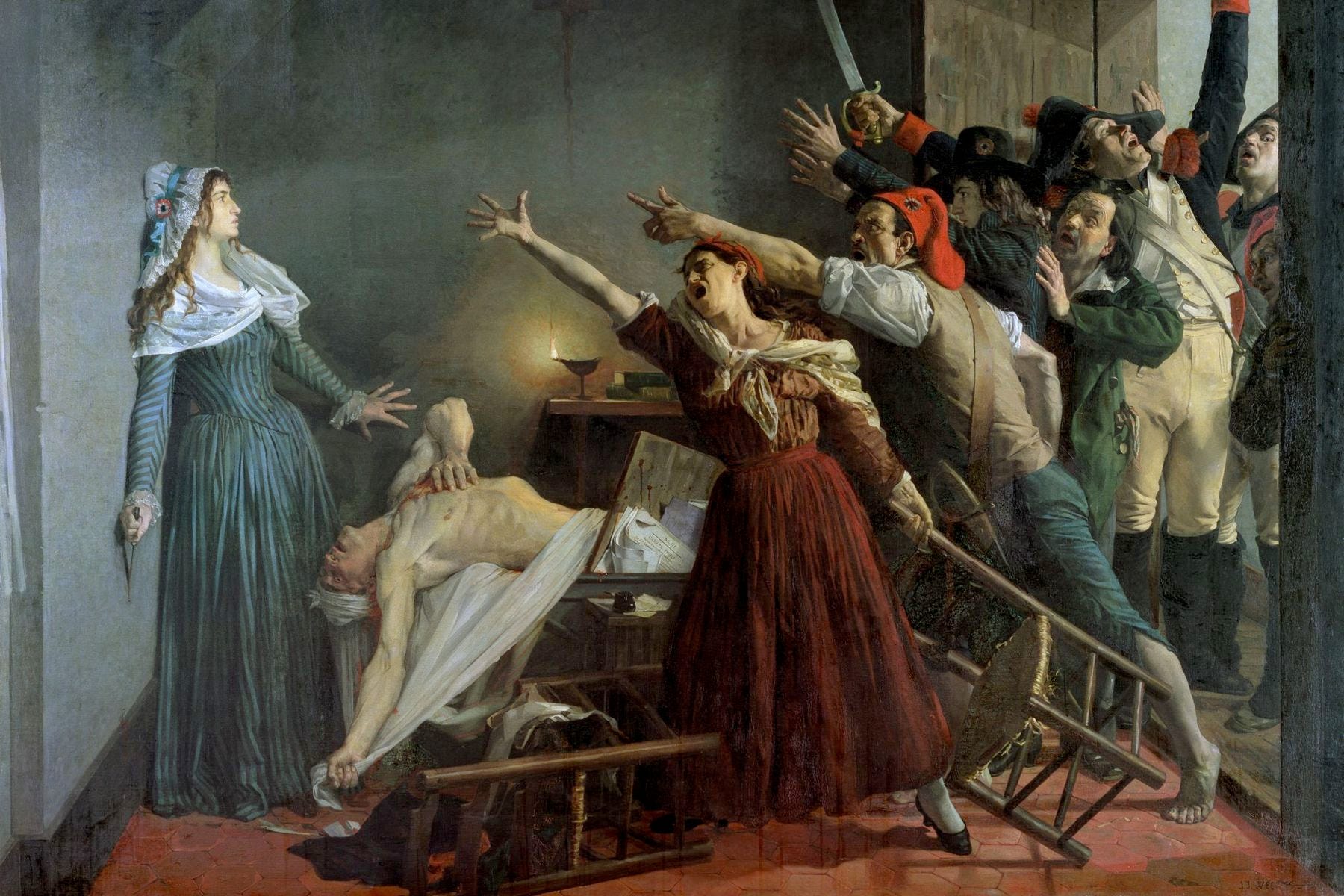
These and similar questions in their abstract form persisted, with much of the immediate post-1789 movements around women’s equality, particularly in France, reflecting similarly bombastic notions. In 1793, the Marquis de Sade had commented harshly on the female assassin of Marat. Charlotte Corday had been incensed by what she saw as revolutionary ‘excesses’ and stabbed Marat to death while he was bathing. Sade excoriates her as “like those mixed beings to whom no sex can be assigned, vomited by hell for the despair of both, does not belong directly to any... a Tartar fury.”[101] This dehumanized archetype of a ‘femme-homme’ would continue to inspire discomfort. A later example, though just as jarring, is that of the Saint-Simonians and Simon Ganneau, a mystic and charismatic rabble-rouser who tried to embody ‘androgyne’ characteristics. Saint-Simon’s successors claimed that a “Female Messiah”[102] would be found in the ‘Orient’ and several followers set out to try and find her. As a direct influence upon people like Flora Tristan, charismatics such as Saint-Simon, Ganneau and their many followers attempted to combine this feminine fervor with utopian spiritualist constructions. One acolyte asserted:
MY TEMPLE IS A WOMAN[103]
It is not for nothing then that the first recorded political usage of the term “feminists,” [104] as a pejorative referring to equal-rights activists, was by A. Dumas, a one-time follower of Ganneau. In 1840s America, middle-class women writers could see more Earth-bound ‘bread & butter’ issues of the day and reflect upon them, but to what political end?
[V]isions of the past crowded upon me… our merry-makings and our tragedies, my school-mates, the partners of my life, the partners of my hoped-for immortality… My binding tears fell thick and heavy… Lilly [a Freedwoman domestic worker, wiped the tears]… and rolling up the quilt thrust it back into the old cupboard… As I retraced my way to the village I marked the changes since this patchwork history was constructed. The Indians that figured in Queen Anne’s broadcloths… driven from their loved homes… into the shadowy West and are melted away. The wooded sides of our mountains have been cleared to feed yonder smoking furnace. Those huge fabrics for… chemical experiments indicate discoveries in science that have changed the aspect of the world… Houses have decayed and new ones have been built over the old hearthstone… Families have multiplied and sent forth members to join the grand procession… at this very moment the bell is ringing for a meeting of the town to extend the limits of our burying-ground, it being full! All these changes and the patch-work-quilt remains in its first gloss![105]
What is decisive in the stitching together and creation of history, as well as the creation of man, is “purposive activity” and not a theorized and reflexively sorrowful or mystified sense of resignation. It is labor and technological change which decisively intervene and disclose man’s relationship to Nature. Here, Lafargue gives credence to modern society that “until the epoch of the great mechanical industry, trades were mysteries, whose practices were professional secrets, jealousy hidden from the profane and revealed only to the initiated… crafts of artisan manufacturing, where manual skill and knowledge play a preponderant part, have contributed to reinforce… the human toward religious mysticism.”[106] This must also apply to the textile industry. It is just this type of large-scale mechanized industrial labor offering and requiring that the workers be put under pressure and form new ways of communal being, as well as to discard the obscurant ‘craft’ esotericism. Though luminescent aspects of ancient ‘myths’ also linger, it was the inhumane rise of capital’s anarchic and disruptive rule that subjugated men and women in the working classes, not their specific belief systems or romantic failures interpersonally. Engels shows that it is the economic condition of modern society: “which unsexes the man and takes from the woman all womanliness without being able to bestow upon the man true womanliness, or the woman true manliness -- this condition which degrades, in the most shameful way, both sexes, and, through them, Humanity”[107] Bebel offers encouragement here:
No movement of great importance has ever taken place in the world, in the past or present, in which women have not played a prominent part as combatants and martyrs[108]
Marx and Engels showed[109] that the year 1825 marks capitalism’s first great general crisis. Coincidentally, 1825 was also the first substantial U.S. women’s industrial labor organizing effort and rallying for wage increases.[110] Were working men simply trying to silence these female working class fighters and prevent them from speaking for their class interests? In the year:
“1831, during the tailoresses’ strike, “A Mechanic” repeatedly urged the women on, suggesting that they open their own shop and receive work based on their own pricelist… [w]hen the women shoe binders organized in 1835, one union member offered a detailed exposé of the atrocious conditions in which the women labored and concluded that “it is high time, in this republic, that such slavery is done away with.” The all-male shoe binders’ union agreed and passed a strong resolution of support… [the New York Association of Journey Bookbinders] approved a public address expressing its deep interest in the women’s struggle and vowing to use ‘all honorable means’ to help them… the National Trades’ union went so far as to suggest that all trades affected by female labor add women’s auxiliaries to their unions”[111]
For enslaved women in America at the same time, ‘family life’ was itself a cruel and torturous experience completely predicated on violently enforced property claims and involuntary lifelong domestic servitude. Harriet Jacobs was not only harassed and abused by her former master who threatened to sell off her children if she didn’t comply, but in her prolonged escape, she had to hide underneath the floorboards of a nearby house for almost a decade. Intentionally deforming herself to avoid what were the master’s constitutionally-upheld property claims against her life. In one incident, Jacobs swore she heard her former master coming to eject her from the crawlspace. But she remained hidden, “the key was turned in my door… and there stood my kind benefactress alone… ‘I thought you would hear your master’s voice’ she said… ‘I came to tell you there is nothing to fear. You may even indulge in a laugh at the old gentleman’s expense. He is so sure you are in New York… The doctor will merely lighten his pocket hunting after the bird he has left behind.’”[112] Mary Livermore claimed to have spoken to a slave ‘Aunt Aggy’ who told Mary that before the Civil War she had prayed for the Lord to “hasten de day when de blows, an de’ bruises, an’ de aches, an ‘ de pains , shall come to de white folks , an’de buzzards shall eat’em as dey’s dead in de streets. Oh, Lor’ ! roll on de chariots , an ‘ gib de black people rest an ‘ peace.”[113] Her prediction came true. Nevertheless, many ‘feminist’ leaders of the time in America such as Elizabeth Cady Stanton still could only exhibit fear of immigrants and laboring “lower orders of foreigners”[114] like Irishmen or Black men or Germans or Asians, who after obtaining some measure of formal equality, would rule alongside Anglo-Saxon men and crowd ‘noblewomen’ such as Stanton out.
The labor organizer Sarah Bagley fought for a reduction in work hours, whereas more refined ‘thinking women’ like Harriet Farley pressed for upwardly mobile demands of ‘respectability’ in the 1830s and 1840s. Between the two of them, the feminine “mind among the spindles”[115] being referred to in their heated debates apparently took on a different character. Textile mill owners themselves, who saw Farley’s positive portrayal of ‘emancipatory’ aspects of industrial working life for women as a valuable advertisement for employment in their mills “bought back subscriptions and supplemented the pay of the editors. The mill owners’ support undermined the paper’s reputation among mill women, and the paper folded in 1845.”[116] On the other hand, Bagley’s working class fervor also failed “to gain respect from middle-class women,”[117] who were themselves more well-placed in reformist social movements. Sarah Bagley also polemicized with the Abolitionist William Garrison, who had come out against the labor unions. Bagley asked “[d]o our anti-slavery friends over discuss the merits of the Labor question?… We discuss all of these, and Slavery, South and North… What say, friend, Garrison? …Affinities find each other, say you, and we shall understand each other in due time. Till then let us exercise charity for each other, and not claim for ourselves more of the genuine spirit of reform, than we are willing to award others, who are laboring as sincerely as ourselves, if not in the same department, in some other, to bring about the glorious era, when wrong and injustice shall cease, and universal rights shall be recognized from East to West, from North to South.”[118] Lacking the scientific orientation and partisan spirit that subsequent decades would grant to the workers’ movement, zig-zags “(or the female line, as certain wits [call it]… not without reason)”[119] in organizational methods were still being made, though perhaps not abstractly as regards ‘feminism.’ During the uproarious 1840s, Flora Tristan had also taken up the struggle of working people:
Workers, you are unhappy. Yes, no doubt; but where does the main cause of your ills come from?... If a bee and an ant, instead of working in concert with the other bees and ants to supply the home commune to live, they were advised to separate and want to work alone, they too would die of cold and hunger in their solitary corner. Why then do you remain in isolation?... —Isolated, you are weak and fall overwhelmed under the weight of miseries of all kinds! — Well then! Come out of your isolation: unite! — Union is strength[120]
Tristan in Europe and in her travels, though still anti-slavery, was however not as racially[121] enlightened as Bagley or others, and also did not forward class struggle as such. A year after Flora Tristan addressed these crowds of angry workers, the ‘anarchistic’ and anal-retentive radical set in Germany fired back at her, but Marx and Engels appear to defend Flora’s role, if only to highlight what she forgot:
The worker creates even man; the critic will never be anything but sub-human though on the other hand, of course, he has the satisfaction of being a Critical critic.
“Flora Tristan is an example of the feminine dogmatism which must have a formula and constructs it out of the categories of what exists.” Criticism does nothing but “construct formulae out of the categories of what exists”… Formulae, nothing but formulae. And despite all its invectives against dogmatism, it condemns itself to dogmatism and even to feminine dogmatism. It is and remains an old woman — faded, widowed Hegelian philosophy which paints and adorns its body, shrivelled into the most repulsive abstraction, and ogles all over Germany in search of a wooer[122]
Marx and Engels are not rejecting women in the revolutionary and labor movements so much as feminist and ‘anti-feminist’ posturing at the level of ‘criticism’ from abstract moral principle, or the mere lack thereof. The individual’s memory is not the primary arena of class struggle, neither then is the emotionally individuated rehashing of such critically ‘lived experiences.’ Benjamin also writes that “what has been forgotten... is never solely individual… Everything forgotten mingles with what has been forgotten of the prehistoric.”[123] The social metabolic process of material production is this primary arena of revolutionary undertaking, whether today or 15,000 years ago. Women and children ripped out of their homes in the endless search for wages not only disrupts domestic situations undergoing various states of ‘tranquility’ or ‘strife,’ it pits men already in competition among themselves as now competing for wages directly against their very own families:
Thus the social order makes family life almost impossible for the worker… The husband works the whole day through, perhaps the wife also and the elder children, all in different places; they meet night and morning only, all under perpetual temptation to drink; what family life is possible under such conditions? Yet the working-man cannot escape from the family, must live in the family, and the consequence is a perpetual succession of family troubles, domestic quarrels most demoralizing for parents and children alike[124]
Engels extends this to say “[i]f the family of our present society is being thus dissolved, this dissolution merely shows that, at bottom, the binding tie of this family was not family affection, but private interest lurking under the cloak of a pretended community of possessions.”[125] Some few decades later, with the major strife of the American Civil War behind them and a resulting rise of the organized industrial labor movements in the U.S., it was not lost on that generation at all that working class concerns would also have to take on a more partisan path for both sexes. William Sylvis did not silence women laborers either, comparing one’s misery to another:
As men struggling to maintain an equitable standard of wages and to dignify labor, we owe it to consistency, if not to humanity, to guard and protect the rights of female labor, as well as those of our own. How can we hope to reach that social elevation for which we all aim, without making woman the companion of our advancement as she has been of our depression? Are we to march on to the goal of our ambition and leave her behind to drink the dregs of misery?[126]
Marx took note of this ‘sensitive’ approach and commended the “very great progress… demonstrated at the last congress of the American ‘Labor Union’, inter alia, by the fact that it treated the women workers with full parity; by contrast, the English, and to an even greater extent the gallant French, are displaying a marked narrowness of spirit in this respect.”[127] In Russia during the late 19th and early 20th centuries too, the momentous wheels of change and the brutal processes of historical development lurched ever forward and people like V. Zasulich and K. Zetkin and A. Kollontai could not but observe a similar reality unfolding under brutal early capitalistic conditions in Russia:
However, the working class knows who is to blame for these unfortunate conditions. The woman worker, no less than her brother in suffering, loathes that insatiable monster with the gilded maw which falls upon man, woman and child with equal voracity in order to suck them dry and grow fat at the cost of millions of human lives. The woman worker is bound to her male comrade worker by a thousand invisible threads, whereas the aims of the bourgeois woman appear to her to be alien and incomprehensible, can bring no comfort to her suffering proletarian soul and do not offer women that bright future on which the whole of exploited humanity has fixed its hopes and aspirations. While the feminists, arguing the need for women’s unity, stretch out their hands to their younger working-class sisters, these ‘ungrateful creatures’ glance mistrustfully at their distant and alien female comrades and gather more closely around the purely proletarian organisations that are more comprehensible to them, and nearer and dearer to their hearts[128]
It is against such a background that a political vanguard of working class revolutionary transformation takes shape in the early proletarian socialist movement. This too is stalked by the same nagging attempts to waylay that development in a series of counter-posed turns shouting for ‘unity.’
[C]an man or woman choose duties? No more than they can choose their birthplace or their father and mother[129]
Heroines and Harpies
What is the aim of the feminists? Their aim is to achieve the same advantages, the same power, the same rights within capitalist society as those possessed now by their husbands, fathers and brothers. What is the aim of the women workers? Their aim is to abolish all privileges deriving from birth or wealth. For the woman worker it is a matter of indifference who is the ‘master –a man or a Woman. Together with the whole of her class, she can ease her position as a worker[130]
The modern industrial system has changed the ‘little shop of the primitive patriarchal master into the large factory of the Bourgeois — capitalist. Masses of operatives are brought together in one establishment, and organised like a regiment of soldiers ; they are placed under the superintendence of a complete hierarchy of officers and subofficers. They are not only the slaves of the whole middle-class (as a body,) of the Bourgeois political regime, — they are the daily and hourly slaves of the machinery, of the foreman, of each individual manufacturing Bourgeois. This despotism is the more hateful, contemptible, and aggravating, because gain is openly proclaimed to be its only -object and aim. In proportion as labour requires less physical force and less dexterity — that is, in proportion to the development of the modern industrial system —-is the substitution of the labour of women and children for that of men. The distinctions of sex and age have no social meaning for the Proletarian class. Proletarians are merely so many instruments which cost more or less. When the using-up of the operative has been so far accomplished by the mill-owner that the former has got his wages, the rest of the Bourgeoisie, householders, shopkeepers, pawnbrokers, etc., fall upon him like so many harpies[131]
Women in the 19th century labor movement ran a double risk of being both silenced and forgotten, but did this keep them from contributing to early Marxist and proletarian socialist history? In the passage directly above, a quoted section of The Communist Manifesto is presented in its first English translation from 1850. Helen Macfarlane here includes this key line regarding women and children’s wage labor and the ‘social meaning’ of sex distinctions disappearing as a result. In Russia too, the developments of Western Europe were brought by both force and accident. By the late 1860s, Elisabeth Dmitrieva had read Chernyshevsky’s What is to be Done and was inspired to follow the novel’s main character Vera Pavlovna in pursuing a ‘marriage-of-convenience’ as her springboard into the general revolutionary ferment. Dmitrieva emigrated while still a teenager to Switzerland and then later met Karl Marx in England. After growing quite close to Marx’s daughters, Dmitrieva was tasked by Marx to travel to Paris as a representative of the First International and went on to achieve much in just a few months’ time. The fighting and losses in Paris gave some hope as “after the heroic struggle of women workers on the barricades, their international prestige had grown significantly. For the first time, the revolution brought to the arena of struggle not individuals, but masses of women.”[132] So it was that “the very dream that Elizaveta Dmitrieva had begun to realize during the days of the Commune was realized: the women’s movement merged with the international movement of the proletariat.”[133] Dmitrieva’s jointly published address written as one of the leaders in the “Women’s Union” during the Commune’s fiercest period of fighting attests to this determination:
[I]t is not peace, but all-out war that the workers of Paris have come to demand! The tree of liberty grows watered by the blood of its enemies... All united and resolute, grown and enlightened by the suffering that social crises always bring in their wake, profoundly convinced that the Commune, representative of the international and revolutionary principles of the peoples, carries within it the seeds of the social revolution, the women of Paris will prove to France and to the world that they too will know, at the moment of supreme danger, at the barricades, on the ramparts of Paris, if the reaction forces the gates, how to give like their brothers, their blood and their lives for the defense and triumph of the Commune, that is to say, of the people! Then, victorious, able to unite and agree on their common interests, workers, all in solidarity, will, by a final effort, forever annihilate every vestige of exploitation and exploiters![134]
So disruptive were these images and developments of the working women doing battle for the Paris Commune’s defense that tropes emerged caricaturing these women as ‘petroleuses’ [arsonist women] who by “forgetting their sex and their gentleness to commit assassination… to burn and to slay; little children converted into demons of destruction, and dropping petroleum into the areas of houses… all combine to enact on civilized ground… scenes which find a parallel only in the infernal regions imagined by prophets and poets.”[135] Marx’s own daughters also underwent somewhat less harrowing experiences during the ‘Commune’ on the French border with Spain. Engels commented that when Lafargue and the Marx girls attempted to cross from France into Spain, they were arrested and nearly-incriminated as Jenny carried a letter from a commander of the Commune that she quickly stashed away in “a dusty old account book.”[136] The Marx girls’ subsequent answers so frustrated the French police that they stormed out of the interrogation room muttering “in a fit of rage about ‘the energy that seems peculiar to the women of this family.’”[137] Jenny later wrote in Victoria Woodhull’s magazine that her sister and Lafargue’s personal plight was not the focus, and from this the reader should “[t]hink only of the ‘petroleuses’ before the court-martial of Versailles, and of the women who, for the last three months, are being slowly done to death on the pontoons.”[138]
At the same time in America, while women abroad like Dmitrieva actively and purposefully combined the women’s movement with the leading edge of proletarian socialist class warfare, Victoria Woodhull herself was involved in the overt and accelerated separation between working class mass organization and ‘feminism.’ Friedrich Sorge, a Marxist leader of the I.W.A. in America, pointed out how Woodhull’s social-reformist grab-bag of woo-woo investment banker lifestyle and elitist grandstanding “tried to force the workingmen to kill their time with idle talk about women’s rights and suffrage, universal language, social freedom‘-a euphemism for Free Love-’every possible kind of financial and civil reform and the like.”[139] As a stark example of this endlessly circuitous ‘idle talk’ in the I.W.A.’s general councils, the Minutes of the First International Workingmen’s Association meetings gives some indication:
Citizen Engels then proceeded with the reading of the General Statutes.
Citizen Eccarius proposed and Citizen Hales seconded that the word “persons” should be substituted for “men” in the declaration, upon the ground that the word “men” was generally understood as being a limitation to one sex.
Citizen Engels thought it was generally understood “men” was a generic term including both sexes.
Citizen Jung supported the proposition. He thought that while we understood the word in that sense, many outside the Association understood it differently[140]
Upon investigation, Eccarius[141] among others later turned out to have likely been in the direct pay of Woodhull’s organization and had to resign from the I.W.A. after refusing to send Marx’s criticisms to the ‘reformist’ American Section 12. Sorge and the American Marxists were livid at these events but made clear that they were not disputing Woodhull’s or the Section’s “right to have their particular views on the women’s question, religion, free love, etc.,… what was disputed was the right to make the I.W.A. responsible for this”[142] Marx himself grew more and more uncompromising with this turn of events, although he had celebrated the American movement’s forward-thinking position on sexual equality as compared to French workers’ movement prospects. Upon seeing the extent of Miss Woodhull’s opportunism, Marx expelled the first female American Presidential candidate from the I.W.A. on the grounds that her Section was “constantly at pains to inform the world that the International was not a workers’ organisation, but a bourgeois one.”[143]
In the 1880s, Marx’s daughter Eleanor showed “it is necessary to remind [feminists] that with all these added civil rights English women, married and unmarried alike, are morally dependent on man, and are badly treated by him. The position is little better in other civilised lands, with the strange exception of Russia, where women are socially more free than in any other part of Europe.”[144] And this exceptionality was itself to grow and manifest in time, especially as regards women’s involvement in revolutionary politics. Barbara Clements shows that Russia at the turn of the 20th century was host to such divergent and extreme political circumstances that between taking on this immense historical risk or giving over to nihilistic victimhood and disgruntled ‘theoretical’ retreat, “[t]housands of young women made that choice in the period 1890-1910, with the consequence that Russia ended up with more female radicals than any other nation in Europe.”[145]
In the early 1900s industrialized West however, this problem of ‘propriety’ and an emerging ‘New Woman’ had an even more flattening effect within middle class women’s ‘activism.’ Olive Schreiner passionately writes, not without some basis, that a rise of prostitution and dissolved families in modernity was a direct result of industrial mechanization: “Our spinning-wheels are all broken; in a thousand huge buildings steam-driven looms, guided by a few hundred thousands of hands ( often those of men ) produce the clothings of half the world; and we dare no longer say, proudly, as of old, that we and we alone clothe our people.”[146] Schreiner attempts to emphasize the contradictory liberatory aspects of modern technological development by putting forward female control/proprietorship as a way out of the madding whorl of wage labor. While the American Marxist Daniel De Leon attacked[147] Schreiner’s undialectical position referencing her misplaced emphasis on ‘Justice,’ the eugenicist elitist female doctor Arabella Kinealy rhetorically assailed Schreiner and others by outlining that “Feminist leaders… claim as jealously the undivided loyalty and subjection of their flock as ever Tyrant-Men demanded of the sex.”[148] For Schreiner then, with or without ‘social reformist’ intentions and a self-convinced political interest, the ‘feminism’ of such writing moves often in a more masochistic direction here, “[i]t is not against man we have to fight but against ourselves within ourselves.”[149] Masoch himself all but worshiped a heroic woman fighting on the police barricades in 1848, “an amazon with a pistol in her girdle, such as he loved to later depict.”[150] Here in both places there is also to be seen a neglect of class struggle and its being overlooked in a self-obsessed manner.
Some of these Western European ‘radical’ socialist feminists were able to travel to the U.S.S.R. in the 1920s, but even the more pro-Soviet among them still retained a vastly alienating elitism. Magdeleine Paz, after giving a peasant woman uncharacteristically lavish gifts, complained that the woman threw herself at Magdeleine’s feet, “she groveled like a squaw!... Wasn’t this thing at my feet one of those cringing worms who reared themselves at their master’s whistle?... This woman abasing herself wasn’t [herself].”[151] Saying ‘you’re welcome’ and moving on was too undignified for this high-minded Western radical. Despite such examples of psychological cleavage, part of one’s involvement in a working class movement does involve a necessary amount of ‘self-criticism’ that someone like Kollontai was able to show throughout her decades of involvement in the CPSU. She also recognized that, “[o]nly if [the fighting workers] are firmly united amongst themselves and, at the same time, one with their class party in the common class struggle, can women workers cease to appear as a brake on the proletarian movement and march confidently forward, arm in arm with their male worker comrades to the noble and cherished proletarian aim -towards a new, better and brighter future”[152]
Yet Kollontai and other women involved in the real work of socialist construction after 1917 could also bring upon themselves their own undoing, and commit many of the same kinds of mistakes that also undermined men in revolutionary work. Some of these were peculiar to Kollontai’s own predicament. Lenin grilled Klara Zetkin on the Western Marxist tendency to divert practical organization with endless ‘idle talk’ once more. In constructively reproaching Zetkin, Lenin says “I was told that questions of sex and marriage are the main subjects dealt with in the reading and discussion of evenings of women comrades. They are the chief subject of interest, of political instruction and education. I could scarcely believe my ears… surrounded by counter-revolution of the whole world… [the situation] requires the greatest possible concentration of all proletarian, revolutionary forces to defeat… counter-revolution. But working women comrades discuss sexual problems… What a waste!”[153] Kollontai apparently agreed in theory, though in practice, this involved other matters.
The above is something the feminists cannot and do not wish to understand… However, each such success, each new prerogative attained by the bourgeois woman, only puts into her hands yet another instrument with which to oppress her younger sister, and would merely deepen the gulf dividing the women from these two opposing social camps.
Their interests would clash more sharply, their aspirations become mutually exclusive. Where, then, is this universal ‘women’s question’?[154]
Some years prior, Daniel De Leon wrote from America demonstrating just how much:
“machinery, together with concentrated capital, [stripped] man as well as woman of one household function after another… as fast as sewing, spinning, etc, was taken from the house-wife, carpentering, tinkering, etc. was also taken from the pater familias, production tended evermore to be carried on en masse, for sale, ever less for home use or consumption; and thus… depriving man as well as woman of the function of procreation… WOMAN, as well as MAN, figures among the pestiferous tyrants as the beneficiary of this family-destroying and race-unsexing system of capitalism.”[155]
Formerly enslaved revolutionary Black American women around this time period could also unmistakably recognize that a “woman question” was being asked and could also give an answer, though the ‘feminists’ of the time and many alive today might find it distasteful:
Still, I hold now, as I have ever held, that the economic is the first issue to be settled; that it is woman’s economical dependence which makes her enslavement to man possible... I have too much faith in the purity of my sex, to believe there are any considerable number of them, who would submit to men’s domination, if it were possible for them to make an independent living, without having to submit to the debasing factory rules of today?... These are in brief my views upon the sex question, for this reason I have never advocated it as a distinct question[156]
Recollecting Rabotnitsa and the end of Zhenotdel
I absolutely do not believe in happiness, but believe only that it is possible to forget about unhappiness, one’s own and others’ (and that only partly), by fulfilling one’s duty[157] - Olga Ulyanova after the execution of her brother Alexander
Lenin himself gave warnings to several prominent Soviet women about major risks to be confronted. These groups had to first pass through some of those potential follies. The privileging of certain ‘emotional’ or ‘subjective’ questions over practical and revolutionary everyday habits has its expected outcomes. Stalin also gave a prescient warning in his statement published in the woman’s Party theoretical journal Kommunistka in 1923 about dangers that were ahead: “[Class-conscious Woman] can bring in this matter tremendous benefit if she frees herself from ignorance and darkness. And vice versa: she can slow down the whole matter if she continues to remain in captivity of ignorance.”[158] This not only applies to ‘backward’ peasant women, but also to those who insisted upon an adventurist direct ‘intervention’ in those ‘backward’ women’s lives.
After the 1917 Revolution, the Bolshevik women continued to agitate and win over the working masses and peasantry throughout the Civil War period. One instance features “Bolshevik woman worker Kruglova… [and] workers of her factory [fighting] against the soldiers… and some Cossack troops. The Cossacks turned on the marchers ready to charge. Their officer cried: “Who are you following? You’re being led by a baba [old hag, a peasant woman]!”[159] Firing back “Kruglova replied, ‘I am not a baba, but a rabotnitsa [an independent female factory worker], wife and sister of the soldier.’ This short interchange signified the transformative potential of revolutionary discourse. Kruglova demanded to be identified as a rabotnitsa, or an independent civic subject, but at the same time she used kinship metaphors to represent her affiliation with the soldiers.”[160] The Revolution itself was what brought about this outpouring of class consciousness and militant attitude toward one’s duty to the proletarian struggle. “L. Ded, an apprentice who became a Bolshevik in 1917, wrote that after she heard a Bolshevik speech, ‘Everything became clear and understandable to me.’ An unnamed hospital employee echoed these sentiments in a letter to Pravda in 1919. ‘I am a worker,’ she wrote, ‘and only now do I see who buries our rights deep and does not want us to be free.’”[161]
Much gender-reductionist acrimony in contemporary academic ‘Marxist-Feminism’ revolves around negative assertions made against the early USSR. Did Stalin ‘cancel’ Kollontai? Did collectivization ‘cancel’ women’s emancipation? Did the end of the magazine Kommunistka and reintegration of the women’s departments signify a silencing of women’s participation in socialist construction? Each of these can be answered in the negative. The magazine Rabotnitsa arrived years before publications like Kommunistka, and outlived it by nearly 100 years. Rabotnitsa was a widely celebrated and popular magazine that played an integral part in mass dissemination of Soviet women’s accomplishments. It also paid attention to practical everyday concerns such that:
[i]n the first year of publication Rabotnitsa claimed to have 10,000 subscribers, with the number rising to 165,000 in 1928. By 1941 the print-run was around 400,000, though it fell to less than 100,000 after the Nazi invasion. In the postwar era it picked
up once more, and by the Brezhnev era was counted in the millions rather than the thousands. The number of people actually reading it would have been much higher since magazines were passed from friend to friend, from one family member to another, and between the members of a work collective. Krest′yanka was produced in smaller numbers, probably reflecting the higher level of illiteracy in the countryside; in the early years it would be read out to illiterate village women at a meeting in the village reading hut by a local delegatka, or political activist. In the 1920s the print run ranged between 30,000 and 50,000, but this had risen to more than 200,000 by the late 1930s[162]
Far from being a stilted theoretical exercise, or simply person-to-person propaganda agitation, Rabotnitsa also had a wide selection of reader-submitted, woman-created fiction and other broad-minded endeavors folded in. The magazine always sought to highlight working woman’s emancipation from domestic drudgery and poverty as its goal. In staking out and engaging with its less privileged readership, “it was emphasized that the goal was to reduce the cost of the publication in order to ‘promote the magazine to a wider female mass and give every working family the opportunity to have a magazine at an affordable price.’”[163] After Lenin’s death in 1924, Ho Chi Minh (writing under the name Nguyen Ai-Quoc), contributed to Rabotnitsa while working under Borodin in China. Offering his condolences and heartfelt determination for the fight ahead, Ho Chi Minh writes “[s]ince the death of Comrade Lenin, political, literary and other student organizations in the countries of the East have been organizing meetings and gatherings… [t]he human race is awakening, but in order to achieve its final liberation, it still needs to fight… a great revolution has taken place in the countries of the East since the Red Banner with the hammer and sickle was raised over the former tsarist Russia.”[164] Ho Chi Minh would also write under an assumed female pseudonym “Loo Shing Yan”[165] in a different issue.
N. Tolstikova gives a clear assessment of this magazine’s importance and the real part it played in existing struggles on behalf of and among Soviet women stating, “Rabotnitsa was started by Nadezhda Krupskaia, Lenin’s wife and a revolutionary, together with a group of Bolshevik women. Gail Lapidus claimed that Rabotnitsa in 1914 was intended ‘as the theoretical organ and organizational center for the socialist women’s movement, a device that would link female party activists to women workers.’ Its first editorial insisted that women workers were the most backward and exploited part of the proletariat.” Thus, the magazine was designed to disseminate ideas of the Bolshevik revolution and to bring women into the proletarian struggle, because they made up more than half of the population and without them success in the revolutionary struggle would be in question. Although Rabotnitsa was organized and run by women and directed toward women, it called for women to join male organizations. An independent, autonomous women’s press would have contradicted many of the Bolshevik and, later, Soviet fundamentals. However, the importance and great potential of a women’s press as a cultural and political influence on the female masses was well recognized by the party. Nevertheless, some male Bolsheviks had doubts about a separate magazine for women and being associated with… feminism threatened the proponents of Rabotnitsa for a long time. However, Bolshevik women were careful to separate themselves from… feminists, whom they called “ravnopravki” [those for equal rights). The founders of the magazine believed that only a class struggle could eliminate gender problems. Thus, they exercised an ideological balance between being labeled a feminist organ and their desires to liberate proletarian women… According to the introductory article to the published archival documents on the history of Rabotnitsa, “[T]he publication of the magazine was assigned by the Central Committee [of the party] to the Bolshevik women,”1” therefore taking the initiative from the women and placing it within the party.”[166] One issue of “Rabotnitsa” in 1928 shows how much average working women appreciated the magazine over the years:
Interest in the magazine has increased. And with it, subscriptions have begun to grow rapidly. The scribes themselves are campaigning for the magazine… A worker at B.D.M. recruited 60 subscribers for 6 months…
It must be said that the worker has a loving attitude towards her magazine. ‘You get used to reading, you are drawn to it. And if you don’t for a long time, then it’s as if something is missing. I had such a case,’ says worker Shelanova, ‘I sent a note, they didn’t put it in, and there was no answer in the mailbox. I stopped subscribing, I got angry. So I didn’t subscribe for two months, and then I couldn’t stand it and signed up for a year.’
The workers connect all their conversations with increasing the subscription. It is necessary to create a cadre of magazine distributors in factories and reward them for good work. Lively discussions about “Rabotnitsa” also contributed to the success of the conferences. Conferences were held in Rodniki, Shuya, Kineshma, Sereda, Yakovlevsky, Ivanovo-Voznesensk, In Sereda there were over 400 people at the conference, in Yakovlevsky - 200, in Kineshma - 300, in Shuya - 600 and in Ivanovo-Voznesensk - 250 people. In the V. Posadsky district committee 140 people gathered on New Year’s Eve, when no one expected that they would gather[167]
The workers’ feedback was directly taken into account and their requests are not at all surprising, considering the ongoing issues with NEP and pressures on the family:
GIVE US SOME CHEERING STORIES
-say the workers… You want to rest when you read “Rabotnitsa”… [in fictional published stories in the magazine] Either the husband beats his wife, or the beautiful wife poisoned the child, or the girl froze to death in the attic, or the worker-social activist can’t find a way out. –Give us some cheerful stories, show us a good husband, so that I can say under my fool’s nose: look, what kind of real husbands there are. That’s what the workers say, and they’re right[168]
But within this entire post-1917 development of the Zhenotdel, or women’s department, debates and pressures of reality next to an effervescent utopian stance among intellectuals took a noticeable toll. The formal equality granted to Soviet women in work and in society was a world-historical development. But an early debacle in the unfolding of the revolutionary period gives a brief glimpse into the type of absurdities that were to follow. Some time in early 1918, a document began to circulate in areas like Saratov that purported to be “Decree of the Saratov Provincial Council of People’s Commissars on the Abolition of Private Ownership of Women,”[169] this later led to a trial and rumors circulating about a polyamorous “’Palace of Love of the Communards’ in Sokolniki”[170] and lurid stories in the west about “Nationalization of Girls” and “Free Love Bureaus”[171] being promoted as anti-communist propaganda slanderously against the Soviet Union.
Lenin himself not only had to weigh in on such off-the-wall speculations from a theoretical standpoint, both with regard to other leaders in the Party and the urban intelligentsia, he also contended with these ‘salacious rumors’ during a tense period of the Civil War then ongoing. In one notable instance, these similar kinds of ‘socialization of women’ accusations and rumors had spread to the point where Lenin “Received a complaint… that the committee of the poor of the village of Medyany, Chimbelevskaya volost, Kurmysh district, has introduced the nationalization of women. Immediately check most strictly, if confirmed, arrest the guilty,” Lenin left no doubt as to how ‘revolutionary expediency’ approached such matters, “the scoundrels must be punished severely and quickly and the entire population must be notified. Telegraph the execution.”[172] It took a few weeks before the Cheka reported back saying, “an investigation has established that there was no nationalization of women in Mediny by the Committee on the Poor; the statement by Kumysnikov, Baimanov, and Rakhimova is a fabrication.”[173]
The NEP policy also created a mass of formerly peasant and lower class women who, expecting to attain some immediate foothold in the productive urban economy after the Civil War, were in many cases drifting back into the largest cities’ streets and left unable to compete for a smaller number of industrial jobs after the War Communist drive wound down. Kollontai in 1922 writing in the pages of the more stilted party theoretical journal for women Kommunistka points out a form of ‘lumpenization’ among them, closely mirroring Schreiner’s terminology:
But it is not the only one that distinguishes between life and morals, threatening the decomposition of healthy habits in the field of relations between the sexes even in our party—an incomparably greater danger is the type of “doll-parasite” resurrected by the NEP. These parasite dolls are usually recruited not from the working class environment… The majority are “young ladies” from the former middle and even big bourgeoisie, daughters of manufacturers, landowners, former generals and officials of the tsarist era. But there is also a more democratic stratum among them, thrown into the cycle of NEP life, girls from the petty-bourgeois environment: daughters of artisans, former masters, petty employees. During the years of universal labor service, they constituted the most typical core of those very powdered “Soviet young ladies” who lost papers and confused relationships that caused the indomitable anger and hatred of the average person. But the labor force for them always served only as a springboard for making advantageous acquaintances[174]
Such risks were reflective of the entire early Soviet period, and also impacted organizational leadership. Rightly or wrongly, accusations were made against Kollontai and the “glass of water” theory as well as other ‘sexually liberatory’ musings. Kollontai had also been associated with a well-known pre-1930s libertine attitude to marriage and gender relations. However, with such lax ‘sexual’ attitudes, coupled with unavoidably perverse incentives of the NEP and a ‘youth movement’ with easy access to divorce and abortions, the effects soon became obvious: “’they all begin to engage in promiscuous behavior: 50 per cent of female Komsomol members are screwing around and making abortions’… At the Nogin factory in Moscow, for example, the youth, including Komsomol members, ‘both male and female, swap “wives” and “husbands” as gloves. Sometimes girls turn into hooligans no more virtuous than the guys’... more than a hundred thousand—Komsomol members had to be expelled for drunkenness and hooliganism in 1926 alone… debunking of religion and attacks on courtship, the family, and the private sphere necessarily encouraged a “utilitarian” attitude to women.”[175] A wave of sex ‘liberation’ attitude was accompanied by its excesses, criminal aspects and necessary curtailment. Despite such glaring obstacles, for these many ‘radically charged’ young people, “the liberation of women became synonymous with the imperatives of the Soviet state”[176] as well. Nevertheless, a risk of overindulgence began to grow:
The life and psychology of the “doll” woman have just the opposite effect... Their distinctive feature is idleness. Motherhood repels them, they dump housekeeping and home care at the first opportunity on hired slaves - domestic servants. They do not want to participate in public life, in construction - they do not know how, they cannot. If they have to “serve” - they become the most typical bureaucrats, officials, dry formalists, deadening the business that is alien to them, not dear, not valuable ... Money, clothes and easy love experiences - such is their atmosphere, such is their spiritual baggage...[177]
What was being searched for, apparently, was “the surest way to establish the everyday foundations under which the doll-like women will die out and wither away, and, on the contrary, the type of a new woman, a fighter for the ideals of the working class, a builder and defender of communism, will grow stronger.”[178] But for Kollontai, after her reassignment to foreign service and diplomatic work in Norway and elsewhere, fellow Kommunistka editors and other Zhenotdel members also leveled savvy criticisms against her “Winged Eros” projections. Party theoretical arguments did not cease either, and Kollontai herself came under suspicions from other women comrades. Polina Vinogradskaya, a Zhenotdel member and Kommunistka editor who had also presided over a trial against the sexually libertine anarchist “Khvatov” in 1918-19, weighed in on Kollontai’s overstepping the norms and running ahead of the wishes of the masses here. In defiance of Kollontai’s “Winged Eros”, Vinogradskaya made clear that Soviet youth weren’t renunciate ‘ascetics’, although:
I repeat, this does not at all mean that sexual questions attract the increased attention of young people and distract them from the main thing. Often this speaks rather of the opposite, of the dominance of “wingless Eros”, the decoration of which with peacock feathers Comrade Kollontai proclaims the next task of Marxism and proletarian ideology… [Engels would hypothetically ask Kollontai] how can one, considering oneself a Marxist and a revolutionary, talk so much about love, eros and sexual morality?…
The strength of our party has always been and is in the fact that it was not afraid of the truth; it openly looked the truth in the face and did not hide it from the masses, no matter how bitter it was. But the strength of the party also lies in the fact that it never limited itself to a bare statement of the sores, but always revealed their causes and pointed out the ways to overcome them. However, it would be in vain for us to make such demands on Comrade Kollontai. Not only has she learned nothing in recent times, but she has even forgotten what she taught others. And indeed, how far behind life she is, how much she does not try to think about the environment and understand what is happening…
[Working women] still need support, instructions, but they can no longer put up with just loud phrases, and even more so they cannot be satisfied with a vinaigrette concocted from feminism and communism. They need leaders who, together with them, step by step will help them destroy the old ugly way of life and build a new one. But they no longer need a leader who is more suited to the role of an ideologist of the socialist bourgeoisie of the intelligentsia than to the spokesman for the thoughts and feelings of the Russian working woman and working youth in the 7th year of the revolution[179]
Kollontai was sent abroad in Autumn 1922 as part of the Commissariat for Foreign Affairs, a sort of honorable reassignment. Yet still within the Zhenotdel:
Publicly, in September 1922, the 17th Petrograd Provincial Party Congress specified that a central reason the Petrograd Zhenotdel was made a sub-department of Agit-Prop was ‘to avert feminist work.’ The archival record reveals that reports conducted by the Petrograd Provincial Zhenotdel for the months of September and October 1922 indicated that ‘lately…petty-bourgeois, feminist organizations’ existed which were masquerading as ‘unions, artels and cooperatives’[180]
In April 1923, the 12th Party Congress passed a formal resolution condemning the “feminism” inherent in the views of Golubeva and Kollontai: ‘These [feminist] deviations could facilitate the creation of such special societies, which under the banner of improving the day-to-day position of women, in fact could lead to the breaking away of the female part of the labouring population from the common class struggle.’ Similarly, in May 1923, Smidovich echoed similar anxieties when she called the proposals of Golubeva and Kollontai ‘highly dangerous’[181]
The organ and party discussions leaders therefore “must make it known that zhenotdel is not a women’s organization to defend the rights of women, but a section of the party apparatus for work among backward women workers and peasant masses [my emphasis]” According to Pozdeeva, this article is infused with a “feminist bias” and that ‘it is clear that she completely does not understand Zhenotdel’s tasks, she considers that Zhenotdels are women’s organizations, organized to defend the rights of ‘women’ everywhere.’[182]
After ousting K. Nikloaeva, Kollontai’s actual first replacement,[183] Smidovich as head of the Zhenotdel would criticize Kollontai’s role in the Zhenotdel:
The delay in the construction of institutions that facilitate the actual implementation of the rights acquired by the woman worker in the October Revolution, in connection with her position in production, may create some ground for agitation of a feminist nature. This forces us to treat with particular caution any kind of currents that may lead to an organizational strengthening of feminist sentiments, in the form of impossible “societies” that would inevitably become a concentration of forces of hostile parties to the working class. The Conference decisively condemns attempts to organize such associations of a vague nature, trying to replace the work of Soviet, trade union and cooperative bodies under the leadership of the Party in the field of emancipation of the woman worker[184]
This is not a reference to ‘bourgeois feminism’ either, since Kollontai in her “Communist Women’s Movement” pronouncements two years prior had purportedly made clear that “there can be no struggle against bourgeois feminism in Soviet Russia,”[185] on account of the bourgeoisie being overthrown there. What women in the party were fighting against would also emerge decades later in the West as the fetishistic tendency of ‘marxist’-Feminism, though we might not accurately describe Kollontai using this term. The Zhenotdel kept on fighting this in order to uphold a ruthlessly self-critical position and sustain a serious working class revolutionary leadership. On a local level in the Zhenotdel, this early 1920s organizational shift had noticeable consequences.
In Pozdeeva’s words, Orlova was guilty of discussing the common bonds of ‘women everywhere,’ without differentiating between bourgeois women and proletarians’[186]
It wasn’t only difficult leadership questions plaguing the organization, “The Zhenotdel’s tasks became more complex with the assimilation of the Moslem societies of Central Asia. According to Lapidus (1975b, p. 95) the failure of the regime to destroy or permeate traditional associational networks by a direct assault on local elites led to a new strategy in which sex replaced social class as the decisive lever for effecting social change. The task of the Zhenotdel was ... (a revolution) to launch by bringing to Moslem women a vision of the new possibilities open to them by the establishment of Soviet power. Early work amongst Moslem women involved the creation of women’s clubs as a focus for illiteracy elimination campaigns and the introduction of basic political education. Later the Zhenotdel moved to a broad attack on the structure of Moslem society encouraging women to make use of the new divorce laws, to join in mass public unveilings and to enter male roles in competition with men. The response to this ranged from selective accommodation to violent hostility. Uzbekistan recorded 203 cases of anti-feminist murder in 1928 (Lapidus, 1975b, p. 95). Hostility was not confined to Central Asia. During the 1920s there was increasing conflict between Zhenotdel and party and trade union leaders with party leaders regularly expressing worries about ‘feminist deviations’”[187]
Rabotnitsa would cover more everyday developments and attempt to highlight the arduously achieved gains that could be pointed to directly because of industrialization and the ‘unequal right to unequal work’ that comes of necessity with building socialism in what were once vastly disconnected regions. Among the many areas in Soviet Central Asia undergoing these swift changes in daily productive life and legal and social codes, Turkmen Silk spinners’ own perspectives feature in the magazine. Incidents of abuses and ‘hooliganism’ suffered by women were set against a tenacious and persistent ability to carry out their duties as workers in direct defiance of such offenses:
The rhythmic noise of the machines, the rustling running of the drive belts, are woven into the multi-colored patterns of the silk-winders’ songs, sung in a half-voice
‘Brother, at least have pity on me, poor thing. There is no worse fate than a hard and miserable one. My husband beats me like a slave… the next one. He often beats me with a heavy stick’
These are the songs with which many came to the factory. But they already have other, more cheerful ones:
‘The iron bird flies high, Bathes in the sky, light as smoke... My brother Berdy has gone to study, Let a scientist come back’[188]
Inspirational reading fare though this was, Central Asian society was still very much culturally conservative. Bride-price or ‘qalin’ and strict veiling of women was still the norm, and this was often enforced by older village women themselves on the youth. Upon these plans for the “Hujum,” or veil-tearing campaigns, to escalate, Stalin had another premonition and piece of advice that sadly would not be followed immediately, “What for? Why drag women of the veil here? We will have too many problems to deal with. The husbands would protest. It’s too early. Who wants their affairs to be examined?”[189] The party itself could be equally infiltrated by both men and women looking to take advantage of changes in local and regional politics, and this proceeded in a manner involving the adventurist running far ahead of conditions, followed by setbacks:
Given this fact, it is not surprising to discover some women taking advantage of the resulting opportunities. Mothers as well as fathers had arranged marriages for their thirteen-, fourteen-, and fifteen-year-old daughters, for example, and while seeking good matches they also paid attention to the issue of how much qalin could be obtained. By the early 1930s some party activists wrote confidentially to their superiors to complain that indigenous women helped hide evidence of byt crimes and thus represented a noteworthy part of the byt problem[190]
There are also cases when female workers tried to force Uzbek women to unveil with the aid of various material inducements, such as [promises] that in the city they can have gold teeth put in, they will be given a pretty dress, paid work will be found for them, places will be found for them in school, etc. When these Uzbek women arrived in the city, of course, they received nothing that was promised, and as a result they returned to the village, where some of the deceived women reveiled themselves, and some of them started to agitate against the later unveiling of other women[191]
Yet female criminals in Central Asia specifically were amnestied en masse in 1928, a step meant as a celebratory commemoration of the Zhenotdel’s tenth anniversary. The adoption of gender liberation as shorthand for Soviet revolution helped bring about such an approach, despite the foreseeable consequences: the release of female byt offenders further undercut efforts to enforce the new laws[192]
[I]n many places the courts do not serve us, nor [do they serve] the proletarian state, nor the proletariat, nor the party, nor the laboring masses, but rather the kulak, either openly or in a roundabout manner[193]
Activists wanted to force modernity on their fellow Uzbeks by law… Even if the activist Uzbek women’s petitions found enough agreement in the Uzbekistan Communist Party—and they did not—Moscow made the decision that there would be no decree against veiling[194]
Aleksandra Artiukhina… announced in July 1929… Moscow had decided not to ban the veil. Soviet policy in the hujum would henceforth stress economic and cultural work-bringing women into factories, cooperatives, and schools[195]
Nadezhda Krupskaya admitted this was a consequence of prevailing conditions, not simply that Communist Party goals provided no amount of emancipation for Central Asian working women,
The question is, of course, complicated. Of course, we would like to get rid of both the burqa and the chador, but we cannot always implement by decree what we want.[196]
Nevertheless, the prevailing reality was a Soviet Central Asian society that had not taken the same line of development as the more Western areas:
Sarymsakova, a delegate from Andijon, to an Uzbek Party Congress in 1929. According to her, local authorities were complicit in dodging the requirements of Soviet byt law, and local mahalla commissions often committed “criminal mistakes” in cases of underage marriage. The corrosive influence of such behavior on Soviet authority could be seen in the story of an unnamed twelve-year-old girl who was to be married in Andijon in 1929. As Sarymsakova told it, the local mahalla commission had provided this girl with a spravka attesting falsely that she was of legal age to marry. The commission then sent her to the ZAGS office, first dressing her in a heavy khalat to make her appear more solidly built and placing cotton wadding on her chest to make her appear more fully developed. Sarymsakova, a ZAGS employee, became suspicious and, surmising that the girl was younger and slighter than she appeared, sent her to a doctor for examination. When the doctor fixed the girl’s age at not more than eleven, her marriage application was denied-but the story did not end there. After this application had been denied, Sarymsakova herself endured repeated harassment from a local police officer, Sabirjon, who insisted that she had been wrong to request the doctor’s exam in the first place[197]
Meanwhile “[s]pecial methods of work [would] continue to be used among women, especially in the East”, known as the Zhensektory, but would be “under the direct supervision of the Party apparatus.”161Indigenous women had to be transformed into a mass proletariat to fulfil the ambitious aims of the Plan. Nukrat had earlier declared war on the veil, the yasmak and any other form of indigenous dress that tied peasant women to their old lives[198]
Its success in making such arguments enabled the Zhenotdel to survive in Central Asia after its official disbanding in Moscow in 1930. Under the name “Zhensektor“ (women’s section), these activists retained an organizational presence in Uzbekistan for several more years, at least through the mid-1930s, due to the special circumstances of women in Central Asia[199]
Though there was a larger price to pay for this kind of adventurism as it also saw:
[B]y one estimate as many as 2,500 women were murdered during the first three years of the hujum[200]
The “Zhenotdel” in the abstract of course could not be directly blamed for such poor outcomes, which were also predicted even by leading Soviet women. Anna Louise Strong in Red Star in Samarkand relates frightening detail about the NEP-era corruption in these local administrations and civil institutions:
The local courts condemned the three instigators to death, but the murderers had influence and their sentence was commuted to imprisonment. In one locality nine murders of women occurred before any were discovered. The local authorities took part in them and carefully concealed them from the central government. At last one summer there came to the district Gul Bazar, a woman medical student, giving her vacations to educate other women. She opened a school to teach women to read. When she found that the local officials refused to send their wives, she began to denounce them for their reactionary ideas. Infuriated at the thought that a woman dare criticize them, the local officials lost all caution. They aroused the town against her and lynched her. The woman student was known to the higher authorities; her death was investigated. Thus it was learned that the local officials had murdered nine women who had been agitators for freedom[201]
[F]or abandoning khudzhum and turning to systematic work in Central Asia was made early in 1928 by Alexandra Artiukhina, the head of the central Zhenotdel. As we have seen, both the title and tone of her article (“From ‘assault’ to systematic work . . .”) in Kommunistka, the main journal of the Women’s Department, signaled a hard-headed preference — which must have been shared by at least some of Artiukhina’s colleagues in the party’s Secretariat and Orgburo — for cutting losses by admitting defeat, studying its causes, and retreating to more modest though also safer and more productive tasks[202]
It is therefore not very surprising that A. Artiukhina as “head of the Zhenotdel from 1925” was also known as a pragmatist who could put class and Party ahead of sectionalism, though what is not often discussed is “her involvement in the dissolution of the Zhenotdel in 1930.”[203] It is also complete slander to assert on her behalf that pointing out changes to the women’s department structure was an admission of failure by Communist men to subdue the ‘tyrants of the household.’ Artyukhina is clear here, “The structure of the apparatus is being streamlined. Work among women remains, party organizations will conduct it, and women’s activists are obliged to provide them with all possible assistance.”[204] Not an admission of defeat nor a ‘sigh’ of surrender in any sense. For Lazar Kaganovich, the reasoning he offers was the necessity “to overcome conservatism on the woman question” and “make it a task for the [party] organisation as a whole.”[205] Artyukhina also continued as an editor of Rabotnitsa magazine, which years after Zhenotdel had been reformulated, Stalin still directly supported and advocated on behalf of, writing here in 1933 on the front page of Pravda: “I warmly greet the Rabotnitsa [magazine]… I wish it success in the matter of educating the female proletarian masses in the spirit of struggle for the complete triumph of socialism, in the spirit of fulfilling the great precepts of our teacher - Lenin.”[206] As no minor figure herself, Artyukhina was “one of the first to work on the editorial staff of Rabotnitsa… [and] belonged to that group of women who were aware of specifically female interests and supported the cause within the party. At the same time, she stressed the union of interests between men and women in the proletarian movement.”[207]
But this determination and devotion to party discipline wasn’t something Artyukhina had been ‘inculcated’ with by Stalin nor is this reflective of any ‘tragedy’ associated with Stalin’s rise to prominence. Artyukhina’s Marxism was battle-tested and she had been a Bolshevik since before the Civil War. In 1924, while emphasizing the necessity of discipline in the factory, she wrote “our first slogan in the struggle to increase labor productivity should be a full 8 hours of work. There should not be a single minute of unnecessary downtime of the machine, unnecessary walking, talking, sloppiness. (The worker should set an example of how to work, remembering that the workers and the workers are the owners of production)”[208] The Zhenotdel’s inconsistent approach had probably unavoidably contributed in undercutting many of its own goals, and “[d]espite the rhetoric in Western literature of Zhenotdel being a ‘genuine proletarian women’s movement,’ there were far fewer blue-collar worker delegates as a percentage of the total at the end of the [1920s] than at the beginning.”[209]
It is compelling here also to utilize Kollontai’s more sober statements about work among Social Democrats less than 20 years prior, keeping in mind the emergence of Oppositional blocs and changes in party leadership also taking place in the late 1920s before collectivization. To see this resemblance, “[a]s women continued to argue the need for a women’s bloc, the actual facts of life were clearly and irrefutably revealing the illusory nature of such a plan... The age of the women’s political bloc came to an end shortly after the demise of the men’s liberal bloc. Yet feminists and suffragettes of every hue continue to shout about the need for women’s unity, the possibility of a broad-based women’s party pursuing its own specific goals.”[210] For Patterson, the shortcomings and imbalances between its organizationally utopian intentions and the reality of industrialization and social needs during NEP, the manner in which “Zhenotdel functioned at the local level revealed that the organization as a whole was riven with multiple and conflicting tensions. Zhenotdel was unworkable.”[211]
Aleksandra Kollontai was not a feminist. She was wrong as regards particular policies and theoretical approach among women workers as well as her stance on an immediately realizable utopian development in the sex relation. This alone does not disqualify her from being a Marxist-Leninist, though no amount of desperation arranging the terms Marxism and ‘feminism’ next to one another by means of hyphenation (or without) convincingly achieves the illusion. For Soviet leaders who happened to have been female, “rather than identify with the word ‘feminism’: both Clara Zetkin and Alexandra Kollontai spent a great deal of time and energy insisting that there was no separate “woman question” and should be no separate women’s movement. They argued that it was essential to bring women into politics and that special methods of work and special organisations for women necessary, but that politics meant proletarian politics.”[212] Therefore, ‘feminism’ in this manner does not and functionally is unable to eject Lenin. Although Kollontai was reproached by female leaders in the Party for mishandling specific questions in a libertine manner, Stalin did not remove her from the Party, nor did he slight her. Kollontai herself was a Marxist, not a ‘marxist’-Feminist, and her own voluminous writings can be consulted on such questions:
Is a united women’s movement possible, and in particular in a society based on class antagonisms?... The world of women, as the world of men. has divided into two camps: one, in its aims, aspirations and interests, sides with the bourgeois classes, while the other is closely linked to the proletariat, whose aspiration to freedom also involves the solution of the women’s question in all its aspects. These two groups of fighting women differ in their aims, interests and methods of struggle, even though they are both acting on the basis of the common slogan ‘the emancipation of women’. Each of these militant groups unconsciously proceeds on the basis of the interests of its own class, which gives a specific class colouring to its aspirations and objectives. One individual woman may be capable of standing above the interests of her own class and of disregarding them in the name of the triumph of the aims of another class, but this is impossible for a united women’s organisation reflecting all the real needs and interests of the social group that had founded it. However radical the demands of the feminists may appear, it must not be forgotten that, by virtue of their class position, the feminists cannot struggle to achieve a fundamental restructuring of the present economic-social structure of society, and that without this the emancipation of women cannot be complete[213]
Enormous Gains For Soviet Women and the rise of Marxism-Leninism Globally
There can be no real mass movement without women… [t]hat is not feminism, that is practical, revolutionary expediency[214] - Lenin
In our Soviet Union, comrades, people are not born, organisms are born, and people are made - tractor drivers, motor mechanics, mechanics, academics, scientists, and so on, and so forth. And here is one of these made people, and not born, I - I was not born a person, I became a person.[215] – T. Lysenko
Before the revolution, practically no women were employed in the economy; today about 47% of Central Asia’s workers and employees are female. Before the revolution, only about 2% of all women (aged 9-49 years old) in Central Asia were literate; in 1970, the figure was around 99%, and women accounted for about one-third of all students in higher and secondary specialist educational establishments[216]
It was written even in the early 1930s in US publications that, “The Bolshevik revolution was nothing if not thorough in its handling of the problem of sex equality…Lenin once declared that ‘every cook must know how to manage the state;’… Mrs. Artyukhina, fulfills a multitude of functions… issues eighteen women’s magazines, with a circulation of 670,000… [women] organizers ride about in peripatetic tents, preaching to the Kirghiz nomadic women the new gospel of washing their children’s faces, and try to convince the Calmucks, who dwell in the Astrakhan steppes, that the custom of having the head of the family sleep in a bed while the women lie about his feet is not a proper domestic habit… [d]ivorce is probably more prevalent in Russia than in any other country… [i]t is plain that the revolution has produced a far reaching shakeup in the family… One of the most visibly beneficial social reforms which Russia has experienced under the soviet regime is the large scale provision of free nurseries… eight weeks’ vacation before and an equal amount of time after childbirth for factor workers… [a]ll this has helped to reduce infant mortality in Moscow from 26.3 percent in 1913 to 13.4 per cent in 1926.”[217] A. Artyukhina here was adamant in asserting, “[w]e understood that the enslavement of women occurred together with the establishment of private ownership of the means of production and the beginning of the exploitation of man by man, and that real equality and real freedom for women would only be found in socialism where there would be no exploitation. Therefore, the most reliable path to the liberation of women was the path of political struggle against capitalism in the ranks of the proletariat.”[218] Class struggle isn’t an ‘insensitive’ point of ‘reductionism,’ it is a continually radiating and vigorous current. An active and decisive motive force that propels and impels social history. Soviets in just a few decades of Party leadership by 1940 could say “woman is active in politics and government and at the same time is a mother,”[219] as well as soldier and doctor.
‘Feminists,’ in opposition to working class women’s proletarian martyrdom and honorable struggle, are just as quick to attempt to sever this linkage, and Engels could see such a form of ‘parasitism’ across history, pointing out how “it is a curious fact that with every great revolutionary movement the question of ‘free love’ comes in to the foreground. With one set of people as a revolutionary progress, as a shaking off of old traditional fetters, no longer necessary; with others as a welcome doctrine, comfortably covering all sorts of free and easy practices between man and woman. The latter, the philistine sort, appear here soon to have got the upper hand; for the “fornication” is always associated with the eating of “things sacrificed to idols,” which Jews and Christians were strictly forbidden to do, but which it might be dangerous, or at least unpleasant, at times to refuse. This shows evidently that the free lovers mentioned here were generally inclined to be everybody’s friend, and anything but stuff for martyrs.”[220] This is the irreducible chasm between the working women’s movement and feminism. The former, as articulated by Clara Zetkin, understands there to be a “woman question” only as part of the social question, the property question. Here too, Kollontai’s “doll-parasite,” in the form of the “Marxist-Feminist” undergraduate or women’s studies sophomoric blogpost and boutique publication, appears as the inclination to sacrifice material history and win nothing as concerns working class dictatorship:
For the feminists, the immediate enemy are men as such, who have arrogated to themselves all rights and privileges and left women only bondage and obligation. Each victory of the feminists means that men must concede their exclusive prerogatives in favour of the ‘fair sex’. The proletarian woman, however, has a completely different attitude to her position: in her eyes men are not her enemy and oppressor but, on the contrary, first and foremost a comrade in sharing a common, joyless lot, and a loyal comrade-in-arms in the struggle for a brighter future. The same social relations enslave both the woman and her comrade; one and the same hateful bonds of capitalism oppress their will and deprive them of the happiness and pleasures of life. It is indeed true that certain specific characteristics of the present system weigh doubly upon the woman, it is also true that the conditions of hired labour sometimes transform the woman friend and worker into a menacing rival of the man[221]
A rarely remarked upon 1921 speech at the Second International Conference for the “Communist Womens’ Movement,” headquartered in Berlin, saw a Russian comrade Anna Kaligna confidently explain, “[o]ur working women have found their bearings at once, and they are marching not with the Mensheviks or the feminists, because these forces are not a help but a hindrance to them. Such forces do not believe in these active workers – all these feminists will go to the devil – but the working woman will not follow such leaders. She will follow those who will lead her to an open war, who will realise all the rights and achieve the liberation of women.”[222] Retroactively but nonetheless lazily attempting to assert that Kaligna was a feminist despite explicitly distinguishing the two in her own articulation is simply a bourgeois individualist liquidation of Communist history. Woman under socialism could be dignified having attained social equality, and working to live up to this responsibility in Marxist-Leninist states. These Communist women themselves, “insist that they are not feminists... Feminism, to most of them, is the outlook of extremists, unhappy outsiders, trouble-makers or ethical nihilists. Emancipation - defined as the right to equal opportunity in education and employment - is considered to have been achieved.”[223] Fighters on behalf of the working class such as K. Zetkin, A. Artyukhina, P. Vinogradskaya and others are all ‘gender traitors’ insofar as they did not become ‘menacing rivals’ to Marxists. To this extent, ‘critical theory’ since the late 20th century in the West has also attempted to frantically ‘explain’ away or de-signify the material gains of Soviet and Marxist-Leninist history.
Communists in China could also predict this outcome. At the Sixth Party Congress in 1928, a particular motion was passed which established that, “The feminist women’s movement… divorced from politics and revolution, is completely illusory. However, it has a profound influence on the thinking of the average petty-bourgeois intellectual woman.”[224] In its arduous and protracted struggle against colonialism and genocidal imperialism and the vestiges of a semi-feudal landlord oppression, the CPC and Mao could also flex the overwhelming might of party discipline in showing that the male members had to follow a strict code of conduct, and any acting out would be met harshly by proletarian justice. The CPC required that “those who have committed other serious crimes that have incurred the anger of the masses, such as in cases of raping… be executed.”[225] Mao and the Chinese Communist movement always recognized that “[t]he thinking of “Leftists” outstrips a given stage of development of the objective process; some regard their fantasies as truth, while others strain to realize in the present an ideal which can only be realized in the future. They alienate themselves from the current practice of the majority of the people and from the realities of the day.”[226] Working women’s equality and focus on women’s movement developments within the Chinese masses were always pushed to the fore. Mao was not afraid to truthfully represent realities that China faced either. Despite the Communist Party of China’s victory in 1949, Mao was able to point out:
This contemporary Chinese society is still filled with the influences of the exploiters, with selfishness and self-interest, hidden scheming, bureaucratism, and other evils. We have many good Party members who are not easily influenced by these things, but some Party members bring with them, or reflect, in our Party the evils of society. Is there anything strange about this? (It is) just like finding mud on the body of one who creeps out of the mire and who often has to stay in the mire. Is there anything strange about that? This is not strange, but unavoidable. On the contrary, it would be strange if these evils did not exist in the CCP. How could an evil society produce a CP completely devoid of evils?[227]
Chinese Communists showed that “Without the successful transformation of society, without the completion of land reform, without a victorious defense of the Liberated Areas, it was impossible to talk of liberation of women”[228] In those areas where Communists were most successful in winning over the masses during the Civil War, “classes were organized for literacy and for the study of politics, cotton loans were made to stimulate spinning and weaving, the women were brought together to make uniforms and shoes for the soldiers, and wives and mothers were urged to encourage their husbands, sons, and brothers to enlist in the army.”[229] ‘Holding up half the sky,’ here is an objective and enormous social effort rather than an accusatory or subjectively considered slogan. Such practical proximity between slogans and social undertaking in reality mirrors changes in China over the course of socialist development. A more fondly remembered aspect of the Cultural Revolution were the ‘Iron Girls,’ a highly-celebrated movement of female Stakhanovite-type paragons of socialist labor most notably represented by Guo Fenglian. Recollecting their experiences from that time, many former ‘Iron Girls’ look back on “their ‘life of struggle’ during the ‘passionate years’ as the most wonderful time in their otherwise commonplace life. The period left them with a great sense of achievement and pride. ‘We often had meetings in the township’, Gu Yingzhen remembered, ‘there were many chances to go outside. We also enjoyed great political honour.”[230] However, the mass momentum and involvement in socialist revival also carried a corresponding corruption within the upper bureaucratic echelons competing for who would be Mao’s replacement.
In the immediate aftermath of Mao’s passing in 1976, one intriguing episode shows the extent to which party leadership and the field of anthropology were contested ground regarding a Marxist view of ‘matriarchy’ in history. Jiang Qing, even before Mao’s health entirely declined, was moving in untoward ways behind the scenes. In the model socialist village of Dazhai, Jiang Qing tried to curry favor with the workers. Her domineering and presumptuous attitude hardly won wide support, “she enlarged her own photo and gave it away, hoping everyone would hang it. In September of this year, Jiang Qing visited Dazhai and, not seeing the large photo she had given her, questioned Comrade Guo Fenglian, “Why aren’t you hanging the photo I gave you?” Comrade Guo Fenglian coldly replied, “You’ve made your own photo larger than Chairman Mao’s. I’m afraid it’s inappropriate to hang it like that!” This single sentence left Jiang Qing speechless.”[231] Jiang Qing “[i]n September 1976… visited Dazhai for the second time. She went to the supply and marketing cooperative to buy something. She first asked the salespersons their names and asked them to write down their family background, personal class status, political affiliation, and the names of their parents on a piece of paper. After they finished writing, Jiang Qing realized that no one had written their mother’s name. She asked, “Do you have a mother?” “If you do, why don’t you write it?” So the salespersons wrote the mother’s name below the father’s. Jiang Qing then said, “If you want to rebel against your father, write your mother’s name above your father’s.” She said, “[i]n a matriarchal society, women hold power. In a communist society, there will still be empresses, and women will also hold power.”[232] The party had to clarify what Jiang Qing had muddled, “Manifestly [Jiang Qing] was an ignorant simpleton and silly ass.”[233] Within these primitive ‘matrilineal’ societies, “[t]here was no surplus labor, and hence neither classes nor exploitation existed. Women shouldered an extremely heavy work load in the community and were highly respected. They could become the head of their clan just like men”[234] One scholar wrote:
We know that matriarchal society is a crucial link in the development of human history, and all ethnic groups have experienced matriarchal societies throughout their history. In the late primitive period (the Middle and Late Paleolithic Age, as archaeologically described, approximately 100,000 to 50,000 years ago), the rapid rise in productivity inevitably led to corresponding changes in production relations. The previously unstable, loosely structured groups could no longer adapt to the new situation. These new circumstances required people to “children could not identify their fathers, but could undoubtedly identify their biological mothers. This is what ancient Chinese texts say: “People know their mothers, but not their fathers.” At this time, a clan’s lineage could only be calculated through the mother’s side. Many ethnic myths and legends often cite a single female ancestor as the origin of their ethnic group, reflecting this historical reality… The fact that women were respected did not mean they enjoyed privilege, nor did it mean they could arbitrarily command, drive, or oppress men”[235]
Jiang Qing on the other hand exhibits a utopian and inhumane aberration in this view:
In her view, communism was a matriarchal society, the same as primitive communism, where people lived in caves and ate raw meat and drank blood. This shameless slander is a deadly counterpart to the reactionary rhetoric of the world’s most reactionary figures, who slander Communists as “murderers, arsonists, rapers, and looters; they disdain history, culture, and the motherland; they are unfilial to their parents, disrespectful to their teachers, unreasonable; they practice communal wives and use human wave tactics; in short, they are a group of unforgivable criminals.” Isn’t it clear which class Jiang Qing served?... History has mercilessly mocked this clown[236]
This ferocious and vicious white-bone demon, holding the so-called “Seal of Empress Lu” discovered in recent years and donning out-landish garments of the Wu Tse-t’ien period, lorded it over the Party and the people and cherished her pipe dream of becoming the contemporary “empress.”[237]
Chairman Mao declared that Jiang Qing “does not represent me” and yet still could look upon a more broad horizon and see the determination by the masses themselves, and from this an infinite well-spring of hope since, “If it can’t be solved in the first half of the year, we’ll solve it in the second half. If it can’t be solved this year, we’ll solve it next year. If it can’t be solved next year, we’ll solve it the year after.”[238] Nevertheless, in the West, so far remaining unchanged, Caroline Ramazanoglu observed nearly 40 years ago that, “Marxism and feminism have not been integrated.”[239] Whether such a proposed ‘integration’ has ever been desirable or necessary at all for workers’ emancipation and anti-imperialist victory is anyone’s guess.
Black Panther Party before 1970
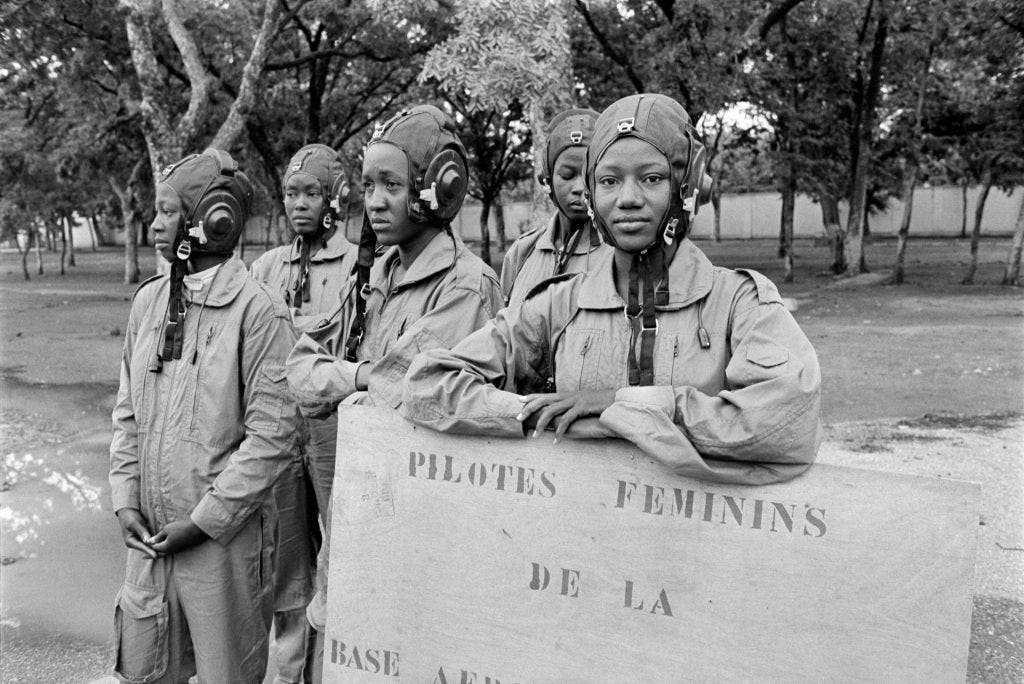
Early issues of the The Black Panther publication offer a wide variety of insights and interpretations on the so-called “woman question” as it developed within the organization and required theoretical clarification for the BPP:
The bourgeois female, i.e., young, whorish... uses (and emasculates) her man as a social coat-hanger, a bill-payer, a dude, a vehicle to further her own confused self-image... The emasculation concept is not just thrown in as an aside. The Negro woman’s disrespect for and hatred of her man is an integral part of her functioning. She comes from a home in which the man is nothing more than an accessory to her mother (and as often as not, grandmother, aunt, and other dominant matriarchal figures). A house in which the male can’t function unless he’s drunk, it’s the first of the month, or he’s physically asserting himself, either by yelling, beating, or fucking[240]
From another perspective, women in the Black Panther Party also looked to other comrades for support and wished for a better future for their families and communities.
These women will survive as they have in the past, but they need the support of their black men.... So black women, dry your eyes, the dawn is breaking and it is a new day. Our men are about to wake up and discover the treasures and wealth of these new days and most of all YOU[241]
One entry in The Black Panther, apparently written from ‘a Male’s point of view’ says:
Revolutionaries are a small lot indeed. Yet revolutionary women are fewer. Black women are for the most part selfish and subjective. In past times Black men existed in a matriarchal society… This condition created a feeling of superiority in Black women. Black women have failed to see that this unbalanced economic condition helped to rob the men of their manhood… Black women today relate to the revolution only from the viewpoint of Culture Nationalism… they dig on courses in Swahili… But when the Black man starts to talk about getting some guns and offing some white pig who misuses or abuses him, his woman starts to fall apart… To a great extent, her attitude explains the high rate of divorce among Panthers and other revolutionaries[242]
Panther Sisters apparently did not want “doll-parasites” lurking around and getting into trouble either:
You are not here as powder puff bitches. The pig is oppressing you too too! So don’t think you can Georgia your way out. The amount of suffering we have all been subjected to does not separate we females. The hog don’t care who he beats in the head so remove your false eyelashes so you can see that they will suppress you too. If you cannot remove your disguise then young hoe you don’t belong here! cause a fat ass and silk stocking don’t create a bullet proof shield And if a silk stud Daddy is your goal then you might as well watch a rat run in his hole. cause a punk decorated in diamonds and gators will leave you on your fat ass. You better get real slick, hop into some big bens and become a worker for the people. Become a revolutionary woman and have a revolutionary man. To be the other half, you must be strong and carry the love of your people instead of mascara. Because I know for a fact, mascara runs when you cry[243]
One particularly egregious example of the disconnect between the Panther Party’s practice and the ‘New Left’ inspired ‘feminist’ shows:
[H]ow the general movement towards WOMEN’S LIBERATION can be… used to further the desires of some Individuals to gain attention and at the most a flash of notoriety. In essence, their actions are… theatrical…
The MOTOR CITY NINE Invaded a final exam session at Macomb College, and demanded! that the students listen undividedly to their rhetoric. When students (male) attempted to leave in disgust they attacked them using Karate (hardly a way to win them over). These pseudo FREEDOM FIGHTERS by using antagonastic methods to air their grievances against male chauvanism unfortunately heighten the contradictions between men and women in this society. Apparently they rapped about the Black Panther Party and it would be interesting to learn their specific references as their tactics certainly didn’t reflect any understanding of Party Program or Principles. If they had a minimal understanding behind the real issues of women’s liberation struggle, they would have been more responsible in dealing with the Problem. Instead, by abstractly talking about their actions could only have had a negative influence on the people they were trying to relate to… their practice was ‘anti-men’, Physical force and coercion is not the way to deal with contradictions among the people. They repeatedly mentioned the Vietnamese women’s participation in the struggle, but we hardly think that the Vietnamese women resorted to theatrics and gimmicks to gain their liberation. On the contrary, their serious struggle in life and death situations hardly allows for such disunifying tactics, Women in the Black Panther Party can only view such actions perpetrated by the MOTOR CITY NINE as reactionary and as a backward step in resolving very serious problems between men and women[244]
One Comrade Candi Robinson, writing for the The Black Panther newspaper in 1969 called for
“Black Women, Black Women,” to “Hold your head up, and look ahead We too are needed in the revolution… We too are strong, We too are a threat to the oppressive enemy. We are revolutionaries, We are the other half of our revolutionary men, we are their equal halves, may it be with gun in hand, or battling in streets to make this country a socialist lead. Sisters, let’s educate our people Combat liberalism, and combat male chauvanism, Awaken our men to the fact that we are no more nor no less than they. We are as revolutionary as they. For too long, we have been alone. For far too long we have been women without men, for far too long we have been double oppressed, not only by the capitalist society, but also by our men.
Now we are no longer alone, our men are by our sides. We revolutionary men and women are the halves of each other. We must continue to educate our men, and bring their minds from a male chauvanistic level to a higher level. Our men need, want and will love the beautiful children, that come from our fruitful wombs. They need our trust and encouragement as well as we need theirs. They need us to educate, them, the people and our children as well as we need them to educate us. Sisters, we are being called by life itself. We are being called by the revolution, We are mothers of revolutionaries, with us is the future of our people. We my sisters, are mothers of revolution and within our wombs is the army of the people. Sisters! Revolution Is Here! Bring Forth The Army! Bring Forth The Guns! We my sisters are revolutionary women of revolutionary men! We are mothers of revolution!”[245]
So tough love and discipline for fighters in the party, and scorn for ‘feminism.’ Yet, in the history of the Black Panthers’ rise and rapid dissolution, one woman’s story figures quite prominently amidst so many rank-and-file member women doing the real world work on the ground feeding children and caring for communal concerns. Elaine Brown, in contrast to those aforementioned women, was more focused on her own political prospects and driving wedges between leadership figures, “Newton said he first began to suspect that Brown was an agent when it came out during Pratt’s trial that Brown’s name was on a receipt from a paint shop that changed the color of Pratt’s car to implicate Pratt in a murder of which he was falsely accused. When the court overturned Pratt’s case twenty-seven years later, the government settled with Pratt for $4.5 million in a false imprisonment lawsuit.”[246] These accusations were not a ‘one-off’ either, “Elaine Brown, [was] widely suspected among former party members of having been a police agent.”[247] Kathleen Cleaver and “Geronimo” ji Jaga once accused Elaine Brown of snitching and said they “would never support Ms. Brown because she was an FBI informant.”[248] ji Jaga claimed “[t]here is much much more irrefutable evidence that continues to expose this sad sally for the COINTEL conspirators? but do not lose sight of the fact that this girl Elaine was brought to ucla for psychiatric treatment which seems to be a pre-requisite for patsies of elaine’s type and that she was but one, tho a very important one, of so many others who were used, unwittingly, as moles, provocateurs.”[249]
Relevant to these developments, a long-time New Orleans police officer gave an interview in which he showed that, in carrying out espionage on the Black Panthers through this period “’I could get more information from the groups if I infiltrated them with women rather than men. Men didn’t suspect women of being undercover agents. Women could form confidential relationships. Women always know things that the guys didn’t know, saw things that the guys didn’t know. They could go places where the guys would be suspicious. They could ask questions that wouldn’t arouse suspicion, whereas if a guy asked the same question, there would have been suspicions.’ Williams told me he had a female in the Panthers and one in the Klan, both of whom worked out well.”[250]
Western ‘Feminism’ vs. Eastern Socialism since 1970
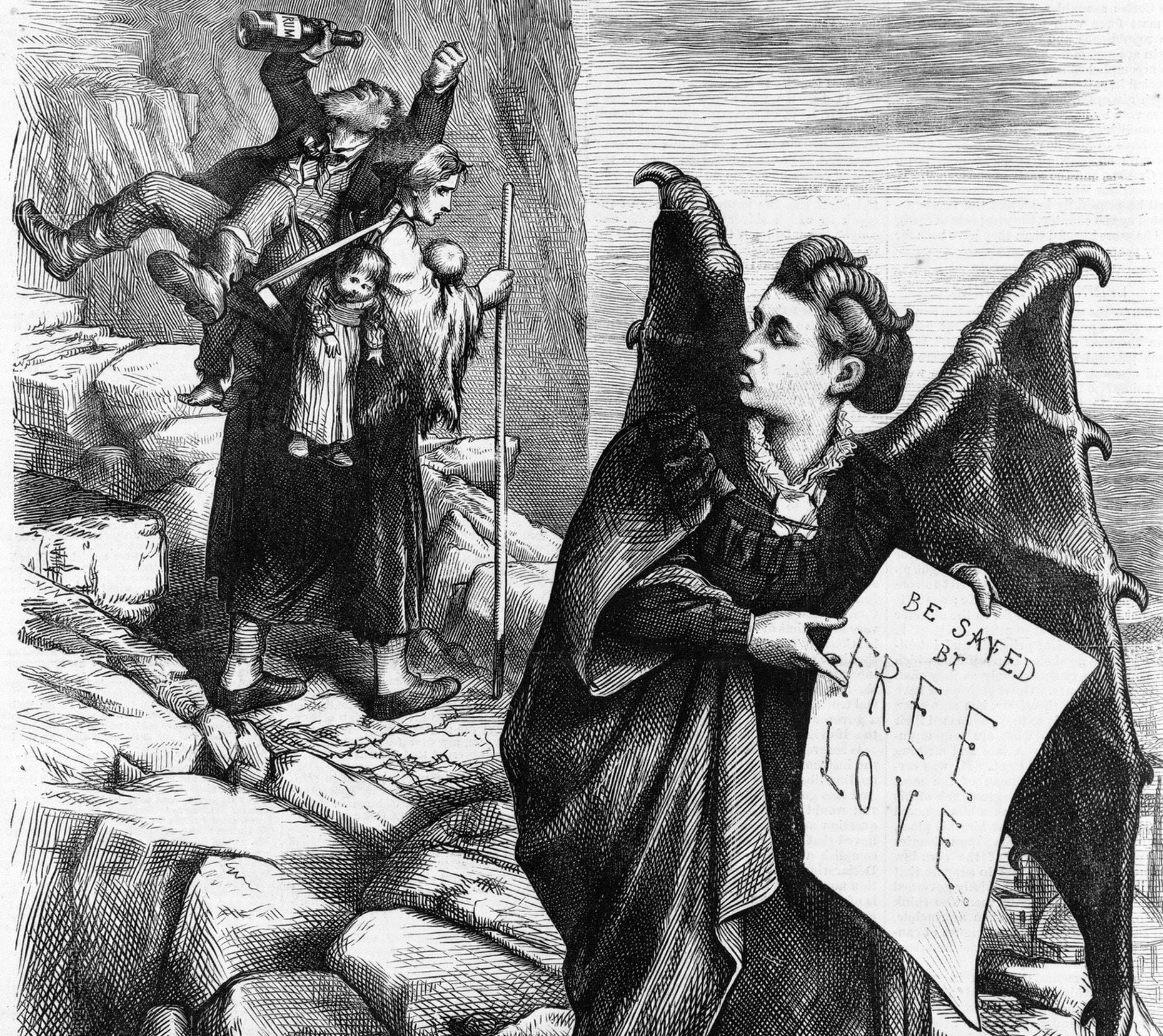
If the conclusion escapes from the beginning; is unaware of it or keeps it in indifference? Strange rhetoric! Strange way of invading the impossible! Denial, forgetting, existence with out form, ambiguous weapons . . . Laziness itself used as unbreakable energy[251]
For former Black Panther women, even abroad in places like the UK, incongruous goals and combativeness among socialists caused Black ‘feminists’ to tire of the ‘laziness’ by a self-appointed ‘women’s lib’ set. OWAAD made clear:
We’re not feminists— we reject that label because we feel that it represents a white ideology… Our group is not anti-men at all… When we have study sessions on Black history and culture, men come along… We don’t alienate men because they put Black women down, because we recognize that the source of that is white imperialist culture… What’s the point of taking on male violence if you haven’t dealt with state violence? Or rape, when you can see Black people’s bodies and lands being raped everyday by the system?[252]
But perhaps this hyperfocus on ‘discourse’ itself as a panoptic and omnipresent circular accusation is the entire gist? Cellestine Ware had said that despite the ‘radical feminists’’ seemingly subversive rhetoric and attempts to negate class politics, for the Black masses, “it is remarkable that feminists often cite the political strategy of the black movement and encourage themselves with black precedents while they are seemingly unable to attract black women to the female liberation cause… [f]eminists are perceived as whites before they are seen to be oppressed.”[253] Here too, in attempting to lament just how much ‘class struggle’ replaces their own particular concerns, ‘radical’ and ‘Marx’-inspired feminists would just as soon eagerly take “the liberty of correcting the author[s], who [are] somehow charged with failing to live up to [their] own theory.”[254] If for such ‘radicals’ and ‘gender-criticals,’ “[p]atriarchy’ would then possess a theoretical status within feminist theory similar to that enjoyed by the concept of ‘class’ within Marxism… [yet] this solution unintentionally places strict limits on the significance of history and, ironically, of patriarchy too… [its] tautology could only be resolved by contending that men are stained… if patriarchy’s existence has been used deduced from evidence showing women’s oppression by men then logically the concept cannot be used to explain that evidence.”[255] For Chris Middleton, “man’s access to the control of female labour was conditional on his position in the class structure… [since] understanding the patriarchal organization of labour [is possible only] in relation to the matrix of… property relations.”[256] For a large portion of ‘Marxist-feminists’ however, Marx and Engels become unworthy of, or even offensive to, their own contributions to human history and class struggle on this account.
Such an inane sense of ‘impropriety’ as a norm reaches ridiculous extremes in cases such as Susan Brownmiller, who said “Going further, I reserved my toughest comments for the story of Emmett Till, the fourteen-year-old youth lynched in Money, Mississippi, in 1955 for whistling at a white woman. I said that Till and the men who lynched him shared something in common: a perception of the white woman as the white man’s property… Angela Davis… devoted her radio program on KPFA one evening to my purported racism… extended her damning charge to Diana Russell… Shulamith Firestone… and recycled her views…”[257] Then Brownmiller announces that Angela Davis, whose own misunderstanding regarding Marxism is well-known, is “[t]rapped by… intellectual dependence on Marx.” [258] This might be deemed the ‘height’ of such discursive controversy between socialist & ‘radical’ feminisms and their co-habiting attempts to negate history. Although this is far removed from the historical origin and discussions of the ‘matriarchy,’ so it is that even between ‘marxist’-Feminists and a larger portion of ‘feminist’ discourse generally, “there is no longer subject-object, but a “yawning gap” between the one and the other and, in the gap, the subject, the object are dissolved; there is passage, communication, but not from one to the other: the one and the other have lost their separate existence”[259] What may have been fanciful ‘New Left’ distinctions between ‘radical’ and ‘materialist’ or ‘xeno-‘ or ‘socialist’ attempts to promote bourgeois feminist affectations all blur back together. Here, ‘marxist’-Feminism flits about, although a ‘divorce’ in such an ‘unhappy marriage’ could only reflect a long-interred fact, since Marx deemed that the “marriage in question is a dead marriage, the existence of which is mere semblance and deception.”[260]
Yolande Cohen once reviewed Batya Weinbaum’s 1978 work in which Weinbaum repeated among other things the common ‘radical feminist’ trope that their especially ‘analytical’ or ‘methodological’ standpoint enables an “awareness of the initial patriarchal bias of Marx’s entire framework.”[261] Cohen points out how the ‘Marxist/Feminist’
wants to distance herself from Marxist analysis, but she places her own approach within this revised framework. Hence the great ambivalence of the work. To give Marx and Engels their due, the author places the feminist movement of the 1970s in direct lineage with Marxism.... Although they distance themselves somewhat from him, they borrow “The Basic Framework” from him. But the fundamental difference, according to the author, between Marxism and feminism is the “patriarchal component” inherent in Marxism, which feminism must identify (chap. 4). It remains nonetheless true that Marxism, despite its flaws, remains the true strategy for change (chap. 5), or at least the starting point for women’s struggle (chap. 6). This concludes the first part of the book. In an uneven and contradictory exchange, these 56 pages contribute to making the debate completely confusing and inextricable[262]
An incident[263] in which white ‘feminists’ from the West attempted to insert themselves into the 1979 Iranian Revolution also calls to mind the insuperable gap between Western ‘feminism,’ unshakeable in its bourgeois origins, and the working women’s movement internationally, especially as it relates to anti-imperialism. Despite a historical and particular political dynamic in which during the 1930s, “Reza Shah banned the veil as parts of his modernizing crusade… Veiled women were arrested and had their veils forcibly removed,”[264] Western ‘feminists’ asserted themselves in this overeager manner. Nawal El Saaddawi wrote in the 1980s that “leftist movements… [were] utilized in this ‘game of nations’ and… in the hands of reactionary forces posing under the guises of democracy, liberalism, humanism, modernism, and human rights… discovered that ‘human rights’ had to be defended in Iran. Progressive feminist movements intervened on behalf of Iranian women, not realizing that sometimes the form and even the content of their intervention was being used to discredit the Iranian people’s struggle against American intervention… [this led to] feminist movements to taking a stand that is against the interests of the liberation movements in the East, and therefore also harmful to the struggle for women’s emancipation.”[265] A desperate insistence on there being a ‘universal’ sisterhood that accompanies such a disposition is clearly undermined, though only from the standpoint of ‘sisterhood’ abstractly, insofar as this does not reflect the fact of labor as species-being. One female interviewee in Pakistan after the ‘Aurat March’ in 2020 observed “You can’t have respect by disrespecting the opposite gender. Women’s rights doesn’t mean no boundaries at all… if this is what you call feminism then I’m anti feminist from now,”[266] The subaltern was always able to speak, and they never needed to be marionetted or assumed to be silent by the Western ‘academics’ or ‘radically’ effeminate.
Caroline Ramazanoglu explains that because “different windows on ‘reality’ cannot simply be added together to make a coherent whole” one does not need to “impose a general theory of oppression of other women’s experiences,” since it is undeniable that “[w]omen can oppress and exploit other women.”[267] Ramazanoglu includes here a quote from Maureen Cain who suggests that “knowing from a feminist standpoint… precludes knowing from a working-class”[268] position. Does one need to take such a combative stance to show it isn’t ‘anti-feminism,’ nor anti-womanism, neither misogyny nor ‘patriarchy,’ that enframe Marxism and proletarian internationalism or how they’ve been sustained in history? In both instances, it is also not ‘pro-feminism’ nor a sentimentality regarding forgotten ideals in the past which animate Marxist practice and achievement today. Soviet party member A. Ryazanova wrote in the early 1920s that “any deviations on this question prepare the ground for ‘women’s’ actions, which further contribute to the obscuring of the class consciousness of the proletariat. To the extent that within the class, proletarian organization, groups are created that take “initiative” on all questions concerning women’s labor, to the extent that groups are created that “represent” the interests of working women, the class struggle is tinged with feminism and anti-feminism.”[269] The Marxist therefore attacks neither of these per se, but rather emphasizes the thing many others are so eager to forget or have ‘tinged’ in this way.
“Feminism never flourished in Burkina Faso!”[270]
[T]he fruit of my womb is Helios[271]
Arriving here once again at the 1980s revolution in Burkina Faso, gaps in geographical distance and modes of existence separate various developments of each victorious Marxism-Leninist practice from almost every other. What they are united by is a kind of, “secret pact… and we cannot easily throw off the demand they make upon us if we wish to remain faithful to historical materialism... each generation possesses a small portion of messianic power, which it must strive to exert.”[272] Thomas Sankara as an individual persisted in extreme danger. Burkina Faso had experienced several violent coups in the 20 years before Sankara took power. Even his surviving to adulthood had been against all odds as:
Out of 1,000 children born the same year I was, half died in the first three months. I had the great fortune to escape death, just as I had the great fortune not to die later from one of the diseases here in Africa that knocked out more of those born that same year. I am one of the 16 children out of 100 who went to school. This is another extraordinary piece of luck. I’m one of 18 out of a 100 who managed to obtain a high school degree and one of the 300 from the entire country who were able to go abroad and continue their education and who, on coming home, were assured of a job. I’m one of those 2 soldiers out of 100 who, on the social level, have a stable, well-paid position, because I’m an officer in an army where this rank represents something. The number of people who have been this lucky amount to only 30,000 in a country of seven million inhabitants[273]
Years before 1987, the affectionately humorous but morbidly mindful Sankara referred to his wife as “La Veuve,” or “The Widow.”[274] This danger was a lived part of the experience of being raised in a mixed Silmi-Mossi household and growing up in a rapidly changing ‘postcolonial’ West Africa. Thomas Sankara, in coming from both the Mossi and Fulani ethnic groups in what was then Upper Volta, could also speak on general shortcomings in the women’s situation throughout these overexploited areas. “We must pay the closest attention to women’s situation because it pushes the most conscious of them into waging a sex war when what we need is a war of classes or parties, waged together, side by side… It is men’s attitude that spawns the bold assertions made by feminism”[275]
For three and a half years our revolution has worked to systematically eliminate all practices that demean women, such as prostitution and related activity, like vagrancy and female juvenile delinquency, forced marriages, female circumcision, and their particularly difficult living conditions.
By working to solve the water problem; by building windmills in the villages; by assuring the widespread use of the improved stove; by building public nurseries, carrying out daily vaccinations, and encouraging healthy, abundant, and varied eating habits, the revolution has no doubt greatly contributed to improving the quality of women’s lives[276]
Regarding the fight against FGM, Sankara was no less uncompromising, “we can only see excision as a measure of inferiorization. In defending women and in appealing to them to fulfil themselves, we say that women should not rely on men and should not expect any condescension from them. The development and the liberation of the women of our country, the women of Africa, of women as a whole, will not come about as an act of charity. It will depend on their will and their determination to struggle and, therefore, their grasp (...) of the social contradictions that oppose women and men.”[277] However, this struggle is both regarding culture and material development as during Sankara’s leadership, “rural peoples resisted the state efforts to end female circumcision, and much of the pushback came from women, as it was usually the aunts and mothers who led such rituals.”[278] Sankara’s own Minister Josephine Ouedraogo stated that in approaching these cultural practices, “certain revolutionary policies and actions risked alienating the population, that “the danger exists of seeing a resistance movement take shape that will go against our aspirations.” She advocated for “proceeding gradually so as to not offend mentalities and customs.”[279]
A major aspect of Sankara’s attempt to wed women’s household productive labor and material emphasis on national self-reliance, was this enormous campaign to promote locally made textiles. “Thus, in 1985, the name Faso dan fani, or literally “the woven loincloth of the homeland” in Dioula, was coined to designate the bands”[280] For women in Burkina Faso since that time, “the cotton strips woven locally by women became the preferred illustration of its anti-imperialist economic policy of promoting local products, which was simultaneously based on a cultural policy of nation-building and revalorizing Burkinabe identity. The Faso dan fani movement, created in 1985 to designate the consumption of locally woven fabrics, contributed to the reinvention of a textile tradition, which thirty years later continues to embody the pride of Burkinabe identity”[281]
Thomas Sankara, a critic of traditional chieftaincy and customs deemed feudal and enslaving, sought to promote not a centuries-old weaving craft, but rather a modern and productive one, relying on new technologies and innovation to develop a substantial market that would ensure the stability of the artisanal textile industry. He therefore focused on the modern practice of weaving carried out by women. The very strong cultural dimension infused into cotton fabric linked the fabric, at the same time, to the reconquest of an identity frustrated by colonization and to a return to pre-colonial roots. From this ambiguity between the advent of the modern and the rebirth of the past, a reinvented textile tradition was born in the collective imagination, making Faso dan fani and weaving practiced by women on horizontal looms symbols of Burkina Faso’s traditional artisanal heritage. Thirty years after the fall of the Sankarist revolution, history itself has been reclaimed. When I ask them about the country’s textile traditions, the majority of people I meet evoke a direct connection between the weaving of narrow bands carried out by men on hanging-hedged looms and the current weaving practiced by women on horizontal pedal looms. Some of them even consider the female practice of weaving to be pre-colonial, because they no longer view it in any other way than traditional[282]
Textile crafts, made from locally grown and spun cotton, are particularly representative of Burkina Faso’s cultural and ethnic pluralism, as the vast majority of the country’s 66 ethnic groups practice them and dress in the woven fabrics. The cotton loincloth is an everyday object that accompanies individuals throughout their lives, serving as both clothing and shroud, and that excludes no one in its consumption. Finally, clothing embodies the primary image one projects of oneself to others and contributes to the dissemination and promotion of one’s culture abroad. Thus, hand-woven cotton strips were chosen by the regime to symbolize this economic development and to serve as a means of building identity through which the pride of the entire Burkinabe people would be embodied. Weaving, practiced by a growing number of women, also offered the government the opportunity to develop a profitable and rewarding activity for women, contributing to their emancipation[283]
But none of this countenances the normal channels and approaches of ‘feminism’ due to the fact that “feminism in Africa fails to tackle issues affecting women and fails to engage men at the grassroots (Chidam’Modzi 1994/5)… Thus, Sankara… encouraged men towards cultural transformation, to recognise women as counterparts in the liberation struggle”[284] Sankara also gave credit to the historical working class and world revolutionary tradition he had come to participate in:
We certainly owe to dialectical materialism the strongest light it has shed on the problems of women’s status, the light that allows us to grasp the problem of the exploitation of women within a generalized system of exploitation. […] In such a cycle of violence, inequality will only end with the advent of a new society, that is, when men and women enjoy equal social rights, resulting from upheavals in the means of production as well as in all social relations[285]
Thomas Sankara spoke out as well against that fact that “women from the towns were concerned with the latest fad in feminist politics… demanded the right of the woman to be masculine.”[286] This apparently is different from those who see ‘feminism’ in the West as something quite like the opposite. In practice, Sankara is questioning both, since he also sees ‘complementarity’ between sexes that can also be projected geographically and across other such lines, since Sankara asserts:
This war is one we can and will win—if we understand that we need one another and are complementary, that we share the same fate, and in fact, that we are condemned to interdependence[287]
Since this time period, Burkina Faso spent decades piecing together its revolutionary history and maintaining a connection in this sense to their own revolutionary tradition, its rewards as well as its risks. However, in recollecting this history, the required approach of the present day also shows that Western ‘feminism’ cannot be applied to an anti-imperialist nation still beset by internal and external pressures. Such a weight requires revolutionaries to “break-away from certain universalised, narrowed, and polarising conceptualisation of patriarchy as the de facto problem for women.”[288] Despite that recognition among today’s revolutionaries in Burkina Faso, other more urbanized and Western-educated social workers lament that “people are reluctant to hear anything about gender because they think that we NGO gender workers ‘are helping our affiliated development cooperation agencies to promote homosexuality. University students made this remark as well’ (D30, a female NGO worker).”[289] So it is that “African women criticize their Western sisters for their ignorance and arrogance in wanting to speak on behalf of all women.”[290] These popular masses are able to see right through Western ‘liberal’ universalism and “feminist foreign policy is argued to be yet another instrument that could help reproduce the unequal power relations, further gendered development coloniality through development cooperation, Western feminism, and neoliberal discourses”[291]
In 2021, a former minister for the Advancement of Women, Nestorine Sangaré, stated that she rejected attempts by foreign NGO workers to introduce ‘outside’ cultural affectations, stating “[t]here are many homosexuals among foreign diplomats in Burkina Faso, and they encourage this practice… We should not make love everywhere, anytime, or with just anyone.”[292] This reflects the desire among the masses in a largely traditional society like Burkina Faso to then move toward a “revival of ‘our true culture’ before colonisation that had certain checks and balances for both genders. This is not an idealisation or romanticisation of the past but an argument against certain mentalities that are quick to affirm ‘our culture’ does not allow women to do this or that.”[293] The rise of Ibrahim Traore has inspired many to harken back to this 1980s period and attempt to revive and even to go beyond Sankara’s achievements. Thomas Sankara’s brother was interviewed in 2025, saying:
Absolutely. You can see the work being done throughout Burkina Faso today. That shows he [Traoré] is sincere. It’s not about promises, it’s real, concrete. There’s construction everywhere, we’re laying bricks, cobblestones, we couldn’t ask for more. If you can make it happen and prove it, people will support you without hesitation. That’s how it works. Today, people are ready to contribute to the country’s development. It’s visible. It’s not made up. It’s real.[294]
In emphasizing labor and community-centered social development initiative, Sankara demonstrated, echoing Fourier, that “woman’s consciousness of herself is not only a product of her sexuality. It reflects her position as determined by the economic structure of society, which in turn expresses the level reached by humankind in technological development and relations between classes.”[295] This road is arduous and challenges remain, though culture itself does not hurriedly ‘march’ to the demeaning orders barked by Westernizing ‘progress.’ Even today, it is surmised “approximatively two-thirds of rural women in Burkina Faso are in a polygynous union.”[296]
It is forgotten that Marx’s thesis—that men become conscious of fundamental conflicts on the terrain of ideology—has an organic value; it is an epistemological rather than a psychological or moral thesis. This forgetting results in a frame of mind that looks on politics and all of history as a marche de dupes, a matter of conjuring tricks and sleight of hand. All cultural activity is thus reduced to ‘exposing’ tricks, provoking scandals, and prying into the private affairs of political figures[297]
A few years after Sankara was killed, Balufu Bakupa-Kanyinda released a short documentary on the Captain’s life and political work. A poem is recited in short verses peppered throughout the film: “Let memory be our iron ring. Forget nothing on your way. The Sun never sets. It is man who moves away from the light.”[298] Cheikh Anta Diop attempted to show “[m]atriarchy is a tribal institution, and, as such, should disappear with the decline of tribal authority and the appearance of the monarchy; but its deep-seated vestiges still remain in the whole society: this applies to Nubia, Egypt, and to all the other regions of Africa.”[299] Regarding a Fulani heritage, Diop argues that for this widely spread ethnic group, “matriarchy is at the basis of their social organization, in spite of their nomadism.”[300] For Ifi Amadiume, the long arc of African history shows that throughout the continent, “there was a matriarchal construct. This is not in the sense of queen rule (although the matriarchs sat like ‘queens’ in the marketplaces, monopolizing such space as women only and excluding anything male in some cases), but in the sense of a viable female-controlled autonomous system, both complementary and juxtaposed to the male or patriarchal system.”[301]
Sankara once gave an interview with a Swiss journalist in 1985 telling him, “[o]f course, those who came before us were more or less obliged to act the way they did in order to show the way forward, even if sometimes they fell into acting like messiahs. But more and more, we are talking about universal civilization.”[302] Let us not yet say that a ‘messiah’ has come forth, but we may still recognize that it was a veiled woman in Ouagadougou in 2017 who “asked President Macron about declassifying the French archives on the assassination of former revolutionary President Thomas Sankara of Burkina Faso, whose death is believed to have been orchestrated by France.”[303] This was seen as a catalyzing moment that increased anti-French sentiment leading up to major political shifts in the country seen in recent years.
Therefore, it is also not surprising to see from Sankara a “dismissal of feminism as something that is contradictory to the core of the revolutionary transformation of gendered relationships within Burkinabè society, and the argument for complementary social relationships as an unavoidable inevitability.”[304] In contradistinction to one aspect of Mayanja’s assertions, Sankara did in several places refer to countering ‘excessive’ self-indulgence, “Some forget by indulging in drink or drugs, others through the various kinds of perversity they engage in throughout life. Does anyone ever say that these men are forgetful?”[305] What would they be forgetting?
Marx himself wrote to his wife asking rhetorically, “Who of my many calumniators and venomous-tongued enemies has ever reproached me with being called upon to play the romantic lead in a second-rate theatre? And yet it is true. Had the scoundrels possessed the wit, they would have depicted ‘the productive and social relations’ on one side and, on the other, myself at your feet. Beneath it they would have written: LOOK TO THIS PICTURE AND TO THAT. But stupid the scoundrels are and stupid they will remain, [forever and ever]”[306] Marx shown as utterly subservient to the household Deity, this without prevaricating or clutching pearls at what he at one time referred to as a “spiritual essence of marriage.”[307]
Once more here about the Veil. Kant wrote “[t]o see into the sun (the supersensible) without first being blinded by it is not possible; but to see it in the reflection (of reason that morally enlightens the soul), and even for practical purposes, is sufficient, as the elder Plato… since he cannot lift the “veil of Isis,” he nevertheless makes it so “thin” that one can sense the goddess beneath it.”[308] Looking Eastward amidst so much failure in the Westerly direction, one also recognizes that “paradise is locked, and the cherub is behind us; we must make the journey around the world and see if perhaps it’s open again somewhere behind.”[309] For Heidegger, poiesis refers to an “unveiling of the present,”[310] and A-letheia etymologically refers to an absence of forgetting. By stepping into Heraclitus’ house, or being invited into this space, “it may be essential… to explain their ‘words’ to know the houses of their time, their heating appliances,“[311] and in doing so, the ‘scandal’ of the East in relation to Westernizing private property’s seclusion of women in the household is revealed. The young Greeks relate to Heraclitus through the lens of women’s relegation, as in the ‘Backofen,’ “the workers… are being oppressed, forced to sit and be shaded, and some even to be exposed to the fire… the souls of those whose bodies are being feminized also become much sicker.”[312] An opposite-facing revulsion was described by Wilhelm Liebknecht over 120 years ago as he recounted an incident where Richard Wolff’s distant relative, a comrade of Marx nicknamed “red Wolff”, had:
[A]dopted Parisian manners and was very shortsighted, noticed one evening on the street a graceful female figure that he followed. Although he encircled the veiled lady several times, she took no notice of him until he, becoming bolder, came so close to her face that he ‘could distinguish her features in spite of his ‘ shortsightedness and—“Hol’ mich der Deuwel (may the devil get me)—it was Mrs. Marx!” he ‘related to me excitedly next morning. “Well, what did she say to you?’ “Nothing at at all that is the devil of it!” “And what did you do? Did you apologize?’ “[may the devil get me ]—I ran away’… the red Wolff, who enjoyed a certain reputation on account of his imperturbable cynicism could not be induced for six months to enter the house of Marx, although I could tell him on the next day that Mrs. Marx, when I sounded her carefully, had broken out in merry laughter at the recollection of the inexpressibly bewildered and frightened face of the red Wolff thwarted in his role as Don Juan[313]
The Cresting of the ‘marxist’-Feminist ‘Wave’ and History’s ‘Lethe’ of Redemption
Every woman is a human being—one cannot repeat that too often—and a human must have occupation, if he or she is not to become a nuisance to the world[314]
Agrippa warned against the keeping of women “at home in idleness from her first years… as if incapable of a higher province… to conceive nothing but needle and thread.”[315] In this case, the needle is ‘feminism’ abstrusely or idly thrust against Communism and the Marxist tradition. But no thread holds together what is being insinuated. This degeneration in historical accounting is also reflected as a breakdown in the relation to labor. For some time then, ’marxist’-Feminism has been bandied about and toyed with. Though to what actually existing political end remains unclear. A glaring problem “for Marxist Feminism is the question of its theoretical and practical approach…” and its inability to conceptualize about “sexual violence against women without constructing naturalised and essentialised dichotomies of masculinity versus femininity.”[316] For others like M. Barrett, they see Foucault and critiques of ‘power’ as “a much more sophisticated methodology for providing an account of sexual identity than the traditional ‘social construction of gender.’”[317]
According to Frigga Haug, the origin of ‘M-F’ can “only be vaguely delineated. A survey in 2014 asked 30 international Marxist Feminists already active in the 1970s about who coined the term [‘marxist’-Feminism.] Their responses generated only hesitant references to one another, but no clear results suitable for a historical account…”[318] Its orientation and goals are even less certain. Roxanne Dunbar writes that ‘Marxist-Feminism’ “is a hybrid born in the late 1960s… not monolithic or even unified.”[319] It is likely then, that those most ‘verbose’ among self-described radicalized or socialist feminists in this camp were never silenced by Marx or Marxist-Leninists. The ‘sub-field’ exists simply as an ‘illegible rage’ of ‘consciousness-raising’ amidst general so-called ‘neoliberal circularity’ and New Left stagnation. In a recently published ‘Symposium’ of these self-styled activists, “[t]he authors defined themselves as Marxist feminists” and the respondents “respected the diversity of their self-definitions as Marxist feminists.”[320] Quite courteous. For others, “[t]he relationship between Marxism and Feminism has been a tenuous one… [many] have attempted to integrate feminism and Marxism and some have even given up the efforts.”[321] Rosalind Petchesky, again writing in the late 1970s, showed that a supposed ‘risk’ here had apparently already been identified:
We have not worked out what this means, this hyphen. We think that a revolution which proceeds from the insights of Marxism and feminism is what we want; our own practice as a group leaves everything but the formalistic aspects of such a revolution to be delineated. All too often all this has meant is that we are Marxists to our feminist sisters and feminists to our Marxist brothers. The gravest danger . . . facing us right now is that we will settle for this hyphen, we will settle in with it comfortably as a self-explanation. It will become a counter, a cipher, instead of a project. It will be used as a way to get and insure our place in a declining economy, as a way of finding a comfortable berth that we try to curl into among the available niches in capitalist society, as a way of defining ourselves for the rest of our lives[322]
Catharine Mackinnon would also comment blithely on this ‘hyphen’[323] and its importance, or relativizing unimportance as the case may be. Mackinnon’s colleagues found that her arguments did “not even rise to the level of incoherence: [Mackinnon] is simply (undialectically) confused.”[324] Simultaneously, Mackinnon would by the late 1980s drop any and all pretenses to ‘Marxist’ affinity and state, “no feminism worthy of the name is not methodologically post-marxist.”[325] ‘Cyborg Feminist’ Donna Haraway would argue that “Catherine MacKinnon’s version of radical feminism is itself a caricature of the appropriating, incorporating, totalizing tendencies of Western theories of identity grounding action… [and] develops an even more authoritarian doctrine of experience.”[326] That even earlier alleged allies such as Kollontai could not have foreseen such ‘great’ achievements by late 20th century ‘Marxist feminists’ is its own indictment of the tendency. None among these contemporary career-oriented ‘theorists’ of Marxist-feminism can be identified within the real world as having contributed in any sense to proletarian internationalist victory. In place of women such as Sarah Bagley or Klara Zetkin or Guo Fenglian or even Lucy Parsons and millions of other working class fighters, there is only post-1960s ‘Marxist feminism’s’ attempt to glom onto and yet consequently dispose of the legacy of Marxism-Leninism. Some settle simply for this ‘radical’ thumbing of the nose and other gossip. One asks “in sticking out their tongues, have they literally blocked their ability to speak?”[327] Although still very much obsessed with being perceived as ‘Marx’-linked, are the ‘marxist’-Feminists pretending to be this Other in order to deter working class responsibility toward something they themselves are at odds with? When there is ‘counter-revolution’ all around, should such posturing simply be taken as outbursts of pent-up frustration or ‘victim-centered engagement?’
It was Artyukhina herself who clearly indicated in 1930 that the end of the Zhenotdel was not the end of Soviet Party activity among working women. “There was a time when a separate department for work among women was necessary. As a result of this division of work the party was able to create a large group of women activists over the course of eleven years. Only thanks to the allocation of this work in the party has it become possible to grow a huge female asset in 11 years… [allowing the Party to] now carry out work among women with a general apparatus.”[328] She did not see herself as a victim. She did not need to accost anyone to do ‘emotional labor’ on her behalf. It was also Stalin who made the observation at a moment of danger in his article “Light from the East” that “[a]t such a moment one “involuntarily” tends to lose sight of, to forget the far-off East, with its hundreds of millions of inhabitants enslaved by imperialism.... The imperialists have always looked upon the East as the basis of their prosperity. Have not the inestimable natural resources (cotton, oil, gold, coal, ores) of the East been an “apple of discord” between the imperialists of all countries? That, in fact, explains why, while fighting in Europe and prating about the West, the imperialists have never ceased to think of China, India, Persia, Egypt and Morocco, because the East was always the real point at issue. It is this that chiefly explains why they so zealously maintain “law and order” in the countries of the East—without this, imperialism’s far rear would not be secure… They need, furthermore, the “obedient” “young lads” of the countries of the East from whom they recruit the so-called “coloured” troops which they will not hesitate to hurl against “their own” revolutionary workers”… For the truth must be grasped once and for all that whoever desires the triumph of socialism must not forget the East”[329]
It has been argued[330], and argued by ‘marxist’-Feminists[331] as well, that ‘primitive communism’ and an ‘Asiatic mode of production’ can be interwoven upon the basis of these transformations having taken place in a surmised or mythically-related past. What imperative does this place on Western attempts to grasp these intimations? W. Benjamin once quoted an early 1930s Adorno work on Kierkegaard stating, “in the interior, things do not remain foreign… [f]or the alienated, foreignness transforms itself into expression; the mute speak as ‘symbols’… [a]rchaic images emerge in the interior: that of the flower as organic life; that of the Orient as the nominal home of longing.”[332] But if it’s universally accepted as a fact that couples quarrel, feminism’s long-stalled attempt to ‘marry’ Marxism shows at its basis that “[i]f Marx’s work (and the Marxist tradition, by implication) were indeed substantively afflicted by all the shortcomings that social scientists and feminists attribute to it, it would have been long forgotten.”[333] From the vantage of the actually existing socialist sphere, two centuries of women working class fighters and Party leaders contribute immeasurably both to the construction and longevity of socialism. They have also known the dangers and risks associated with ‘diversions’ now called ‘marxist-’ or ‘materialist-‘ or ‘Socialist-Feminism.’ In fact, women in modern Party leadership in China recently indicated that:
Unfortunately, both Marxist feminism and feminist Marxism ultimately became mired in the quagmire of bourgeois ideology, from which they were unable to extricate themselves and increasingly lacked the capacity to explain and transform society. We attempt to clarify the distinction between Marxist women’s theory and the concept of Marxist feminism by tracing the development of Marxist feminist schools. From a developmental perspective, Marxist feminism refers to the second wave of the “women’s rights” movement that emerged in the West in the 1960s. This theoretical school, based on the integration of feminism and Marxism, has undergone three major stages of development. From the 1960s to the 1970s, Marxist feminism introduced political economic critique to the domestic sphere, focusing on the nature and value of housework and its relationship to women’s oppression. From the 1970s to the 1990s, it focused on how to integrate a gender perspective into classic Marxist concepts such as the division of labor, class, alienation, production relations, and the “two kinds of production,” as well as developing theoretical viewpoints and research perspectives on patriarchy and reproductive labor. After the 1980s, influenced by neoliberalism and postmodern thought, ideological critique replaced historical materialism and political economy as the primary theoretical weapon of Marxist feminists...
Marxist feminism is a theory conceived by white, middle-class women.... Their views, such as the wageisation of housework, are considered to be a ‘break with Marxism from within.’ Especially after being influenced by neoliberalism and postmodernism, Marxist feminist scholars have overly utilised theoretical categories such as ideology, discourse power, and identity politics, rarely discussing material factors and the overall state of society
Marxist feminism elevates gender struggle to an inappropriate level, advocating for female-centeredness to replace male-centeredness, and prioritizing opposition to patriarchy as the primary goal of women’s liberation, thus exaggerating gender differences and oppositions. It can be said that Marxist feminism is merely labeled “Marxism,” its theoretical perspectives and logic falling prey to bourgeois ideology. Therefore, Marxist feminism cannot provide a solid foundation for resolving women’s issues, nor can it achieve the grand goal of all human liberation, including women’s liberation. [334]
Alenka Zupančič writes that if the term ‘ethics’ is seen as “a method for the production of the impossible… we are necessarily led towards Sade’s position: since suffering and pain then become the mark of ethics, the rarity of ‘good’ becomes the omnipresence of ‘evil.’”[335] Benjamin also highlights the ways in which fascination centered around “uncovering… mechanical aspects of the organism is a persistent tendency of the sadist.”[336] While Andrea Dworkin’s own personally sadistic and ‘orgiastic’ travails are documented, her attacks against Bataille are not as often highlighted. Bataille’s shocking juxtapositions and flights of fancy may give the appearance of ‘bawdiness,’ yet Dworkin’s negative appraisal attempts to show him as an ”unproblematic representative of men in control. But the truth of the matter, to a significant degree, as a look at Bataille’s theory shows, is quite otherwise.”[337] Who then could be said to be in control?
Carl Einstein too, a close collaborator with Georges Bataille on the journal Documents, recounts a Congolese tribe’s mask tradition in which once again the exact order of historical origin of the tradition is ‘forgotten’, although they still tell a “tale according to which the woman is the inventor of the mask and the men the usurpers is said to be a relic from the time when matriarchy was the rule in these societies. It is also possible that the two institutions of matriarchy and patriarchy coexist and share power haphazardly.”[338] Here again a particular sequence is ‘forgotten,’ but not put totally out of mind. Conversely, the uncomradely criticism, empty vague accusations against no one in particular, and constant tacking back to breathless insistence on a grand historical narrative of personal victimization does not aid in organizing efforts. Instead, its aim is to pull a parodic emergency brake and needle them. There is an overall ‘decline’ in the ‘M-F’ tendency, as even in the late 1990s, it was admitted, “the intellectual project of reconciling a feminist and a Marxist understanding of the social world could be said to have been shelved - it was abandoned rather than resolved.”[339] Only ‘hungry ghosts’ now stalk about, since “[t]here is, however, no way of being all things to all women within feminism.”[340]
To go about revolution and to create this world which cannot be a priori described in complete arresting detail but only put into formation is “impossible without the female ferment” and due to this, for Marx, “[s]ocial progress can be measured only by the social position of women.”[341] This impossible therefore is not labored or reared through ‘feminism,’ nor through ‘heartlessness’ seeking to one-sidedly negate such a thoroughly bourgeois disposition. For Marx, “all of this has no application to the original humans generated by generatio aequivoca; but this distinction only makes sense insofar as one considers humans as distinct from nature. Incidentally, this nature that precedes human history is… not the nature that exists anywhere today.”[342] So locating the absolute and initial ‘origin’ of oppression perforce is not the ultimate focus for Marxists. Roland Boer says this is an initially “misplaced utopian drive [yet expresses the] desire not for a return to a better state that has been lost but the desire for a better society of the future.”[343] For Benjamin, it is this ‘departure’ which arrives as much as an ‘origin’ running ahead, “[j]ust as the latter points us to a stranger who was on the premises, so there are words or pauses pointing us to that invisible stranger-the future-which forgot them at our place.”[344]
Between Marxism historically and ‘marxist’ Feminism as it persists, there remains “an insurmountable parallax gap, the confrontation of two closely linked perspectives between which no neutral common ground is possible.”[345] To reiterate, this gap is not traversed by means of hyphenation, nor does such a desired ‘possibility’ cut through all the historical exigencies that may have led to the removal of this hyphen symbolically. Household labor cannot be ‘waged’ precisely as long as the domestic sphere resists as a redoubt against monopoly finance and direct capitalist value extraction. If for Marx and Engels too, ‘communism in living,’ is associated with the earliest division of labor between sexes in the primitive household, it doesn’t matter how much one refutes “Bachofen’s glorification and mystification of sexuated community… [this] will still continue to exist until further notice.”[346]
August Bebel thought “that the world has had quite enough male philosophers and can afford to dispense with their feminine counter-parts.”[347] Radical feminists such as Louise C. Johnson averred that “theories of Marxism and patriarchy are ultimately incompatible… and Marxism itself may be thoroughly… unable to incorporate feminist concerns.”[348] In law and modern liberal theories, the feminist ‘legal theorist’ Katherine Franke convincingly spoke of the “centrality and manipulation of sexuality and sexual rights in struggles for and against the civilizing mission that lies at the heart of key aspects of globalization.”[349] Though inconvenient for some to fully grasp, ”U.S. feminists… looked forward to a spirit of global sisterhood, [they]… soon learned that most Third World women rejected “feminism” as hostile to men and believed that economic exploitation by the North, not patriarchy, was the major cause of women’s oppression.”[350]
Lest we forget, women also originally wove the family together and provided a primary basis in the socially constitutive forms of household labor. Or they didn’t. In one or the other case, is it Woman or the “bitter cup” of historical necessity being overthrown by dallying and deception that diverts the present dissolution of bourgeois private property? ‘Wageisation’ of house work is also not a new debate, nor was it new in the early 1970s, though this has been revived to little practical avail several times in the last 125 years. Irene Leslie, writing as part of CPUSA leadership in the 1930s, responds to these attempts to ‘radically’ hand-wave Communists as insufficiently attentive to ‘feminist’ discourse:
Is it necessary to mention that not all women are oppressed? We should not, of course, discuss the question as one of the “weaker sex”; we do not speak of womankind as one homogeneous social mass. It would be nonsense to speak of the women of the ruling class as being “oppressed”, even when they are not allowed to be so active in the exploitation of the workers as are the men, even when they are only parasites upon parasites[351]
Klara Zetkin is who anti-Marxists such as Maria Mies attempt to repossess their own personal academic claims to ‘radicalism’ from. Some early self-described ‘Marxist feminists’ in the late 1960s were able to admit that “[t]he class distinctions between women transcend their sex identity as women” or “[r]uling-class women have exactly the same interest in upholding capitalist society as their men have.”[352] ‘Marxist feminism’ since the 1980s has merely further degraded and jettisoned any form of ‘Marxism’ it claimed to once adhere to. For instance, Mies asserts that Zetkin’s position as merely aping from “the rhetoric of class struggle, was not much different from the content of the bourgeois women’s movement, except that the radical feminists among the latter were much more anti-male.”[353] This suggests Mies thought the bourgeois women’s movement at least had its ‘priorities’ straight. Although in practice, someone like Klara Zetkin had more success as a proletarian internationalist and leader in the working women’s movement than all ‘Marxist-Feminists’ in history combined. This despite the fact that Klara Zetkin too could highlight the imperative that revolutionary “male workers must stop viewing the female worker primarily as a woman to be courted if she is young, beautiful, pleasant and cheerful (or not). They must stop (depending on their degree of culture or lack of it) molesting them with crude and fresh sexual advances. The workers must rather get accustomed to treat female laborers primarily as female proletarians, as working-class comrades fighting class slavery and as equal and indispensable co-fighters in the class struggle.”[354] This last sentence is what ‘anti-feminism’ and ‘feminism’ both seek to forget. Simply affixing the label ‘feminist’ post-hoc to a given female Marxist-Leninist fighter in history does not change that fact. The end of the Zhenotdel was not Stalin’s personally misogynistic cutting-short of women’s emancipation. It was not also not the end of women’s Party organization and activity in the Soviet Union. So it is ‘Marxist-Feminists’ who must reject or squawk about Klara Zetkin for demonstrating that:
Despite some points of contact and even identical demands in the struggle against the lack of rights of women, there is a fundamental opposition between [Marxism and feminism], as insurmountable as the antagonism between the bourgeoisie and the proletariat. The class contradictions between exploiters and exploited are stronger than the feeling of female solidarity to which feminists appeal. Some manifestations of feminism may seem very radical. Let us recall the refusal of feminists in England to pay taxes, and the actions of suffragettes there. Nevertheless, feminism in its essence remains non-revolutionary, and often even counter-revolutionary…Working women can be seduced by feminism and distracted from the class struggle of the proletariat. But the proletarian women’s movement—such is its historical essence—even in its “peaceful” work remains revolutionary; in the spirit of revolutionary Marxism, it devotes all its thoughts directs further reforms, to the overthrow of the class rule of the bourgeoisie, to the overthrow of the bourgeois system[355]
It may be said that we “are all dripping in the blood of previous readings,”[356] or perhaps assigning individual blame for dislocations in history is not the task of Marxism. Here Benjamin’s ‘messianism’ and the traditions of Marxism-Leninism in practice both have instructive and corrective purposes for Marxists led astray by ‘feminism.’ It was Marx and Engels themselves who had to go back to pre-history and the cutting edge of scientific fields like anthropology and ethnology to show that a ‘matriarchate’ could also have a “powerfully subversive impact regarding the history of the family and male power.”[357] The merit of such a discovery, as Engels explained, and “Bachofen argued, united the sensuous and the otherworldly, Orient and Occident. He hoped to revive a long-lost mythic world of immanent life, femininity, and sisterhood that predated Hellenism.”[358] Despite Engels also pointing out shortcomings in Bachofen’s conclusions and methods, the “evolutionary strain in Bachofen, in which history can be seen as ‘a process of redemption,’ is overwhelmed by his Hegelian preference for ongoing struggle, for dualisms never resolved once for all time.”[359] Catherine Liu from a more or less tangential angle addresses ways in which this obtains willingly or not in discourses of ‘virtue hoarding’ and ‘trauma disclosure.’ These professionals and media personalities then establish themselves “in a new matriarchal multiverse governed by unstable but transgressive subatomic particles, zigzagging through reality, ready to blow our minds and bend our genders and our taste cultures.”[360]
In the process of a revolutionary ‘production,’ the necessarily impossible melding of elements in a complementary syzygy also reveals how “in that Divine and universal one, he comes to understand to such an extent that he becomes of necessity included, absorbed, united.”[361]
In the idealistic or miscalculated attempts to marry Marxism and feminism, there has only been “in the same sense, plastic figurations… the expression of an intransigent materialism, of a recourse to everything that compromises the established powers in matters of form, ridiculing traditional entities, naively competing with scarecrows that strike one with stupor.”[362] But here is also great frustration and revelation since movement from day into night shows how this eschatological object is “capable of attracting to itself with a force as compelling as that which directs simple organisms toward the sun.”[363] Bachofen too wrote of a kind of ‘lamp,’ where “[b]y its light Psyche recognizes the divinely beautiful form of her nocturnal visitor, whom her sisters had described to her as a hideous dragon… [t]he flame flickers restlessly while Psyche gazes upon the forbidden sight.”[364]
Marxism-Leninism and the actually existing socialist sphere never needed Western academics to grade their progress. Engels states “[o]ur ideologist may turn and twist as he likes, but the historical reality which he cast out at the door comes in again at the window, and while he thinks he is framing a doctrine of morals and law for all times and for all worlds, he is in fact only fashioning an image of the conservative or revolutionary tendencies of his day—an image which is distorted because it has been torn from its real basis and, like a reflection in a concave mirror, is standing on its head.”[365] One reason is that while ‘marxist’-Feminist self-delusion misdirects into a stultified abyss, the rising Eastern light of the sun moves overhead to give sight rather than to blind.
[L]oosened from the knots of perturbation from the senses, free from the fleshly prison of matter, whence they no longer see their Diana as through a hole or window, but having thrown down the walls to the earth, the eye opens to a view of the whole horizon. So that he sees all as one[366]
The lamp’s form reminds one of Eastern lands; the shade’s movement, of mild oriental breezes. The floor is concealed a carpet woven from a special kind of osier, which immediately betrays its foreign origin. For the moment, I let the lamp become the keynote of my landscape. I am sitting there with her outstretched on the floor, under the lamp’s flowering. At other times I let the osier rug evoke thoughts of a ship, of an officer’s cabin-we sail out into the middle of the great ocean. When we sit at a distance from the window, we gaze directly into heaven’s vast horizon.... no foreground, but the infinite immediacy of the horizon[367]
Engels could not mince words in pointing out:
The determining factor in history is, in the last resort, the production and reproduction of immediate life . . . the production of the means of subsistence . . . and the production of human beings themselves, the propagation of the species[368]
Lenin applied Marxism in the age of imperialism to show that:
[R]eal freedom for women is possible only through communism. The inseparable connection between the social and human position of the woman, and private property in the means of production, must be strongly brought out. That will draw a clear and ineradicable line of distinction between our policy and feminism[369]
George Bataille in September 1933 says that for Western revolutionaries seeking to retain and maintain a real world ‘optimism’ amidst real world setbacks, “if a renewed conception no longer represents revolutionary demands, naively, as a due whose collection is implied, but, painfully, as a perishable force, this force, inscribing itself in a blind chaos, loses the mechanical character that it assumed in a fatalistic conception: just as in every anxious passion, it is liberated and enlarged by the awareness of possible death.”[370] Could such an awareness of this danger be the reason Bataille was misrepresented by notable late 20th century ‘feminists’ like A. Dworkin? This danger and what Engels contrasts to ‘free-love’ opportunism, or its dogmatic counterparts, is exactly what spurs the opportunist’s retreat from concerns regarding class and the state. For self-described ‘marxist’- and radical Feminists since the Cold War period, “[s]ome claimed patriarchal ideology as the underlying cause of women’s oppression, some biological differences between the sexes, and others the operation of the mode of production... We are still left with the problem that neither marxist nor radical feminism can stand alone as a solution to what is wrong with feminism.”[371] Engels makes his own commentary on this ‘doll’ stereotype infiltrating and waylaying workers’ movements and trying to convince others of Marx’s ‘shortcomings.’ He too foresaw these ‘idle’ diversions in ‘critical theory’ as merely being “amusements while waiting for the working class to get moving and sweep away all these mannequins and femmequines.”[372]
Furthermore, “marxist feminists drew on radical feminist notions of patriarchy (the generalized power of men over women) and on the notion of sexual politics (the general struggle of women against men’s power over them)… The concept of patriarchy then became one of the most central, but also one of the most confused terms in feminist use.”[373] This confusion has never practically lent itself toward a ‘marriage,’ let alone a functional or coherent coupling, between Marxism and ‘feminism.’ “Marxist feminism was far from being a union of two compatible theories. Some early attempts to draw on marxist insights to address feminist problems were philosophically quite removed from classical Marxism.”[374] Such a proposal as an “alliance [is] of course, blocked by the more fundamental anti-Marxism which feminism has not, or perhaps is not capable of transcending.”[375] Therefore, no necessary distinction must be made between ‘feminism’ and ‘bourgeois feminism’ because, from a Marxist-Leninist standpoint, the former is the decontextualized & empty ideological drapery masking the latter’s material interests. ‘Feminism,’ as a historical and political identification, emerged from and is fundamentally shaped as part of bourgeois society. Coupled with ‘anti-feminism,’ the most commonly associated central tenets—individual rights, legal recognition within the existing property structure, and a politics of identity or personal grievance against vaguely personified ‘evils’— are entirely bourgeois idealist stances.
Conclusion
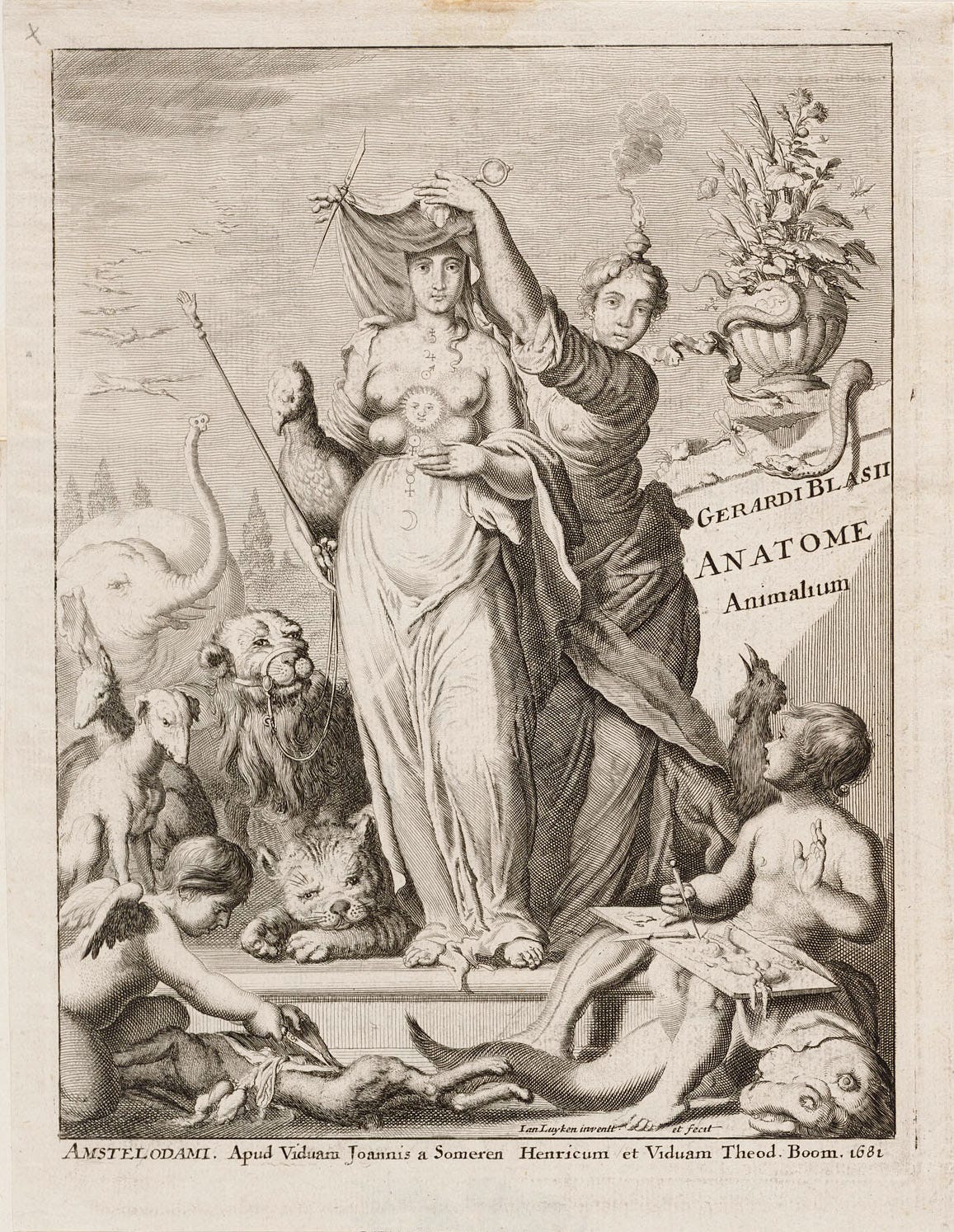
I looked at Paradise and found poor people forming the majority of its inhabitants; and I looked at Hell and saw that the majority of its inhabitants were women[376]
Do you have a mother?... Then stay with her, for Paradise is beneath her feet[377]
To claim a “proletarian feminism” or a “Marxist feminism” is to compose irreconcilably antagonistic terms, no less than claiming such a coupling meets its enemy in a much feared “Marxist-chauvinism” or “proletarian misogyny.” None of these terms link to any existing class formation. There can be no attempt to mask the odious posture of the oppressor class with the historical mission of the oppressed. The working women’s movement is not a branch of feminism; it is its dismantling and overcoming. One way or another, relations of material production and the state almost always get “overlooked in the works of… Marxist feminists who strive to go beyond the explanation of women’s oppression and who strive to propose radical changes in the way human society is today organized.”[378] Simply accusing Marxism in general of ‘class reductionism’ and placing the blame for such offenses, and their vulgar reality, on ‘men’ in general does not endow ‘Marxist-Feminism’ with a revolutionary or coherent critique. It’s also not a workable political alternative. Here perhaps the adage that even the ‘radically’ effeminate are, “too suspicious of men in general, and not enough in particular,”[379] loses or gains fashionable currency periodically. This is also ascribable to the fact that, especially in the West while, “the new cannot be born… a great variety of morbid symptoms appear.”[380]
Contemporary scholar Sophie Salvo argues that Bachofen’s Das Mutterrecht must be read “as a text concerned not only with the distribution of power between the sexes, or the trajectory of human culture, but also with the impossibility of absolute knowledge under patriarchy.”[381] For Marx, a ‘midwife’ is necessary in this arduous labor, this midwife is ‘a state of siege’ for “it should not be forgotten that it was by bayonets, likewise—and the bayonets turned against the people, at that—that it had to be protected in its mother‘s womb, and that by bayonet it had to be planted on earth.”[382] Such a process of ‘creation’ that is also producing these traumatic symptoms is itself tied with immense risk & an ‘immanentization’ with both primordial and eschatological scope. In either case, “marxist-feminism cannot be argued to offer a robust [Marxist] understanding”[383] of history and reality, and due to the fact that it and “radical feminism [uphold] the definition of the feminine as marginal, [the] vision remains fundamentally apolitical.”[384] Another major symptom is precisely this prevailing and overwhelming rejection of class struggle in Western countries that gives someone like Jodi Dean, though herself misled as concerns Marxism-Leninism in general, the reflexive sense to accurately describe “Marxist-Feminism” in the present day. This amounts to little more than frenetic idleness and salacious indiscipline. For the half-in and half-out American ‘left,’ past notions of class solidarity:
[M]ay seem outmoded today. In some organizations and movement spaces, there is a great deal of anxiety around sex. People are viewed as predators and victims rather than comrades. Nuanced calculations of privilege and hierarchy replace suppositions of equality… Suspicion supplies its own erotics of paranoia and punishment. Rather than strengthening solidarity and comradeship, “barbed eros” divides groups, sometimes from within but also from without as self-designated internet sex cops spread accusations and lies, getting off by feeling that they have the power to destroy[385]
This is not a semantic game but a life-and-death political distinction. Here also, a convenient and counterrevolutionary insistence upon an all-pervasive ‘aporia’ between political necessity and personal trauma or navel-gazing is “in sight such an occurrence… [also] forgetting the revolutionary interests of [the working class] through temporary comfort.”[386] In opposition to this, a historically indexed working women’s movement, as embodied in practice by the traditions of fighting and martyred Communist women of the past, the victorious Bolsheviks, and revolutionary parties still in power today, understands that:
I. Its enemy is capital and imperialism, not men. It recognizes that the working-class man is not the oppressor but under the same exploitative system, a potential comrade-in-arms. The aim is not to win a larger share of the spoils of exploitation and blame for women’s oppression (the feminist goal) but to overcome the system of exploitation itself.
II. Its struggle is collective, not individual. It does not seek the “empowerment” of individual women to become prison guards or critical critics. It seeks the collective liberation of the entire working class, without which women’s liberation is impossible. Its focus is on organizing the millions of women in factories, fields, and homes, not on the introspective dramas of the aspiring professional-managerial class.
III. Its method is class struggle, not moralistic accusation. It does not traffic in the vague, ahistorical language of “patriarchy” as a trans-historical demon haunting all men. Instead, it provides a concrete, scientific analysis of the patriarchal family as a historically specific economic unit that arose with private property and serves the ruling class by ensuring the unpaid reproduction of surplus value and the hereditary transmission of wealth. The fight is against this material institution and its development beyond that impasse at the economic base, not to shiver in a haunted house of gendered phantoms, accusing phantoms in turn.
Marxism-Leninism is not a self-involved utopian proposition but a living science of revolution. It does not deal in futuristic speculations about “post-gender” societies. The working class Party and traditions in practice therefore point to the actually existing historical movement and objectively developing conditions emerging as it acquires and consolidates proletarian state power: In the early USSR, it meant the immediate granting of full legal equality, the establishment of the Zhenotdel to politically organize the most backward masses of women, the collectivization of domestic labor through communal kitchens, child care and laundries, and the heroic, difficult, and often violent struggle to liberate women in Central Asia from oppressive bondage. It meant understanding that the limitations of the bourgeois family would not “wither away” overnight by decree or brow-beating the strawman domestic tyrant, but would be revolutionized through the material transformation of its economic foundations and resulting political movement. For ‘Marxist-Feminists’ of the present day, such bleary-eyed criticisms are more likely to attack actually existing socialism in a way that resembles Nanette Funk’s ‘A Very Tangled Knot’ writing from the 2010s. Although, Funk is quite right to point out that the ‘movement’ for them consists of “young self-identified Marxist feminists… resurrecting Marxist feminism and... [making] vague… critiques… talking yet one more time of ‘wages for housework’”[387] This with zero (0) corresponding victories for ‘marxist’-Feminists in proletarian internationalist struggle or party building. Marxist-Leninists on the other hand never simply disregard labor or promise private property’s abstract abolition by decree. Nor is this based upon ‘idle talk’ concerning sex and marriage in smug and breathless terms. Instead, it is the removal of such exploitative economic functions (inheritance, the woman’s role as household servant etc.), allowing a ‘necessary’ to potentially become, for the first time, the union based on free association rather than bestial compulsion or class subjugation. This gritty, practical, and ongoing process of social transformation, full of really existing contradictions and setbacks—not the idealist fantasy of a ‘radical’ college seminar or public display of ‘subversive’ mannerism, attire and flaunting of mass society’s strictures or futurity.
The retrieval of real and revolutionary ‘fighting history’ may lead to the clearing away of so much rubbish cluttering forward momentum. When a ‘thrice-born’ mythology and fetishization around the word ‘feminism’ tries to displace, and attempts the assigning of blame to the tradition of Marxism-Leninism, this moves to active hostility. When the middle-class oversocialized Western feminist accuses Marx of smoothing over “patriarchal” shortcomings[388], she reveals her own profound historical illiteracy and bourgeois subjectivity. This empty moralistic verdict is made against a movement that organized and helped facilitate the self-emancipation of millions of oppressed women, by the standards of even most ‘feminists’’ own individualistic and moralistic requirements. Casting such aspersions therefore is a blithe forgetting, or the admission of never having learned, that real struggle isn’t about reading the right theorists, perfecting one’s language, or self-flagellation for ‘gender essentialist’ claims while decrying sex reductionism; it is centered on the building of working class power to dismantle the oppressive state apparatus of capitalist class society. For instance, in self-described ‘critical theory’ developed in ‘Marxist-Feminism’ since the 1980s:
[Maria] Mies claims that the communists did not consider peasant women to be involved in productive work. However, Mao states clearly that this is the case (Mao 1965d, 44-46). Mies also states that the maoists did not talk of ‘patriarchy’ but conceptualized women’s oppression as being merely a remnant of feudalism. But again, in Mao (1965d), which was written in 1927, women’s oppression is both stressed and specifically called patriarchal. It is hard to not come to the conclusion that Mies’ understanding of China is limited[389]
It is not for nothing then that “M-F” writers themselves have pointed out that Maria Mies and others “distanced themselves from Marxism,”[390] as a label in order to try and drive further theoretical wedges between workers. This attempt to depict waged-work under capitalism, debt, rent, and alienating market discipline as mere self-concerned distractions while the ‘real world’ consists of anxiety-ridden furtive gossip and place-hunting parasitism. Pointing out an overemphasis on “household” labor as requiring exchange relations to the point of claiming that house-work should be “exploited” in Marx’s economic sense is to reverse the order of the development of productive forces and deny historical materialism. Housework and child-rearing have long been waged services provided from servile positions occupied by a mass of unproductive servants, who Marx deems ‘jenkinses.’ Household labor for workers under capitalism therefore is that which cannot dwell in the anarchistic deprivations of the exterior ‘oikos.’ Marx says that under capitalism, “truly productive workers would have to bear these consumption costs themselves and perform their own unproductive labor,”[391] and this is what ‘marxist’-Feminism appears most readily to forget or turn away from. This is also why, in the interstices of some of the most lauded ‘marxist’-Feminist writers, a subtle and self-aware critique stands out since ‘M-F’ as a term “stands before the task of synthesis as if nothing essential to either theory fundamentally opposes their wedding.”[392] As though the ‘hyphenation,’ whether present or not, could remove the confusion and lack of material results after 50+ years of ‘Marxist feminists’ (in)action. The ridiculousness of this self-convinced New Left breakdown most visibly manifests in the disorganization at the material foundations of Western nations’ Communist Party relevance and practice. This history is also at risk, and once sacrificed to an idealistic and insistent socially liberal ‘feminist’ or ‘environmentalist’ discursive posture, it eventually sees assertions such as “women, nature and the ‘Third World’ stood on the side of the exploited while all men stood on the side of the exploiters.”[393] A totally mystifying liquidation of solidarity. This results in a retreat to dehumanized and savage caricatures and to a characteristically mute ‘subaltern’ propped up for Northern and Western ‘feminist’ idleness to hide behind. This too presents its own vain recursive immobilization. One need only read Marx in 1844 to arrive upright before the horizon:
The direct, natural, and necessary relation of person to person is the relation of man to woman. In this natural species-relationship man’s relation to nature is immediately his relation to man... In this relationship, therefore, is sensuously manifested, reduced to an observable fact, the extent to which the human essence has become nature to man, or to which nature to him has become the human essence of man… This relationship also reveals the extent to which man’s need has become a human need; the extent to which, therefore, the other person as a person has become for him a need—the extent to which he in his individual existence is at the same time a social being[394]
The rise of capital in the West intensified the historical subjugation faced by women, but also paradoxically created the conditions necessary for the negation of that suffering. It “unsexed” men and women alike, as Engels noted, tearing them from the sluggishness of rural life and assembling them in factories, transforming the isolated drudgery of the household more and more into socialized, collective labor. This process, brutally dehumanizing, also created the objective basis for a new, proletarian development that could both accelerate ahead and return to the long-established relations of human community. The early organizing of women shoebinders and tailoresses, the heroic role of Elisabeth Dmitrieva and the pétroleuses of the Paris Commune, and the mass mobilization of rabotnitsii (female workers) in Russia demonstrated that the path to women’s liberation was not through an alliance with ‘feminists’ against ‘patriarchy’ in the abstract; seeking a place within some idealized structure of ‘post-patriarchy,’ but through the class struggle to do away with exploitative economic structures altogether. Subsequent development in China and Southeast Asia and Africa also showed these proletarian socialist movements around the globe further extended the fault line between Marxism and ‘feminism.’ Although 1940s Soviet anthropology could show that “the very idea of matriarchy is organically alien to class ideology, and class science will always remain hostile to this idea. Perhaps no other topic in the history of bourgeois science so vividly reveals the class face of this science, its class bias and prejudice,”[395] many bourgeois ‘radicals’ desperately attempt to obscure and mask bourgeois disposition on such questions by only emphasizing ‘patriarchy’ moralistically. Therefore, the fight for the women’s communist movement was never concerned with good or bad men or ‘masculinism,’ but in standing alongside other class-conscious workers against a capitalist system that savagely pitted them against one another as rivals and reduced both sexes to mere instruments of profit. This too accompanies a kind of forgetting, yet as Benjamin writes, “time not only extinguishes the traces of all misdeeds but also — by virtue of its duration, beyond all remembering or forgetting… helps to complete the process of forgiveness, though never of reconciliation.”[396] Forgiveness here of a kind that only the potency and legitimacy of workers’ dictatorship may mete out, as for those whose only route is ‘critical critique,’ and to the extent this imperative “even when it commandeth itself… must it atone for its commanding. Of its own law must it be come the judge and avenger and victim.”[397]
Considerable time has yet passed since most of the events described here took place. Skeptically passing over daily events is common, but disavowing them loses sight of the fact that this too is its own particular context for offensive maneuvers or holding actions within historiography. One can also see this flippant and untoward treatment of Marxism and Marxists by the academics and ‘not-so-academic’ commentators in their ‘marxist’-Feminist blogosphere posts or on their symposia ‘webinar’ calls. These insidious forms of forgetting are thus merely contemporary obsessions over such-and-such virtuous label in the abstract. Highly idealized institutional hybrids, born of the late 20th century New Left’s march through indifference away from the working class’ fighting history. They are a theoretical and practical nullity. Dana Cloud wrote in the 1990s that “when the raising of consciousness is seen as an end in itself, feminist practice runs up against the wall of the therapeutic, as the working over of identity replaces politics.”[398] As the Chinese Communist analysis correctly identifies, ‘marxist’-Feminism remains a bourgeois ideology that utilizes the ultra-impotent language of ‘discourse power, and identity politics’ while rarely discussing the material factors of class and state power. It is the needle without the thread, and a performative radicalism that critiques its own hysterically termed and ever-pressing brutish ‘toxic masculinity’ while unable to conceive of a revolutionary apparatus or class-equipped approach capable of smashing the state which materializes it.
Risks to the ‘tradition’ of Marxism do not merely stem from frontal assaults by open anti-Communists. As Marx himself wrote, the working class fighting women up to the present also take up and re-acquire a tradition that, if only in hindsight, includes all whose deeds amount to the “heroic, noble, and devoted, like the women of antiquity.”[399] One doesn’t need ‘marxist’-Feminism, you need world historically proven working class revolutionary practice. One doesn’t need “false emancipation of women”[400] as Marx described it, nor another digression into another ‘post-’ or ‘sur-’ or ‘xeno-‘ long-toothed pseudo-psychoanalytic misunderstanding. The working women’s movement therefore, armed and supported and sustained through the achievements of proletarian party leadership and Marxism-Leninist victories, does not seek an exalted or worshipful place in the pre-existing terror of history. It stirs working masses from inactivity or self-defeatism, suturing the present and previous struggles into one united red banner. This is the rallying point of that emerging future where identifiable categories of oppressor and oppressed become unrecallable.
Starting from ‘origins’ may therefore appear as a dizzying aside, but the “Origin is not only Entstehung, an emergence, a miraculous birth… [it’s] above all, Ursprung: an original moment that is always renewed… ‘The Origin is the goal.’”[401] In reference to these primary developments between the primitive and undifferentiated ‘horde’ up to higher phases, Lenin says, “[i]n reality, it was not the idea of God that curbed “zoological individualism”; it was both the primitive herd and the primitive commune.”[402] These primitive communities thus were never “ahistorical phenomena that invariably everywhere and everywhere preserve their once-and-for-all properties and features.”[403] They changed both with the development of property and family, but also with the position of women. Zupančič asserts that “what is included as something (as an entity) receives the very logical impossibility on which the alternative mother/not-mother is based… as included in reality, the impossible-real can only be a specter.”[404] In examining ‘marxist’-Feminism as a fad as well as Communism as a ‘real movement,’ historiography since the 19th century also demonstrates that everything, with only one sure concrete exception, abstracts to not-Mother.
Marx himself chided anthropologists with regard to the ‘Sumpfzeugung,’ or inhuman ‘primordial ooze,’ yet he observed as well that humanity emerged from “life in the horde.”[405] Bachofen also shows that this movement through mother, or history, is the dynamic “in which all the others find their conclusion and foundation.”[406] Today also, we do not necessarily have to invoke a caricature against the ‘dogmatic feminine’ in order to show that a dark looking-glass of clairvoyantly murky and wide-eyed myopia misleads in either case. If, as for Kristeva “the abject is edged with the sublime,”[407] this ‘edge’ too is also that which is only diaphanously concealed. Inferences made in this regard, whether regarding paternity or the future, also stridulate against one another, engendering friction between total forgetting and grasping forward. For Simone de Beauvoir, though she believes that “[s]ociety has always been male,”[408] she unintentionally points out for our purposes here regarding, “the fact that governs woman’s actual condition is the obstinate survival of extremely antique traditions into the new civilization that is just appearing in vague outline.”[409] In attempting to rip away that which conceals this future, one threatens to also uncover what “no mortal has hitherto drawn aside;”[410] and this vouchsafed obscurity in turn also shows “there must be Veil upon veil behind.”[411]
Jogging the memory then becomes an act of reintegration with luminant and telluric or base material dignity. Rosa Luxemburg shows that investigating such apparently unreachable early forms of human society clarifies “noble survivals of the obscure past [which offer] a hand to the revolutionary efforts of the future; the circle of knowledge [is] closed harmoniously” and the era of capitalism and subjugation of man (or woman) by man appears “merely as a tiny temporary stage on the great cultural advance of mankind.” [412] Bachofen continues here in his own illustrious fashion, “the use of information that is widely separated in terms of ethnicity and time is often the only means of gaining light. Only by considering all clues can we succeed in properly organizing the fragmentary information.”[413] Such an acknowledgement here references both the historical and historical materialist sources, as well as the everyday and practical, since a revolutionary without this scientific standpoint, as Marx argues, “will lead only to ultimate destruction, and not to the salvation of the suffering… tantamount to an empty and dishonest game of preachers… on the one hand… [and on the other] only asses…. [listening] with open mouths.”[414] To avoid such pitfalls is to focus attention where so much muddle emerges among those whose mere “forgetting [has become] an antidote to the suffering, a relief from the harshness of her existence.”[415] But what kinds of unconscious or ‘intellectual property’ and forms of discipline/self-discipline must Marxists leave behind to sustain and edify posterity? In the West, the memorials and traditions of proletarian internationalism and Marxism-Leninism must constantly be won anew from the ravages of parasitic boredom and excess.
In the early 20th century, Austrian Catholic priest Martin Gusinde wrote on his ethnological contacts among the hunter-gatherer Yámana tribe in the Southern Cone. In his observations, Gusinde describes how tribal origin myths explained a narrativized ‘coup’ against the formerly all-female cult leadership that once controlled the tribe’s most important initiation rituals. The inquisitive ‘Sun-man’ became curious as to the ‘true nature’ of spirits and tall-tales used to ‘trick’ men into serving the aims of the women. Some women showed him that “[t]here are no others (spirits) there. It is the women themselves who scream and yell to frighten the men; Tänuwa doesn’t do these things.”[416] In the story, the men find this out and react harshly, chasing these women down and killing many of them. This is why men now lead these rituals and ‘gained the upper hand,’ in the sex relation. Glimpses have also been given by anti-Marxist ‘socialist’ and ‘radical’ feminists themselves into their own mythologies, which are then used to remain in a frightened state as a result of counter-Promethean anxieties. On one hand, if a “privileged positioning and explanatory potential of gender difference as the origin of oppression”[417] may be called into question, it is also observed that “while we theorize endlessly about the oppression of women, we all too frequently forget that the position of the one is maintained only through the exploitation of the other and that such a relationship leaves little concrete room for sisterhood.”[418] Here, the working class Party in its struggle to attain international proletarian victory or redeem the past, provides either a frame upon which to further construct and preserve heirlooms of a working peoples’ history, or the constant and ignoble drilling in repeat failure which nevertheless “strives to turn toward that sun which is rising in the sky of history.”[419] A sun disposed to making light work of the necessary, and casting its long shadows beyond the sacral and the omphalic.
This training made the working class forget both its hatred and its spirit of sacrifice, for both are nourished by the image of enslaved ancestors rather than that of liberated grandchildren.[420]
We think that had the wall been still higher — had it encircled us yet more closely, there would still have been light above; and, unless Heaven itself is shut from our view, there will be bright starbeams, and calm moonlight, and blessed sunshine, coming down, and struggling towards us through the darkened window.[421]
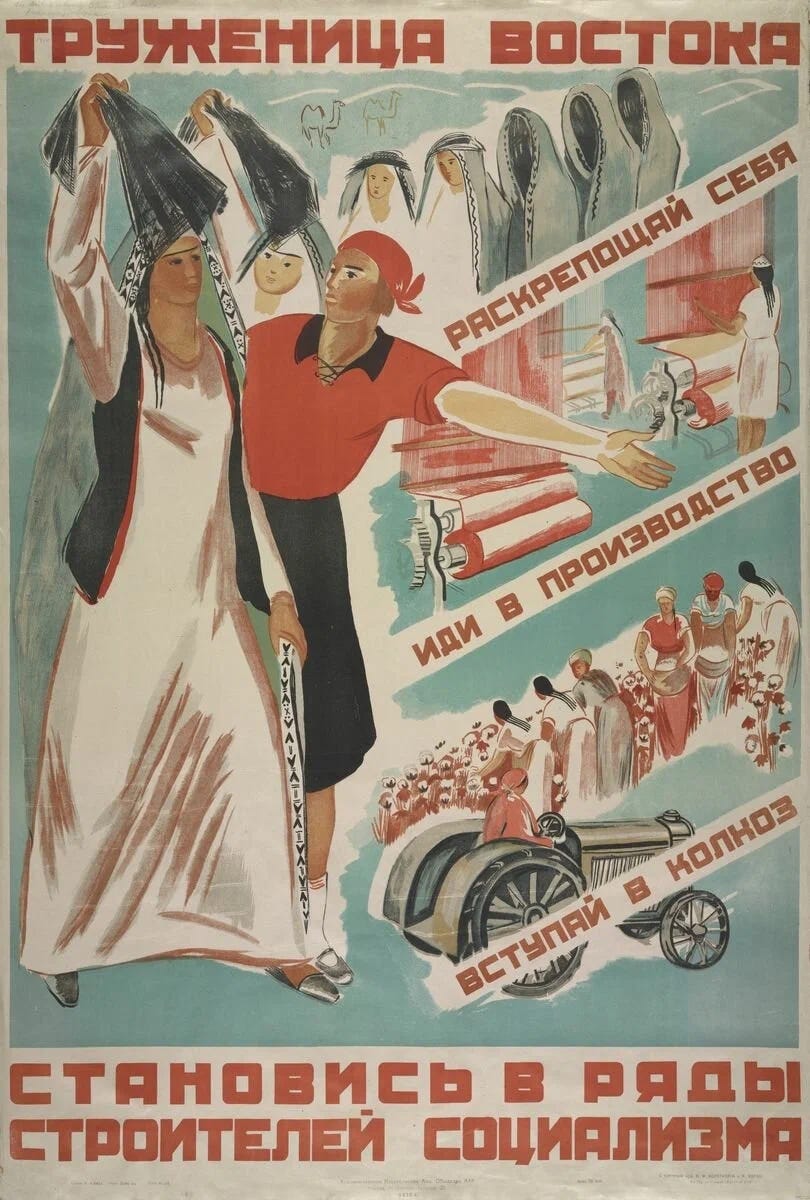
Works Consulted
a Black Revolutionary. “BLACK WOMAN.” The Black Panther: Black Community News Service, Vol. 2 Iss. 6, Sept. 14, 1968, 9. https://ia903108.us.archive.org/16/items/DSStore_20180324/Black%20Panthers%20Party/BPP_vol02_1968-1969/02%20no%206%201-14%20sep%2014%201968.pdf.
A Collection of Materials on the Counter-Revolutionary Crimes of the “Gang of Four”
1976.10-1977.4. Beijing: Library of the Institute of Philosophy, Chinese Academy of Social Sciences, 1977.
Agrippa, Henry Cornelius. Armatae Militiae Equitis Aurati, Et Iuris Vtriusque Ac Medicinae Doctoris, Opera Omnia. Lyon: Beringos Fratres, 1550.
Alekseeva, N. “О СВОЕМ ЖУРНАЛЕ.” Работница, Vol. 4, January 1928: 6-7.
Amadiume, Ifi. Re-inventing Africa. London & New York: Zed Books, 1997.
Andriotakis, Pamela and Chambers, Andrea. “In the Name of Sisterhood, Kate Millett Finds Herself in the Eye of the Storm in Iran.” People, Vol. 11 Iss. 13, April 02, 1979, 43. https://web.archive.org/web/20110202173909/http://www.people.com/people/archive/article/0,,20073303,00.html
Anger, Jane. Jane Anger: Her Protection For Women. London: Richard Jones, and Thomas Orwin, 1589.
Annenkov, Pavel. “ЗАМѢЧАТЕЛЬНОЕ ДЕСЯТИЛѢТІЕ.” Вестник Европы, Vol. 4, 1880: 457-506.
Arend, Orissa. Showdown in Desire: the Black Panthers take a stand in New Orleans. Fayetteville: The University of Arkansas Press, 2009.
Arnold, Sir Edwin. The Light of Asia. Leipzig: Bernhard Tauchnitz, 1891.
Artyukhina, Aleksandra. “ПРОЙДЕННЫЙ ПУТЬ,” in ЖЕНЩИНЫ В РЕВОЛЮЦИИ edited by V. Vasylenko. Moscow: STATE PUBLISHING HOUSE OF POLITICAL LITERATURE, 1959.
Artyukhina, Aleksandra. “РАБОТНИЦА, ПОДНИМАЙ ПРОИЗВОДСТВО,” Работница, Vol. 18(30) 18, September 1924: 1-2.
Artyukhina, Aleksandra. “РАБОТУ СРЕДИ ЖЕНЩИН ДОЛЖЕН ПРОВОДИТЬ ВЕСЬ АППАРАТ ПАРТИИ, СОВЕТОВ, ПРОФСОЮЗОВ: На высшую ступень.” Правда, №18 (4463), January 18, 1930, 4.
Aveling, Eleanor Marx and Aveling, Edward. “The Woman Question: From a Socialist Point of View.” The Westminster Review, Vol. 125 Iss. 1, January 1886: 207-222.
Attwood, Lynne.. Creating the New Soviet Woman. New York and London: Palgrave Macmillan, 1999.
Bachofen, J.J. Das Mutterrecht. Stuttgart: Verlag Von Krais & Hoffmann, 1861.
Bachofen, J.J. Myth, religion, and mother right; selected writings of J.J. Bachofen. Princeton, NJ: Princeton University Press, 1967.
Bachofen, J.J. Versuch über die Gräbersymbolik der Alten. Basel: Bahnmaier’s Buchhandlung (E. Detloff), 1859.
Bagley, Sarah G. “Reply to a statement of Miss Farleys,’” Voice of Industry, Vol. 1 No. 8, July 17, 1845, 3.
Bagley, Sarah G. “Anti-Slavery Convention,” Voice of Industry, Vol. 1 No. 47, May 8, 1846, 2.
Bahrami, Tooran Shariari. “The Social Position of Women in Old Persia,” in MEHREGAN IN SYDNEY edited by Garry Trompf et. al, Sydney, NSW: University of Sydney Printing Service, 2006.
Barrett, Michèle. Imagination in Theory. New York: New York University Press, 1999.
Barrett, Michèle, The politics of truth: from Marx to Foucault. Stanford, CA: Stanford University Press, 1991.
Bataille, Georges. Inner Experience. Albany, NY: State University of New York Press, 1988.
Bataille, Georges. “La Notion de Dépense,” La Critique Sociale, Vol. 7, (January 1933): 7-15.
Bataille, Georges. “Le Problème de L’État,” La Critique Sociale, Vol. 9, (September 1933): 105-107.
Bataille, Georges. “The Base Materialism and Gnosis.” Documents, Vol. 2 Iss. 1, 1930: 1-8.
Bäumler, Alfred. Bachofen und Nietzsche. Zürich: Neuen Schweizer Rundschau, 1929.
de Beauvoir, Simone. The Second Sex. New York: The Modern Library, 1968.
Benjamin, Walter. Gesammelte Schriften: Band V. Frankfurt am Main: Suhrkamp Verlag, 1982.
Benjamin, Walter. Illuminations. New York: Harcourt, Brace & World, Inc., 1968.
Benjamin, Walter. Selected writings: Volume 1 1913-1926. Cambridge, MA and London: Belknap Press of Harvard University Press, 1999.
Benjamin, Walter. Selected writings: Volume 3 1935-1938. Cambridge, MA and London: Belknap Press of Harvard University Press, 2006.
Benjamin, Walter. The Arcades Project. Cambridge, MA and London: The Belknap Press of Harvard University Press, 2002.
Benston, Margaret. “Political Economy of Women’s Liberation.” Monthly Review, Vol. 21 Iss. 4, 1969: 13-27.
Bebel, August. Society of the Future. Moscow: Progress Publishers, 1971.
Bebel, August. Woman in the past, present, and future. New York: AMS Press, 1976.
Bebel, August. Woman and Socialism. New York: Socialist Literature Company, 1910.
“BLACK WOMEN AND THE REVOLUTION.” The Black Panther: Black Community News Service, Vol. II No. 24, March 3, 1969, 9. https://archive.org/details/02-no-24-1-20-mar-3-1969/mode/2up.
Boer, Roland. “Women First? On The Legacy of ‘Primitive Communism.’” Journal for the Study of the Old Testament, Vol. 30 Iss. 1, (2005): 3-28.
Brandt, Conrad. A documentary history of Chinese communism. New York: Atheneum, 1966.
Bridenstein, Joseph I. Nietzschean, Feminist, and Embodied Perspectives on the Presocratics. Cham, Switzerland: Springer Nature, 2023.
Brovkin, Vladimir. Russia After Lenin: Politics, Culture and Society 1921-1929. London and New York: Routledge, 1998.
Bruno, Giordano. The Heroic Enthusiasts: An Ethical Poem Part the Second. London: Bernard Quaritch, 1889.
Bryan, Beverly and Dadzie, Stella and Scafe, Suzanne. “The heart of the race: Black women’s lives in Britain” in Black British Feminism edited by Heidi Safia Mirza. London and New York: Routledge, 1997.
al-Bukhari, Muhammad. The Translation of the Meanings of Sahîh Al-Bukhâri: Volume 4. Riyadh: Darussalam, 1997.
Busygin, Alexandr A. “50 лет „Происхождения семьи, частной соб-ственности и государства” Ф. Энгельса.” Советская этнография, № 6, 1934: 5-16.
Cai Fengshu. “批江青所谓的 ‘母系社会’” Literature, History and Philosophy, Vol. 0 Iss. 1, 1977: 59-66.
Chamberlin, William Henry. Soviet Russia: A Living Record And A History. Boston: Little, Brown, and Company, 1931.
Chatterjee, Choi. Celebrating Women: Gender, Festival Culture, and Bolshevik Ideology, 1910-1939. Pittsburg: University of Pittsburg Press, 2002.
Cixous, Hélène. The Newly Born Woman. Minneapolis: University of Minnesota Press, 1986.
Clements, Barbara Evans. Bolshevik Women. London: Cambridge University Press, 1997.
Clements, Barbara Evans. “The Utopianism of the Zhenotdel.” Slavic Review, Vol. 51 Iss. 3, (1992): 485–496.
Clements, Barbara Evans. “Working-Class and Peasant Women in the Russian Revolution, 1917-1923.” Signs, Vol. 8 Iss. 2, (Winter, 1982): 215-253.
Cloud, Dana L.. Control and Consolation in American Culture and Politics. Thousand Oaks, CA and London and New Delhi: Sage Publications, Inc., 1998.
Churchill, Ward and Wall, Jim Vander. The COINTELPRO Papers. Boston: South End Press, 1990, 362.
Cohen, Yolande. “REVIEW: Weinbaum, Batya, The Curious Courtship of Women’s Liberation and Socialism, Boston (Mass.), South End Press, 1978, 181 p.” Études internationals, Vol. 11 Iss. 2, 1980: 341-342.
Commerson, Jean-Louis-Auguste. Pensées d’un Emballeur – Premier Volume. Brussels: Chez Tarride, Libraire, 1851.
Darmangeat, Christophe. Primitive Communism Is Not What It Used To Be. Leiden | Boston: Brill, 2024.
Davies, Peter. “Woman Warriors, Feminism, and National Socialism: The Reception of J.J. Bachofen’s View of Amazons among German and Austrian Right-Wing Women Writers” in Women and Death 2 edited by Sarah Colvin and Helen Watanabe-O’Kelly. Rochester NY: Camden House, 2009.
Davy; An Englishman. The Insurrection in Paris. Paris: A. Lemoigne, 1871.
De Leon, Daniel. “IS THERE A ‘WOMAN QUESTION’?” The People, Vol. 9 Iss. 42, Jan. 14, 1900, 2.
De Leon, Daniel. Woman’s Suffrage. New York: New York Labor News Company, 1911.
Deepwell, Katy. “Bad Girls? Feminist identity politics in the 1990s” in Other than identity: the subject, politics and art edited by Juliet Steyn. Manchester and New York: St. Martin’s Press, 1997.
Delzell, Ruth. “1825-1851–Organization of Tailoresses and Seamstresses.” in Life and Labor, Vol. 2 Iss. 8, (August, 1912): 242-245.
Diop, Cheikh Anta. Civilization of barbarism: an authentic anthropology. Chicago: Lawrence Hill Books, 1991.
Diop, Cheikh Anta. The cultural unity of Black Africa: the domains of patriarchy and of matriarchy in classical antiquity. London: Karnak House, 1989.
Dmitrieff, Elisabeth et. al. “Manifesto of the Central Committee of the Union of Women for the Defense of Paris and Care of the Wounded.” Journal Officiel de la République Française, No. 128 (May 8, 1871), Morning Edition, 287.
Drake, Judith. An Essay In Defence of the Female Sex. London: Black Boy, 1696.
Dumas, Alexandre. L’homme-femme. Paris: LIBRAIRIE NOUVELLE, 1872
Dunbar, Roxanne. “Marxist Feminism.” in The Reader’s Companion to U.S. Women’s History edited by Wilma Mankiller et. al, New York: Houghton Mifflin Company, 1998.
Duveyrier, Charles. “La Ville Nouvelle,” in Paris, ou Le Livre Des Cent-Et-Un: Tome Huitième., Paris: Chez Ladvocat, Libraire De S.A.R Le Duc D’Orleans, 1832.
Efremova, Nata Pavlovna and Ivanov, Nikolai Nikolaevich. Русская Соратница Маркса. Moscow: Московский Рабочий, 1982.
Einstein, Carl. “Masques Bapindi,” Documents, Vol. 2 Iss. 1, 1930: 38.
Enfield, William. The History of Philosophy: Vol. 1. London: J.F. Dove, St. John’s-Square, 1819.
Engels, Friedrich. The condition of the working class in England in 1844. New York: John W. Lovell Company, 1887.
Eller, Cynthia. Gentlemen and Amazons: the myth of matriarchal prehistory. Berkeley and Los Angeles: University of California Press, 2011.
Ellis, Havelock. Psychology of Sex. Philadelphia: F.A. Davis Company, 1908.
Eliot, George. Romola. London: Smith, Elder & Co., 1869.
“Ex-Black Panther sues over FBI snitch claim.” The Times-Herald (Newnan, GA), December 14, 2007, 10A.
Fakier, Khayaat et. al., “Opening Conversations with Marxist Feminists: A Response to the Symposium on Marxist-Feminist Theories and Struggles Today,” Rethinking Marxism, Vol. 36 Iss. 2, 2024: 170-174.
Farley, Harriet. Shells from the strand of the sea of genius. Boston: James Munroe and Company, 1847.
Fluehr-Lobban, Carolyn. “Marxism and the Matriarchate” in Familie, Staat und Gesellscahftsformation edited by Joachim Herrmann et al. Berlin: Akademie-Verlag, 1988.
Fogel, Joshua. Between China and Japan. Leiden | Boston: Brill, 2015.
Forest, Claude. Les salles de cinema en Afrique sud saharienne francopjhone (1926-1980). Paris: L’Harmattan, 2019.
Fortin, Laura. “La trame d’une anthropologie textile. Soixante-quinze ans d’évolution de l’artisanat textile féminin au Burkina Faso (1912 – 1987),” Working Paper. Fondation Maison des sciences de l’homme, Vol. 141, (March 2019): 1-20.
Fourier, Charles. ŒUVRES COMPLÈTES Tome 1. Paris: À LA LIBRAIRIE SOCIÉTAIRE, 1846.
Fraisse, Geneviève. Reason’s muse: sexual difference and the birth of democracy. Chicago and London: The University of Chicago Press, 1994.
Franke, Katherine. “Dating the State: The Moral Hazards of Winning Gay Rights.” COLUMBIA HUMAN RIGHTS LAW REVIEW, Vol. 44 Iss. 1, Fall 2012: 1-46.
Fromm, Erich. Love, sexuality, and matriarchy: about gender. New York: Fromm International Publishing Corporation, 1997.
Funk, Nanette. “A very tangled knot: Official state socialist women’s organizations, women’s agency and feminism in Eastern European state socialism.” European Journal of Women’s Studies, Vol. 21 Iss. 4, 2014: 344-360.
Gilliam, Angela. “Women’s Equality and National Liberation. in Third World women and the politics of feminism edited by Chandra Talpade Mohanty and Ann Russo and Lourdes Torres. Bloomington and Indianapolis: Indiana University Press, 1991.
Gimenez, Martha E. “Capitalism and the Oppression of Women: Marx Revisited.” Science & Society, Vol. 69 Iss. 1, (January 2005): 11-32.
Gramsci, Antonio. “Fourth Notebook, §38” in Prisons Notebooks Vol. II edited and translated by Joseph Buttigieg. New York: Columbia University Press, 1996.
Gramsci, Antonio. Selections from the Prison Notebooks edited and translated by Quintin Hoare and Geoffrey Nowell Smith. New York: International Publishers, 1971.
Gómez-Jeria, Juan Sebastián. “About Alfred Baeumler’s Nietzsche. 3. ‘Bachofen and Nietzsche’.” Journal of Advances in Education and Philosophy, Vol. 7 Iss. 11, (Nov. 2023): 474-485.
Gulli, Florian. “Have we read Engels correctly? Primitive matriarchy and the oppression of women.” La Pensée, Vol. 419 Iss. 3, (2024): 41-52.
Gusinde, Martin. Folk literature of the Yamana Indians. Berkeley and Los Angeles and London: University of California Press, 1977.
Haraway, Donna. “A Manifesto for Cyborgs” in Coming to Terms: Feminism, Theory, Politics edited by Elizabeth Weed. New York and London: Routledge, 1989.
Hart, Judy. “Sisters’ Section: Black Womanhood No.1” The Black Panther: Black Communist News Service, Vol. 1 Iss. 5, July 20, 1967: 11-14.
Haug, Frigga. “Marxism-Feminism.” Historical Materialism, Vol. 24 Iss. 4, (2016): 257-270.
Hegel, G.W.F. Vorlesungen über die Philosophie der Religion: Erster Theil. Berlin: Verlag von Duncker und Humblot, 1840.
Heidegger, Martin. Gesamtausgabe, II. Abteilung: Vorlesungen 1923-1944, Band 55 Heraklit. Frankfurt Am Main: Vittorio Klostermann, 1987.
Heidegger, Martin. Gesamtausgabe, III. Abteilung: UNVERÖFFENTLICHTE ABHANDLUNGEN VORTRÄGE - GEDACHTES, Band 76. Frankfurt Am Main: Vittorio Klostermann, 2009.
Hinton, William. Fanshen: A Documentary of Revolution in a Chinese Village. New York: Monthly Review Press, 1967.
Ho, Chi Minh. TOÀN TẬP - TẬP 2 1924-1929. Hanoi: National Political Publishing House - The Truth, 2011.
Ho, Chi Minh (as Nguyen Ai-Quoc). “Женщина Востока.” Работница,, Vol. 9(21), May 1924: 10.
Holt, Alix. Selected Writings of Alexandra Kollontai. Westport, Conn.: Lawrence Hill and Company, 1977.
Husband, Julie. Antislavery Discourse and Nineteeth-Century American Literature. New York: Palgrave Macmillan, 2010.
Ilboudo, Monique. “Le féminisme au Burkina Faso: mythes et réalités.” Recherches feminists, Vol. 20 Iss. 2, 2007: 163–177
Itzkowitz, Ken. “Feminism and the Problem of Georges Bataille.” in Her voices: hermeneutics of the feminine edited by Fabio B, Dasilva and Mathew Kanjirathinkal. Lanham, MD and London: University Press of America, Inc., 1996.
Jacobs, Harriet. The Deeper Wrong; or, Incidents in the Life of a Slave Girl. London: W. Tweedie, 1862.
Jazayeri, Maryam. “Revolution” in Marxism and Feminism edited by Shahrzad Mojab. London: Zed Books, 2015.
Johnson, Louise C.. “Socialist Feminisms” in Feminist Knowledge: Critique and Construct edited by Sneja Gunew. London and New York: Routledge, 2013.
Jin Yihong. “Rethinking the ‘Iron Girls’: Gender and Labour during the Chinese Cultural Revolution.” Gender & History, Vol. 18 No. 3, November 2006: 613-634.
Jørgensen, Lisa Bender et. al, “Earliest Evidence for Textile Technologies,” Paléorient, Vol. 49 Iss. 1, 2023: 213-228.
Kaligna, Anna. “The Fight for Women’s Equality, 15 june 1921, Morning Session” in The Communist Women’s Movement, 1920-1922 edited by Mike Taber and Daria Dyakonova. Leiden | Boston: Brill, 2022.
Kamp, Marianne. “Pilgrimage and Performance: Uzbek Women and the Imagining of Uzbekistan in the 1920s.” International Journal of Middle East Studies, Vol. 34 Iss. 2, (May, 2002): 263-278.
Kant, Immanuel. vermischte Schriften: Dritter Band. Halle: in der Rengershen Buchhandlung, 1799.
Karambiri, Mawa and Ville, Alizée H.G. et al. “What is the Problem of Gender Inequality
Represented to be in Inter-National Development Policy in Burkina Faso?” Forum for Development Studies, Vol. 51 Iss. 1, 2024: 71-100.
Kelles-Krauz, Casimir v. “J.J. Bachofen. (1861-1901.),” Die Neue Zeit, Vol. 20 Iss. 17, (1901-1902): 517-524.
Kierkegaard, Søren. Enten - Eller: Et Livs-Fragment udgivet af Victor Eremita Forste Deel. Copenhagen: Bianco Lunos Book Printing House, 1843.
Kinealy, Arabella. Feminism and Sex-Extinction. London: T. Fisher Unwin, LTD, 1920.
Kirova, Milena. “The Early Fathers of Marxist Feminism and the Holy Book” in Marxist Feminist Criticism of the Bible edited by Roland Boer and Jorunn Øklund. Sheffield, UK: Sheffield Phoenix Press, 2008.
Kleist, Heinrich Von. Sämtliche Werke: Zweiter Band. Berlin: A. Warschauer’s Verlag, 1888.
Knehans, Gregory Neil. “AGAINST THE MANUFACTURE OF WASHING MACHINES:
MAOIST MATERIALIST DIALECTICS, POSTSTRUCTURALIST
FEMINISM AND THE LIBERATION FROM METAPHYSICS.” Ph.D Diss., The University of Arizona, 2007.
Kollontai, Aleksandra. “Forms and Methods of Work, 12 June 1921, Morning Session” in The Communist Women’s Movement, 1920-1922 edited by Mike Taber and Daria Dyakonova. Leiden | Boston: Brill, 2022.
Kollontai, Aleksandra. Selected Articles and Speeches. New York: International Publishers, 1984.
Kollontai, Aleksandra. “Новая угроза.” Коммунистка, Vol. 8-9, August-September 1922: 5-9.
Kosven, Mark Osipovich. “Энгельс и Морган” in Вопросы истории доклассового общества edited by A. M. Deborin. Moscow: АКАДЕМИИ НАУК, 1936.
Kosven, Mark Osipovich. “ПЕРЕХОД ОТ МАТРИАРХАТА К ПАТРИАРХАТУ” in РОДОВОЕ ОБЩЕСТВО edited by S.P. Tolstov, Moscow: ИЗДАТЕЛЬСТВО АКАДЕМИИ НАУК CCCP, 1951.
Kosven, Mark Osipovich. МАТРИАРХАТ. Moscow & Leningrad: ИЗДАТЕЛЬСТВО АКАДЕМИИ НАУК СССР, 1948.
Kristeva, Julia. Powers of horror: an essay on abjection. New York: Columbia University Press, 1982.
Krupskaya, N. K. “ПУТИ РАСКРЕПОЩЕНИЯ ЖЕНЩИНЫ ВОСТОКА (РЕЧЬ НА ВСЕСОЮЗНОМ СОВЕЩАНИИ ЖЕНЩИН ВОСТОКА).” Коммунистка, Vol. 12, December 1928: 5-12.
Ku Yen, “CHIANG CH’ING’S WOLFISH AMBITION IN PUBLICIZING “MATRIARCHAL SOCIETY,” Chinese Studies in History, Vol. 12 Iss. 3, (1979): 75-79.
Lafargue, Paul. “Le Matriarcat – Étude Sur Les Origines De La Famille,” La Nouvelle Revue, Vol. 30, (March-April 1886): 301-336.
Lafargue, Paul. “Der Mythos von Adam und Eva.” Die Neue Zeit, Vol. 9 Iss. 2, (1890-91): 225-232.
Lafargue, Paul. La Question de la Femme. Paris: EDITION DE L’OEUVRE NOUVELLE, 1904.
Lafargue, Paul. The Evolution of Property from Savagery to Civilization. Chicago: Charles H. Kerr & Company, 1910.
Lafargue, Paul The Origin and Evolution of the Idea of the Soul., Chicago: Charles H. Kerr & Company, 1922.
Lafargue, Paul. “The Myth of Athena.” in Time: A Monthly Magazine Vol. II – July to December 1890 edited by Edmund Belfort Bax. London: Swan Sonnenschein & Co., 1890.
Lebovic, Nitzan. Homo Temporalis. Ithaca, NY: Cornell University Press, 2024.
Leonard, Miriam. “Tragedy and the Seductions of Philosophy.” The Cambridge Classical Journal, Vol. 58, (2012):145-164.
Lenin, V.I. “119 ПРЕДПИСАНИЕ СИМБИРСКОМУ ГУБИСПОЛКОМУ
И СИМБИРСКОЙ ГУБЧЕКА, 10 февраля 1919 г.” in В.И. Ленин и ВЧК. Сборник документов (1917—1922 гг.) edited by С. К. ЦВИГУН et al. Moscow: ИЗДАТЕЛЬСТВО ПОЛИТИЧЕСКОЙ ЛИТЕРАТУРЫ, 1975.
Lenin, V.I. Collected Works: Volume 7 – September 1903-December 1904, (Moscow: Progress Publishers, 1977.
Lenin, V.I. ЛЕНИНСКИЙ СБОРНИК I. Leningrad: Государственное издательство Печатный двор, 1924.
Leslie, Irene. “Lenin on The Woman Question.” The Communist, Vol. 15 Iss. 3, (March 1936): 245-252.
Liebknecht, Wilhelm. Karl Marx Biographical Memoirs. Chicago: Charles H. Kerr, 1901.
Linder, Marc. “MacKinnon on Marx on Marriage and Morals: An Otsogistic Odyssey.” Buffalo Law Review, Vol. 41 Iss. 2, (1993): 451-522.
Livermore, Mary Ashton. My Story of the War: A Woman’s Narrative. Hartford, Conn.: A.D. Worthington and Company, 1888.
Liu, Catherine. Virtue Hoarders. Minneapolis and London: University of Minnesota Press, 2021.
Lokaneeta, Jinee. “Alexandra Kollontai and Marxist Feminism.” Economic and Political Weekly, Vol. 36 Iss. 16, (Apr. 28-May 4, 2001): 1405-1412.
Lovenduski, Joni. “USSR.” in The Politics of the Second Electorate: Women and Public Participation edited by J. Lovenduski and J. Hills. London: Routledge & Kegan Paul Limited, 1981.
Lowes, Sara and Nunn, Nathan. “The slave trade and the origins of matrilineal kinship.” Philosophical Transactions B, Vol. 379 Iss. 1897, 2024: 1-12.
Löwy, Michael. Fire Alarm. New York: Verso, 2005.
Lubin, Nancy. “Women in Soviet Central Asia: Progress and contradictions.” Soviet Studies, Vol. 33 Iss. 2, (April 1981): 182-203.
Luxemburg, Rosa. Einführung in die Nationalökonomie. Berlin: E. Laub’sche Verlagsbuchhandlung B.m.b.H., 1925.
Lysenko, Trofim. “Speech by Comrade Trofim Denisovich Lysenko” in
ВТОРОЙ ВСЕСОЮЗНЫЙ СЪЕЗД КОЛХОЗНИКОВ-УДАРНИКОВ
11-17 ФЕВРАЛЯ 1935 ГОДА - СТЕНОГРАФИЧЕСКИЙ ОТЧЕТ edited by M. L. MIKHAILOV et. al. Moscow: Государственное издательство колхозной и совхозной литературы «Сельхозгиз», 1935.
MacKinnon, Catharine A. “Feminism, Marxism, Method, and the State: An Agenda for Theory.” Signs, Vol. 7 Iss. 3, (Spring 1982): 515-544.
Mackinnon, Catharine A. Feminism unmodified: discourses on life and law. Cambridge, MA and London: Harvard University Press, 1987.
Mackinnon, Catharine A. Toward A Feminist Theory of the State. Cambridge, MA: Harvard University Press, 1991.
Mali, Joseph. “The Reconciliation of Myth: Benjamin’s Homage to Bachofen.” Journal of the History of Ideas, Vol. 60 Iss. 1, (Jan 1999): 65-187.
Mao Zedong. Selected Works of Mao Tse-Tung, Volume 1. Beijing: Foreign Languages Press, 1965.
Mao Zedong. The writings Mao Zedong, 1949-1976, Volume I, Sept. 1949-Dec. 1955. Armonk, NY and London: M.E. Sharpe, Inc., 1986.
Marsha, “TO THE WOMEN OF BABYLON,” The Black Panther: Black Community News Service, Vol. 3 Iss. 13, July 19, 1969, 23. https://archive.org/details/03-no-13-1-28-jul-19-1969/mode/2up.
Marx, Jenny. “Correspondence.” Woodhull & Claflin’s Weekly, Vol. 3 Iss. 23, Oct. 21, 1871, 6.
Marx, Karl. Economic and Philosophic Manuscripts of 1844. Moscow: Progress Publishers, 1977, 95-96.
Marx, Karl. Marx Engels Gesamtausgabe² II.4.2 - Karl Marx - Manuskripte 1863-1867 - Teil 2. Berlin: Dietz Verlag, 1992.
Marx, Karl. The Civil War in France. Moscow: Progress Publishers, 1974.
Marx, Karl. The Eighteenth Brumaire of Louis Bonaparte. Chicago: Charles H. Kerr & Company, 1913.
Marx, Karl. The Ethnological Notebooks of Karl Marx. Assen, The Netherlands: Van Gorcum & Comp. B.V., 1974.
Marx, Karl and Engels, Friedrich. Collected Works Volume 4 Marx and Engels 1844-45. Lawrence & Wishart, 2010.
Marx, Karl and Engels, Friedrich. Collected Works Volume 10 Marx and Engels 1849-51. Lawrence & Wishart, 2010.
Marx, Karl and Engels, Friedrich. Collected Works Volume 23 Marx and Engels 1871-74. Lawrence & Wishart, 2010.
Marx, Karl and Engels, Friedrich. Collected Works Volume 24 Marx and Engels 1874-83. Lawrence & Wishart, 2010.
Marx, Karl and Engels, Friedrich. Collected Works Volume 25 Engels. Lawrence & Wishart, 2010.
Marx, Karl and Engels, Friedrich. Collected Works Volume 26 Marx and Engels 1882-89. Lawrence & Wishart, 2010.
Marx, Karl and Engels, Friedrich. Collected Works Volume 37 Marx and Engels - Capital Vol. III. Lawrence & Wishart, 2010.
Marx, Karl and Engels, Friedrich. Collected Works Volume 40 Letters 1856-59. Lawrence & Wishart, 2010.
Marx, Karl and Engels, Friedrich. Collected Works Volume 43 Marx and Engels Letters 1868-70. Lawrence & Wishart, 2010.
Marx, Karl and Engels, Friedrich. Collected Works Volume 44 Marx and Engels Letters 1870-73. Lawrence & Wishart, 2010.
Marx, Karl and Engels, Friedrich. Collected Works Volume 46 Marx and Engels Letters 1880-83. Lawrence & Wishart, 2010.
Marx, Karl and Engels, Friedrich. HISTORISCH-KRITISCHE GESAMTAUSGABE: WERKE/SCHRIFTEN/BRIEFE, Erste Abteiling, Band 1 – Ersterhalbband. Frankfurt: Marx-Engels-Archiv Verlagsgesellschaft M.B.H., 1927.
Marx, Karl and Engels, Friedrich. “The Communist Manifesto,” in The Red Republican & The Friend of the People, translated by Helen Macfarlane. London: Merlin Press, 1966.
Marx, Karl and Engels, Friedrich. WERKE: Band 3. Berlin: Dietz Verlag, 1978.
Marx, Karl and Engels, Friedrich. WERKE: Band 13. Berlin: Dietz Verlag, 1961.
Marx, Karl and Engels, Friedrich. WERKE: Band 26 - Erster Teil. Berlin: Dietz Verlag, 1965.
Marx, Karl and Engels, Friedrich. WERKE: Band 32. Berlin: Dietz Verlag, 1974.
Marx, Karl and Engels, Friedrich. WERKE: Band 35. Berlin: Dietz Verlag, 1967.
Marx, Karl and Engels, Friedrich. WERKE: Band 36. Berlin: Dietz Verlag, 1979.
Marx, Karl and Engels, Friedrich. WERKE: Band 42. Berlin: Dietz Verlag, 1983.
Marx, Magdeleine. The Romance of New Russia. New York: Thomas Seltzer, 1924.
Massell, Gregory J. The surrogate proletariat: Moslem women and revolutionary strategies in Soviet Central Asia, 1919-1929. Princeton, NJ: Princeton University Press, 1974.
Maugue, Annelise. “The New Eve and Old Adam” in A History of Women in the West: IV. Emerging Feminism from Revolution to World War edited by Georges Duby and Michelle Perrot. Cambridge MA and London: The Belknap Press of Harvard University Press, 1993.
Mayanja, Namakula E. “Gender and the Burkina Faso Revolution” in A Certain Amount of Madness edited by Amber Murrey. London: Pluto Press, 2018.
McCafferty, Sharisse D. and McCafferty, Geoffrey G. “Spinning and Weaving as Female Gender Identity in Post-Classic Mexico” in Textile Traditions of Mesoamerica and the Andes: An Anthology edited by Margot Blum Schevill et. al. Austin: University of Texas Press, 1996.
McFadden, Patricia. “Women’s Freedom- Africa’s Future” in A Certain Amount of Madness edited by Amber Murrey. London: Pluto Press, 2018.
McLaughlin, Sigrid. “Introduction” in Image of Women in Contemporary Soviet Fiction edited and translated by Sigrid McLaughlin. London: The Macmillan Press, 1989.
McShane, Anne. “Bringing the Revolution to the Women of the East. The Zhenotdel experience in Soviet Central Asia through the lens of Kommunistka.” PhD. Diss., University of Glasgow, 2019.
Messer-Kruse, Timothy. The Yankee International: Marxism and the American Reform Tradition. Chapel Hill and London: The University of North Carolina Press, 1998.
Middleton, Chris. “The Familiar Fate of the Famulae” in On Work: Historical, Comparative and Theoretical Approaches edited by R.E. Pahl. New York: Basil Blackwell Inc., 1988.
Mies, Maria. “Marxist Socialism and women’s Emancipation: The Proletarian Women’s Movement in Germany 1860-1919” in Feminism in Europe: Liberal and Socialist Strategies 1789-1919 edited by Maria Mies and Kumari Jayawardena and Ettie Baas. The Hague: Institute of Social Studies, 1983.
Minaeva, O.D.. “The struggle of the magazine “Rabotnitsa” for audience and circulation in the 1920s and 1930s.” Bulletin of Moscow University. Series 10. Journalism, Vol. 5, 2013: 7-24.
“Minutes of the Fifth General Congress, September 1872.” in The first International: minutes of the Hague congress of 1872, with related documents edited by Hans Gerth. Madison, WI: The University of Wisconsin Press, 1958.
“Minutes of the General Council, Meeting of July 16, 1872.” in Documents of the First International, The General Council of the First International 1871-1872, Minutes. Moscow: Progress Publishers, 1963.
Mir-Hosseini, Ziba. “Women and politics in post-Khomeini Iran: divorce, veiling and feminism in post-Khomeini Iran” in Women and politics in the Third World edited by Haleh Afshar. London & New York: Routledge, 1996.
Mohanty, Chandra Talpade. “Under Western Eyes: Feminists Scholarship and Colonial Discourses” in Third World women and the politics of feminism edited by Chandra Talpade Mohanty and Ann Russo and Lourdes Torres. Bloomington and Indianapolis: Indiana University Press, 1991.
Momdzhian, H.N. Поль ЛАФАРГ И философия марксизма. Moscow: Publishing House “Thought”, 1978.
Morgan, Lewis H. Ancient Society or Researches in the Lines of Human Progress from Savagery through Barbarism to Civilization. Chicago: Charles H. Kerr & Company, 1909.
Morgan, Lewis H. League of the Ho-dé-no-sau-nee or Iroquois. New York: Dodd, Mead and Company, 1901.
Murrey, Amber. “Introduction,” in A Certain Amount of Madness edited by Amber Murrey. London: Pluto Press, 2018, 11.
Mushtaq, Sehrish and Baig, Fawad. “Reclaiming public and digital spaces.” in THE ROUTLEDGE HANDBOOK OF RELIGION, GENDER AND SOCIETY edited by Caroline Starkey and Emma Tomalin. London and New York: Routledge Taylor & Francis Group, 2022.
Al-Nasāʾī, English Translation of Sunan An- Nasāʾī: Volume 4, Riyadh: Darussalam, 2007.
Nasedkina, D. “ТУРКМЕНСКАЯ ШЕЛКОМОТАЛЬНЯ.” Работница ,Vol. 31, August 1928: 9-10.
Nietzsche, Friedrich. The Complete Works of Friedrich Nietzsche: Volume Eleven. Edinburgh and London: T.N. Foulis, 1911.
Northrop, Douglas. “Subaltern Dialogues: Subversion and Resistance in Soviet Uzbek Family Law.” Slavic Review, Vol. 60 Iss. 1, (Spring 2001): 115-139.
Northop, Douglas. Veiled Empire. Ithaca, NY: Cornell University Press, 2004.
Ouedraogo, Lassane. “Muslim women and pious fashion in Burkina Faso as identity, pose, and defiance.” The Communication Review, Vol. 22 Iss. 4, (Aug. 2019): 271-295.
Ouedraogo, Souleymane. “Nestorine Sangaré crache ses vérités sur l’homosexualité.” ACONews.net, April 15, 2021, https://web.archive.org/web/20250320183541/https://aconews.net/nestorine-sangare-crache-ses-verites-sur-lhomosexualite
Pan, David. “The Struggle for Myth in the Nazi Period: Alfred Baeumler, Ernst Bloch, and Carl Einstein.” South Atlantic Review, Vol. 65 Iss. 1, (Winter 2000): 41-57.
Panther Sisters. “Motor City Nine, Not Women’s Liberation but Women’s Deterioration.” The Black Panther: Black Community News Service, Vol. III Iss. 19, Aug. 30, 1969, 22.
Parsons, Lucy. “Cause of Sex Slavery.” The Firebrand, Vol. 1 Iss. 1, Jan. 27, 1895.
Potash, John L. Drugs As Weapons Against Us. Portland: Trineday Press, 2015.
Patterson, Michelle Jane. “RED ‘TEASPOONS OF CHARITY’: ZHENOTDEL, RUSSIAN WOMEN AND THE COMMUNIST PARTY, 1919-1930.” PhD. Diss., University of Toronto, 2011.
Petchesky, Rosalind. “Dissolving the Hyphen: Report on Marxist-Feminist Groups 1-5” in Capitalist patriarchy and the case for socialist feminism edited by Zillah R. Eisenstein. New York and London: Monthy Review Press, 1979.
Peterson, Brian James. Thomas Sankara: A Revolutionary in Cold War Africa. Bloomington, IN: Indiana University Press, 2021.
Pomeroy, Sarah B. Goddesses, Whores, Wives and Slaves. London: The Bodley Head, 2015.
Prosic, Tamara. “Schizoid Coitus: Christ and the Feminine” in Marxist Feminist Criticism of the Bible edited by Roland Boer and Jorunn Øklund. Sheffield, UK: Sheffield Phoenix Press, 2008.
Ramazanoglu, Caroline. FEMINISM AND THE CONTRADICTIONS OF OPPRESSION. London and New York: Routledge, 1989.
Ramazanoglu, Caroline. “Improving on Sociology: The Problems of Taking a Feminist Standpoint.” Sociology, Vol. 23 Iss. 3, (August 1989): 427-442.
Raskova, Marina Mikhailovna. Записки штурмана. Moscow: ИЗДАТЕЛЬСТВО ЦК ВЛКСМ «МОЛОДАЯ ГВАРДИЯ», 1939.
Reed, Evelyn. Problems of women’s liberation: a Marxist approach. New York: Merit Publishers, 1969.
Religion Saint-Simonienne: Procès en la Cour D’Assises De La Seine Les 27 et 28 Aout 1832. Paris: La Librairie Saint-Simonienne, 1832.
Rich, Adrienne. Of Woman Born: Motherhood as Experience and Institution. New York: W.W. Norton & Company, Inc., 1976.
Robert, Louis. “Héraclite à son fourneau,” École pratique des hautes études. 4e section, Sciences historiques et philologiques. Annuaire 1965-1966, 1965: 61-73.
Robinson, Comrade Candi. “Message To Revolutionary Women.” The Black Panther: Black Community News Service, Vol. 3 Iss. 16, August 9, 1969. https://archive.org/details/03-no-16-1-28-aug-9-1969/mode/2up.
Ruthchild, Rochelle Goldberg. Equality and Revolution. Pittsburg: University of Pittsburg Press, 2010.
Ryazanova, A. Женский труд. Moscow: Московский рабочий, 1923.
Saaddawi, Nawal El. The hidden face of Eve: women in the Arab world. London and Atlantic Highlands, NJ: Zed Press, 1980.
Sade, Marquis de. Oeuvres complètes du Marquis de Sade: Tome Premier. Paris: ÉDITIONS TÊTE DE FEUILLES, 1973.
Salvo, Sophie. “Father is Always Uncertain: J. J. Bachofen and the Epistemology of Patriarchy.” Monatshefte, Vol. 116 Iss. 1, (February 2024): 44-65.
Sankara, Thomas. “ANNEX I, EXTRACTS FROM THE STATEMENT RECORDED IN OUAGADOUGOU ON 20 DECEMBER 1983 BY MR. THOMAS SANKARA, THE CHAIRMAN OF THE NATIONAL REVOLUTIONARY COUNCIL, HEAD OF STATE OF BURKINA FASO.” United Nations Economic and Social Council, E/CN.4/1986/42, Annex I, February 4, 1986.
Sankara, Thomas. Thomas Sankara Speaks: The Burkina Faso Revolution 1983-87. New York: Pathfinder, 1988.
Sankara, Thomas. Women’s Liberation and the African Freedom Struggle. Toronto: Pathfinder Press, 2005.
Sayers, Dorothy L. Unpopular Opinions. London: Victor Gollancz Limited, 1946.
Scheide, Carmen. “‘Born in October’: the Life and Thought of Aleksandra Vasil’evna
Artyukhina, 1889–1969” in Women in the Stalin Era edited by Melanie Ilič. New York: Palgrave, 2001.
Schreiner, Olive. “Letter to Mrs. Mary King Roberts, [January 1889].” in The Letters of Olive Schreiner, 1876-1920 edited by S.C. Cronwright-Schreiner. Boston: Little, Brown, and Company, 1924.
Schreiner, Olive. Woman and Labour. New York: Frederick A. Stokes Company, 1911.
Schuler, Alfred. “Einführung des Herausgebers.” in Fragmente und Vorträge aus dem Nachlass edited by Ludwig Klages. Leipzig: VERLAG JOHANN AMBROSIUS BARTH, 1940.
Sedgwick, Miss C.M.. “The Patch-Work Quilt.” The Columbian Magazine, Vol. 5 Iss. 3, March 1846: 123-126.
Shakespeare, William. Mr. William Shakespear’s Comedies, H
istories and Tragedies. London: the Anchor in the New Exchange, the Crane in St. Pauls Church-Yard, and in Russel-Street Covent-Garden, 1685.
Shi, Hongmei and Qiu, Danwen. “马克思主义妇女理论与马克思主义女性主义释义.” CHINA WOMEN’S NEWS, July 25, 2023, 5. https://epaper.cnwomen.com.cn/images/2023-07/25/5/05BLM05C725_h.pdf.
Smidovich, Sofia. “Совещание заведующих областными женотделами.” Коммунистка, Vol. 5, May 1923: 8-11.
Sobolevsky, Arseniy. Революция Любви или вырождение?,Moscow: ИСКИС, 2012.
Sophia, a person of quality. Woman Not Inferior to Man. London: the Falcon for John Hawkins, 1739.
Sorge, Friedrich. “Friedrich Sorge Minutes, Fifth Sitting, Sept. 4, 1872,” in The Hague Congress of the First International, September 2-7, 1872. Minutes and Documents, translated by R. Dixon and A. Miller. Moscow: Progress Publishers, 1976.
Sousa, Rui Bragado. “MESSIANISMO E MATRIARCADO: CONCEITOS FUNDAMENTAIS NO PENSAMENTO DE WALTER BENJAMIN E DE OSWALD DE ANDRADE.” Guairacá Revista de Filosofia,Vol. 37 Iss. 2, 2021: 83-96.
Spivak, Gayatri Chakravorty. A Critique of Postcolonial Reason. London: Harvard University Press, 1999, 82-83.
Stalin, Josef. “К пятой годовщ ине Первого Съезда работниц и крестьянок.” Коммунистка, Vol. 11, November 1923: 1.
Stalin, Josef. “J. Stalin To Rabotnitsa.” Правда, №25 (5551), January 26, 1933, 1.
Stalin, Josef. Works Vol. 1. Moscow: FOREIGN LANGUAGES PUBLISHING HOUSE, 1954.
Stalin, Josef. Works Vol. 4. Moscow: FOREIGN LANGUAGES PUBLISHING HOUSE, 1953.
Stanton, Elizabeth Cady and Anthony, Susan B. and Gage, Matilda Joslyn. History of Woman Suffrage Vol. II 1861-1876. New York: Fowler & Wells, Publishers, 1882.h
Stevenson, Ana. The Woman as Slave in Nineteeth-Century American Social Movements. London: Palgrave Macmillan, 2019.
Strong, Anna Louise. Red Star In Samarkand. New York: Coward-McCann, Inc., 1929.
Sylvis, James C. The Life, Speeches, Labors and Essays of William H. Sylvis. Philadelphia: Claxton, Remsen & Haffelfinger, 1872.
“虎头山下战鼓响 深揭猛批“四人帮”——大寨干部、群众剥下江青的画皮,还她反革命的真面目 大寨大队党支部的话,” People’s Daily, December 5, 1976, 2.
Tanyildiz, Gökbörü Sarp. Grounding Critique. Leiden | Boston: Brill, 2025.
Tristan, Flora. Mémoires Et Pérégrinations D’Une Paria: 1833-1834 Vol. 1. Paris: Librairie Historique de Ladvocat et Comp.ie, 1838.
Tristan, Flora. Union ouvrière. Paris: Chez Tous Les Libraires, 1844.
Tolstikova, Natasha. “Rabotnitsa: The Paradoxical Success of a Soviet Women’s Magazine.” Journalism History, Vol. 30 Iss. 3, (Fall 2004): 131-140.
Tolstov, Sergey Pavlovich. “В. И. Ленин и актуальные проблемы этнографии.” Советская этнография, № 1, 1949: 1-17.
Ulyanova, Olga Ilyinichna. “Letter to A.F. Shcherbo [January 4, 1888].” in Forgotten Lives: The Role of Lenin’s Sisters in the Russian Revolution, 1864-1937 by Katy Turton. Hampshire, UK and New York: Palgrave Macmillan, 2007.
Valdez, Damian. “Bachofen’s Rome and the Fate of the Feminine Orient.” Journal of the History of Ideas, Vol. 70 Iss. 3, (July, 2009): 421-443.
Vinnikov, Isaac N. “Письма Бахофена к Моргану,” Советская этнография, № 6, 1934: 70-85.
Vinogradskaya, Polina. “Вопросы морали, пола, быта и тов. Коллонтай.” Красная новь, Vol. 5 Iss. 15, (August-September 1923): 179-214
Wang, Jincheng and Yan, Shi and Li, Zhenguang et. al. “Ancient DNA reveals a two-clanned matrilineal community in Neolithic China.” Nature, Vol. 643 Iss. 8074, (June 04, 2025): 1304-1311.
Ware, Cellestine. Woman power: the movement for women’s liberation. New York: Tower Publications, Inc., 1970.
Weinbaum, Batya. The curious courtship of women’s liberation and socialism. Boston: South End Press, 1978.
Wilentz, Sean. Chants Democratic: New York City and the Rise of the American Working Class, 1788-1850. New York: Oxford University Press, 2004.
“Women’s Movement Resolutions, (July 10, 1928) 1. The Communist Party of China and the Women’s Liberation Movement.” 中共中央文件选集 第四册 (一九二八) 中央档案馆编. Beijing: Party School Press of the Central Committee of the Communist Party of China,1991.
Xenophon. MEMORABILIA OECONOMICUS SYMPOSIUM APOLOGY. Cambridge, MA & London: Harvard University Press, 1997.
Yameogo, Viviane and Daum, Thomas et. al. “’We are just like ploughing bulls’: Power relations and cooperation in polygynous households in Burkina Faso” Working Paper, Universität Hohenheim, December 2023.
Yüncü, Eren et. al. “Female lineages and changing kinship patterns in Neolithic Çatalhöyük.” Science, Vol. 388 Iss. 6754, (June 26, 2025): 1-26.
Zetkin, Klara. “Introduction,” in ЖЕНСКИЙ ВОПРОС ЖЕНСКОЕ ДВИЖЕНИЕ edited by E. Milovidova. Moscow: State Publishing House, 1929.
Zetkin, Klara. Reminiscences of Lenin. London: Modern Books Limited, 1929.
Zetkin, Clara. Selected Writings. New York: International Publishers, 1984.
Žižek, Slavoj. The Parallax View. Cambridge and London: The MIT Press, 2006.
Zupančič, Alenka. Ethics of the Real. London and New York: Verso, 2000.
Footnotes
[1] Title: Karl Marx, The Civil War in France, (Moscow: Progress Publishers), 1974, 64.
[2] Thomas Sankara, Women’s Liberation and the African Freedom Struggle, (Toronto: Pathfinder Press, 2005), 19.
[3] Walter Benjamin, Illuminations, (New York: Harcourt, Brace & World, Inc., 1968), 257.
[4] Karl Marx and Friedrich Engels, Collected Works Volume 10 Marx and Engels 1849-51, (Lawrence & Wishart, 2010), 245.
[5] J.J. Bachofen, Das Mutterrecht, (Stuttgart: Verlag Von Krais & Hoffmann, 1861), 272.
[6] Juan Sebastián Gómez-Jeria, “About Alfred Baeumler’s Nietzsche. 3. ‘Bachofen and Nietzsche’,” Journal of Advances in Education and Philosophy, Vol. 7 Iss. 11, (Nov. 2023), 475.
[7] Christophe Darmangeat, Primitive Communism Is Not What It Used To Be, (Leiden | Boston: Brill, 2024), 11-12.
[8] Isaac N. Vinnikov, “Письма Бахофена к Моргану,” Советская этнография, № 6, 1934, 81.
[9] Alexandr A. Busygin, “50 лет „Происхождения семьи, частной соб-ственности и государства” Ф. Энгельса Советская этнография, № 6, 1934, 16.
[10] Alfred Bäumler, Bachofen und Nietzsche, (Zürich: Neuen Schweizer Rundschau, 1929), 16.
[11] Bäumler, Bachofen und Nietzsche, 28-30.
[12] Adrienne Rich, Of Woman Born: Motherhood as Experience and Institution, (New York: W.W. Norton & Company, Inc., 1976), 93.
[13] Damian Valdez, “Bachofen’s Rome and the Fate of the Feminine Orient,” Journal of the History of Ideas, Vol. 70 Iss. 3, (July, 2009), 443.
[14] Karl Marx and Friedrich Engels, WERKE: Band 32, (Berlin: Dietz Verlag, 1974), 51.
[15] Bachofen, Das Mutterrecht, 136.
[16] Peter Davies, “Woman Warriors, Feminism, and National Socialism: The Reception of J.J. Bachofen’s View of Amazons among German and Austrian Right-Wing Women Writers,” in Women and Death 2 edited by Sarah Colvin and Helen Watanabe-O’Kelly, (Rochester NY: Camden House, 2009), 56.
[17] Alfred Schuler, “Einführung des Herausgebers” in Fragmente und Vorträge aus dem Nachlass edited by Ludwig Klages, (Leipzig: VERLAG JOHANN AMBROSIUS BARTH, 1940), 68.
[18] Martin Heidegger, Gesamtausgabe, II. Abteilung: Vorlesungen 1923-1944, Band 55 Heraklit, (Frankfurt Am Main: Vittorio Klostermann, 1987), 12-14.
[19] Joseph I. Bridenstein, Nietzschean, Feminist, and Embodied Perspectives on the Presocratics, (Cham, Switzerland: Springer Nature, 2023), 169.
[20] David Pan, “The Struggle for Myth in the Nazi Period: Alfred Baeumler, Ernst Bloch, and Carl Einstein,” South Atlantic Review, Vol. 65 Iss. 1, (Winter 2000), 42.
[21] Annelise Maugue, “The New Eve and Old Adam,” in A History of Women in the West: IV. Emerging Feminism from Revolution to World War edited by Georges Duby and Michelle Perrot, (Cambridge MA and London: The Belknap Press of Harvard University Press, 1993), 530.
[22] Karl Marx and Friedrich Engels, Collected Works Volume 24 Marx and Engels 1874-83, (Lawrence & Wishart, 2010), 302-304.
[23] Margaret Benston, “Political Economy of Women’s Liberation,” Monthly Review, Vol. 21 Iss. 4, 1969, [Footnote 7], 25.
[24] Charles Fourier, ŒUVRES COMPLÈTES Tome 1, (Paris: À LA LIBRAIRIE SOCIÉTAIRE, 1846), 133.
[25] Geneviève Fraisse, Reason’s muse: sexual difference and the birth of democracy, (Chicago and London: The University of Chicago Press, 1994), 194.
[26] Karl Marx and Friedrich Engels, WERKE: Band 36, (Berlin: Dietz Verlag, 1979), 222.
[27] Casimir v. Kelles-Krauz, “J.J. Bachofen. (1861-1901.)” Die Neue Zeit, Vol. 20 Iss. 17, 1901-1902, 524.
[28] Kelles-Krauz, “J.J. Bachofen,” 523.
[29] Walter Benjamin, The Arcades Project, (Cambridge, MA and London: The Belknap Press of Harvard University Press, 2002), 416.
[30] Walter Benjamin, Illuminations, (New York: Harcourt, Brace & World, Inc., 1968), 130.
[31] Joseph Mali, “The Reconciliation of Myth: Benjamin’s Homage to Bachofen,” Journal of the History of Ideas, Vol. 60 Iss. 1, (Jan 1999), 169.
[32] Erich Fromm, Love, sexuality, and matriarchy: about gender, (New York: Fromm International Publishing Corporation, 1997), 4.
[33] Benjamin, The Arcades Project, 361.
[34] Karl Marx and Friedrich Engels, Collected Works Volume 26 Marx and Engels 1882-89, (Lawrence & Wishart, 2010), 173.
[35] Lewis H. Morgan, League of the Ho-dé-no-sau-nee or Iroquois, (New York: Dodd, Mead and Company, 1901), 314.
[36] Marx and Engels, Collected Works Volume 26, 259.
[37] Marx, Karl and Engels, Friedrich. Collected Works Volume 37 Marx and Engels Works Capital Vol. III. (Lawrence & Wishart, 2010), 176.
[38] August Bebel, Woman and Socialism, (New York: Socialist Literature Company, 1910), 28.
[39] Bebel, Woman and Socialism, 33.
[40] Eren Yüncü et. al, “Female lineages and changing kinship patterns in Neolithic Çatalhöyük,” Science, Vol. 388 Iss. 6754, (June 26, 2025), 20.
[41] Lise Bender Jørgensen et. al, “Earliest Evidence for Textile Technologies,” Paléorient, Vol. 49 Iss. 1, 2023, 213.
[42] Tooran Shariari Bahrami, “The Social Position of Women in Old Persia,” in MEHREGAN IN SYDNEY edited by Garry Trompf et. al, (Sydney: University of Sydney Printing Service, 2006), 25.
[43] Jincheng Wang, Shi Yan, Zhenguang Li et. al, “Ancient DNA reveals a two-clanned matrilineal community in Neolithic China,” Nature, Vol. 643 Iss. 8074, (June 04, 2025), 1310.
[44] Sharisse D. McCafferty and Geoffrey G. McCafferty, “Spinning and Weaving as Female Gender Identity in Post-Classic Mexico” in Textile Traditions of Mesoamerica and the Andes: An Anthology edited by Margot Blum Schevill et. al, (Austin: University of Texas Press, 1996), 25.
[45] August Bebel, Woman and Socialism, 52.
[46] August Bebel, Woman in the past, present, and future, (New York: AMS Press, 1976), 23.
[47] Paul Lafargue, The Evolution of Property from Savagery to Civilization, (Chicago: Charles H. Kerr & Company, 1910), 34.
[48] Paul Lafargue, “Le Matriarcat – Étude Sur Les Origines De La Famille,” La Nouvelle Revue, Vol. 39, (March-April 1886): 318-319.
[49] Lafargue, The Evolution of Property, 47.
[50] Karl Marx and Friedrich Engels, WERKE: Band 42, (Berlin: Dietz Verlag, 1983), 386.
[51] Marx and Engels, Collected Works Volume 26, 158-159.
[52] Walter Benjamin, Selected writings: Volume 3 1935-1938, (Cambridge and London: Belknap Press of Harvard University Press, 2002), 19.
[53] Karl Marx and Friedrich Engels, WERKE: Band 13, (Berlin: Dietz Verlag, 1961), 20.
[54] Josef Stalin, Works Vol. 1, (Moscow: Foreign Languages Publishing House, 1954), 342.
[55] Marina Mikhailovna Raskova, Записки штурмана, (Moscow: ИЗДАТЕЛЬСТВО ЦК ВЛКСМ «МОЛОДАЯ ГВАРДИЯ», 1939), 224-225.
[56] Karl Marx, Marx Engels Gesamtausgabe² II.4.2 - Karl Marx - Manuskripte 1863-1867 - Teil 2, (Berlin: Dietz Verlag, 1992), 407.
[57] Paul Lafargue, “The Myth of Athena,” in Time: A Monthly Magazine Vol. II – July to December 1890 edited by Edmund Belfort Bax, (London: Swan Sonnenschein & Co., 1890), 928.
[58] Paul Lafargue, La Question de la Femme, (Paris: EDITION DE L’OEUVRE NOUVELLE, 1904), 17.
[59] Paul Lafargue, “The Myth of Athena,” 927.
[60] Paul Lafargue, “Der Mythos von Adam und Eva,” Die Neue Zeit, Vol. 9 Iss. 2, (1890-91), 226.
[61] August Bebel, Woman and Socialism, 34.
[62] Sarah B. Pomeroy, Goddesses, Whores, Wives and Slaves, (London: The Bodley Head, 2015), 1.
[63] Marx and Engels, Collected Works Volume 26, 161-162.
[64] Marx and Engels, Collected Works Volume 26, 162.
[65] Lafargue, La Question de la Femme, 18.
[66] Lafargue, The Evolution of Property, 51.
[67] Lafargue, The Evolution of Property, 61.
[68] Pomeroy, Goddesses, 30.
[69] Paul Lafargue, The Origin and Evolution of the Idea of the Soul, (Chicago: Charles H. Kerr & Company, 1922), 39.
[70] Lafargue, The Origin and Evolution of the Idea of the Soul, 50.
[71] Tamara Prosic, “Schizoid Coitus: Christ and the Feminine,” in Marxist Feminist Criticism of the Bible edited by Roland Boer and Jorunn Øklund. (Sheffield, UK: Sheffield Phoenix Press, 2008), 60.
[72] J.J. Bachofen, Versuch über die Gräbersymbolik der Alten, (Basel: Bahnmaier’s Buchhandlung (E. Detloff), 1859), 102.
[73] Bebel, Woman and socialism, 14.
[74] M.O. Kosven, МАТРИАРХАТ, (Moscow & Leningrad: ИЗДАТЕЛЬСТВО АКАДЕМИИ НАУК СССР, 1948), 14.
[75] Lewis H. Morgan, Ancient Society or Researches in the Lines of Human Progress from Savagery through Barbarism to Civilization, (Chicago: Charles H. Kerr & Company, 1909), 6.
[76] Kosven, МАТРИАРХАТ, 5.
[77] Sara Lowes and Nathan Nunn, “The slave trade and the origins of matrilineal kinship,” Philosophical Transactions B, Vol. 379 Iss. 1897, 2024, 1.
[78] M.O. Kosven, “ПЕРЕХОД ОТ МАТРИАРХАТА К ПАТРИАРХАТУ” in РОДОВОЕ ОБЩЕСТВО edited by S.P. Tolstov. (Moscow: ИЗДАТЕЛЬСТВО АКАДЕМИИ НАУК CCCP, 1951), 90-91.
[79] Karl Marx, The Ethnological Notebooks of Karl Marx, (Assen, The Netherlands: Van Gorcum & Comp. B.V., 1974), 126.
[80] Marx and Engels, Collected Works Volume 26, 165.
[81] Marx and Engels, Collected Works Volume 26, 171.
[82] Marx and Engels, Collected Works Volume 26, 172.
[83] Marx, The Ethnological Notebooks, 121.
[84] Olive Schreiner, Woman and Labour, (New York: Frederick A. Stokes Company, 1911), 15.
[85] Schreiner, Woman and Labour, 80.
[86] Marx, The Ethnological Notebooks, 134.
[87] Morgan, Ancient Society, 464.
[88] Marx and Engels, Collected Works Volume 26, 162-163.
[89] Lafargue, La Question de la Femme, 19.
[90] Bebel, Woman and Socialism, 33.
[91] Marx and Engels, Collected Works Volume 26, 173-174
[92] Marx and Engels, Collected Works Volume 26, 170.
[93] Darmangeat, Primitive Communism Is Not What It Used To Be, 128.
[94] Karl Marx and Friedrich Engels, Collected Works Volume 46 Marx and Engels Letters 1880-83, (Lawrence & Wishart, 2010), 22.
[95] Benjamin, Illuminations, 204.
[96] William Shakespeare, Mr. William Shakespear’s Comedies, Histories and Tragedies, (London: the Anchor in the New Exchange, the Crane in St. Pauls Church-Yard, and in Russel-Street Covent-Garden, 1685), 221.
[97] Henry Cornelius Agrippa of Nettesheym, Armatae Militiae Equitis Aurati, Et Iuris Vtriusque Ac Medicinae Doctoris, Opera Omnia, (Lyon: Beringos Fratres, 1550), 541.
[98] Jane Anger, Jane Anger: Her Protection For Women, (London: Richard Jones, and Thomas Orwin, 1589), 11.
[99] Judith Drake, An Essay In Defence of the Female Sex, (London: Black Boy, 1696), 21
[100] Sophia, a person of quality, Woman Not Inferior to Man, (London: the Falcon for John Hawkins, 1739), 8.
[101] Marquis de Sade, Oeuvres complètes du Marquis de Sade: Tome Premier, (Paris: ÉDITIONS TÊTE DE FEUILLES, 1973), 380.
[102] Religion Saint-Simonienne: Procès en la Cour D’Assises De La Seine Les 27 et 28 Aout 1832, (Paris: La Librairie Saint-Simonienne, 1832), 315.
[103] Charles Duveyrier, “La Ville Nouvelle,” in Paris, ou Le Livre Des Cent-Et-Un: Tome Huitième, (Paris: Chez Ladvocat, Libraire De S.A.R Le Duc D’Orleans, 1832), 339.
[104] Alexandre Dumas, L’homme-femme, (Paris: LIBRAIRIE NOUVELLE, 1872), 91.
[105] Miss C.M. Sedgwick, “The Patch-Work Quilt,” The Columbian Magazine, Vol. 5 Iss. 3, March 1846, 126.
[106] Paul Lafargue, The Origin and Evolution of the Idea of the Soul, 72.
[107] Friedrich Engels, The condition of the working class in England in 1844, (New York: John W. Lovell Company, 1887), 146.
[108] Bebel, Woman in the past, 16.
[109] Marx and Engels, Collected Works Volume 24, 315.
[110] Ruth Delzell, “1825-1851–Organization of Tailoresses and Seamstresses,” Life and Labor, Vol. 2 Iss. 8, (August, 1912), 242.
[111] Sean Wilentz, Chants Democratic: New York City and the Rise of the American Working Class, 1788-1850, (New York: Oxford University Press, 2004), 249-250.
[112] Harriet Jacobs, The Deeper Wrong; or, Incidents in the Life of a Slave Girl, (London: W. Tweedie, 1862), 159.
[113] Mary Ashton Livermore, My Story of the War: A Woman’s Narrative, (Hartford, Conn.: A.D. Worthington and Company, 1888), 261.
[114] Elizabeth Cady Stanton and Susan B. Anthony and Matilda Joslyn Gage, History of Woman Suffrage Vol. II 1861-1876, (New York: Fowler & Wells, Publishers, 1882), 353.
[115] Sarah G. Bagley, “Reply to a statement of Miss Farleys,’” Voice of Industry, Vol. 1 No. 8, July 17, 1845, 3.
[116] Julie Husband, Antislavery Discourse and Nineteenth-Century American Literature, (New York: Palgrave Macmillan, 2010), 88.
[117] Ana Stevenson, The Woman as Slave in Nineteenth-Century American Social Movements, (London: Palgrave Macmillan, 2019), 173.
[118] Sarah G. Bagley, Voice of Industry, “Anti-Slavery Convention,” Voice of Industry, Vol. 1 No. 47, May 8, 1846, 2.
[119] V.I. Lenin, Collected Works: Volume 7 – September 1903-December 1904, (Moscow: Progress Publishers, 1977), 19.
[120] Flora Tristan, Union ouvrière, (Paris: Chez Tous Les Libraires, 1844), 5.
[121] Flora Tristan, Mémoires Et Pérégrinations D’Une Paria: 1833-1834 Vol. 1, (Paris: Librairie Historique, 1838), 41.
[122] Karl Marx and Friedrich Engels, Collected Works Volume 4 Marx and Engels 1844-45, (Lawrence & Wishart, 2010), 20.
[123] Benjamin, Illuminations, 131.
[124] Friedrich Engels, The condition of the working class, 86.
[125] Friedrich Engels, The condition of the working class, 98.
[126] James C. Sylvis, The Life, Speeches, Labors and Essays of William H. Sylvis, (Philadelphia: Claxton, Remsen & Haffelfinger, 1872), 218-219.
[127] Karl Marx and Friedrich Engels, Collected Works Volume 43: Letters Marx and Engels 1868-70. (Lawrence & Wishart, 2010), 184.
[128] Aleksandra Kollontai, Selected Articles and Speeches, (New York: International Publishers, 1984), 32.
[129] George Eliot, Romola, (London: Smith, Elder & Co., 1869), 329.
[130] Kollontai, Selected Articles, 64.
[131] Karl Marx and Friedrich Engels, “The Communist Manifesto” in The Red Republican & The Friend of the People translated by Helen Macfarlane, (London: Merlin Press, 1966), 171.
[132] Nata Pavlovna Efremova and Nikolai Nikolaevich Ivanov, Русская Соратница Маркса, (Moscow: МОСКОВСКИЙ РАБОЧИЙ, 1982), 179.
[133] Efremova and Ivanov, Русская Соратница Маркса, 180.
[134] Elisabeth Dmitrieff et. al, “Manifesto of the Central Committee of the Union of Women for the Defense of Paris and Care of the Wounded.” Journal Officiel de la République Française, No. 128 (May 8, 1871) Morning Edition, 287.
[135] Davy; An Englishman, The Insurrection in Paris, (Paris: A. Lemoigne, 1871), 140.
[136] Marx and Engels, Collected Works Volume 24, 461.
[137] Marx and Engels, Collected Works Volume 24, 461.
[138] Jenny Marx, “Correspondence,” Woodhull & Claflin’s Weekly, Vol. 3 Iss. 23, Oct. 21, 1871, 6.
[139] Timothy Messer-Kruse, The Yankee International: Marxism and the American Reform Tradition, (Chapel Hill and London: The University of North Carolina Press, 1998), 132.
[140] “Minutes of the General Council, Meeting of July 16, 1872,” in Documents of the First International, The General Council of the First International 1871-1872, Minutes, (Moscow: Progress Publishers, 1963), 256.
[141] “Minutes of the Fifth General Congress, September 1872,” in The first International: minutes of the Hague congress of 1872, with related documents edited by Hans Gerth, (Madison, WI: The University of Wisconsin Press, 1958), 199.
[142] Friedrich Sorge, “Friedrich Sorge Minutes, Fifth Sitting, Sept. 4, 1872,” in The Hague Congress of the First International, September 2-7, 1872. Minutes and Documents, translated by Richard Dixon and Alex Miller, (Moscow: Progress Publishers, 1976), 60.
[143] Marx and Engels, Collected Works Volume 23 Marx and Engels 1871-74, 181.
[144] Eleanor Marx Aveling and Edward Aveling, “The Woman Question: From a Socialist Point of View,” The Westminster Review, Vol. 125 Iss. 1, January 1886, 213.
[145] Barbara Evans Clements, Bolshevik Women, (London: Cambridge University Press, 1997), 29.
[146] Schreiner, Woman and Labour, 46.
[147] Daniel De Leon, Woman’s Suffrage, (New York: New York Labor News Company, 1911), 27.
[148] Arabella Kinealy, Feminism and Sex-Extinction, (London: T. Fisher Unwin, LTD., 1920), 258.
[149] Olive Schreiner, “Letter to Mrs. Mary King Roberts, [January 1889],” in The Letters of Olive Schreiner, 1876-1920 edited by S.C. Cronwright-Schreiner, (Boston: Little, Brown, and Company, 1924), 151.
[150] Havelock Ellis, Psychology of Sex, (Philadelphia: F.A. Davis Company, 1908), 98
[151] Magdeleine Marx, The Romance of New Russia, (New York: Thomas Seltzer, 1924), 50-51.
[152] Kollontai, Selected Articles, 48.
[153] Klara Zetkin, Reminiscences of Lenin, (London: Modern Books Limited, 1929), 52.
[154] Kollontai, Selected Articles, 34.
[155] Daniel De Leon, “IS THERE A ‘WOMAN QUESTION’?” The People, Vol. 9 Iss. 42, Jan. 14, 1900, 2.
[156] Lucy Parsons, “Cause of Sex Slavery,” The Firebrand, Vol. 1 Iss. 1, Jan. 27, 1895, 3.
[157] Olga Ilyinichna Ulyanova, “Letter to A.F. Shcherbo [January 4, 1888],” in Forgotten Lives: The Role of Lenin’s Sisters in the Russian Revolution, 1864-1937, by Katy Turton, (Hampshire, UK and New York: Palgrave Macmillan, 2007), 23.
[158] Josef Stalin, “К пятой годовщ ине Первого Съезда работниц и крестьянок,” Коммунистка, Vol. 11, November 1923, 1.
[159] Rochelle Goldberg Ruthchild, Equality and Revolution, (Pittsburg: University of Pittsburg Press, 2010), 221.
[160] Choi Chatterjee, Celebrating Women: Gender, Festival Culture, and Bolshevik Ideology, 1910-1939, (Pittsburg: University of Pittsburg Press, 2002), 52.
[161] Barbara Evans Clements, “Working-Class and Peasant Women in the Russian Revolution, 1917-1923,” Signs, Vol. 8 Iss. 2, (Winter, 1982), 233-234.
[162] Lynne Attwood, Creating the New Soviet Woman, (New York and London: Palgrave Macmillan, 1999), 15-16.
[163] O.D. Minaeva, “The struggle of the magazine “Rabotnitsa” for audience and circulation in the 1920s and 1930s,” Bulletin of Moscow University. Series 10. Journalism, Vol. 5, 2013, 11.
[164] Ho Chi Minh (as Nguyen Ai-Quoc), “Женщина Востока,” Работница, Vol. 9 Iss. 21, May 1924, 10.
[165] Ho Chi Minh, TOÀN TẬP - TẬP 2 1924-1929, (Hanoi: National Political Publishing House -The Truth, 2011), 8.
[166] Natasha Tolstikova, “Rabotnitsa: The Paradoxical Success of a Soviet Women’s Magazine,” Journalism History, Vol. 30 Iss. 3, (Fall 2004): 131.
[167] N. Alekseeva, “О СВОЕМ ЖУРНАЛЕ,” Работница, Vol. 4, January 1928, 6.
[168] Alekseeva, “О СВОЕМ ЖУРНАЛЕ,” 7.
[169] Arseniy Sobolevsky, Революция Любви или вырождение?, (Moscow: ИСКИС, 2012),
Chapter 6.
[170] Sobolevsky, Революция Любви, Chapter 6.
[171] “SOVIETS MAKE GIRLS PROPERTY OF STATE,” New York Times, October 26, 1918, 5. https://www.nytimes.com/1918/10/26/archives/soviets-make-girls-property-of-state-decrees-compel-them-to.html.
[172] V.I. Lenin, “119 ПРЕДПИСАНИЕ СИМБИРСКОМУ ГУБИСПОЛКОМУ
И СИМБИРСКОЙ ГУБЧЕКА 10 февраля 1919 г.,” in В.И. Ленин и ВЧК. Сборник документов (1917—1922 гг.) edited by С. К. ЦВИГУН et al., (Moscow: ИЗДАТЕЛЬСТВО ПОЛИТИЧЕСКОЙ ЛИТЕРАТУРЫ, 1975), 149.
[173] V.I. Lenin, “119 ПРЕДПИСАНИЕ СИМБИРСКОМУ,” 149.
[174] Aleksandra Kollontai, “Новая угроза,” Коммунистка, Vol. 8-9, August-September 1922, 6.
[175] Vladimir Brovkin, Russia After Lenin: Politics, Culture and Society 1921-1929, (London and New York: Routledge, 1998), 118-119.
[176] McShane, “Bringing the Revolution to the Women of the East,” 195.
[177] Kollontai, “Новая угроза,” 9.
[178] Kollontai, “Новая угроза,” 9.
[179] Polina Vinogradskaya, “Вопросы морали, пола, быта и тов. Коллонтай,” Красная новь, Vol. 5 Iss. 15, (August-September 1923), 179-214.
[180] Michelle Jane Patterson, “RED ‘TEASPOONS OF CHARITY’: ZHENOTDEL, RUSSIAN WOMEN AND THE COMMUNIST PARTY, 1919-1930,” PhD. Dissertation, University of Toronto, 2011, 41.
[181] Patterson, “RED ‘TEASPOONS OF CHARITY,’” 47.
[182] Patterson, “RED ‘TEASPOONS OF CHARITY,’ 48-49.
[183] Patterson, “RED ‘TEASPOONS OF CHARITY,’” 32.
[184] Sofia Smidovich, “Совещание заведующих областными женотделами,” Коммунистка, Vol. 5, May 1923, 11.
[185] Aleksandra Kollontai, “Forms and Methods of Work, 12 June 1921, Morning Session,” in The Communist Women’s Movement, 1920-1922 edited by Mike Taber and Daria Dyakonova, (Leiden | Boston: Brill, 2022), 255.
[186] Patterson, “RED ‘TEASPOONS OF CHARITY,’” 42.
[187] Joni Lovenduski, “USSR,” in The Politics of the Second Electorate: Women and Public Participation edited by J. Lovenduski and J. Hills, (London: Routledge & Kegan Paul Limited, 1981), 289-290.
[188] D. Nasedkina, “ТУРКМЕНСКАЯ ШЕЛКОМОТАЛЬНЯ” Работница ,Vol. 31, August 1928, 10.
[189] Patterson, “RED ‘TEASPOONS OF CHARITY,’” 30.
[190] Douglas Northrop, “Subaltern Dialogues: Subversion and Resistance in Soviet Uzbek Family Law,” Slavic Review, Vol. 60 Iss. 1, (Spring 2001), 138.
[191] Douglas Northop, Veiled Empire, (Ithaca, NY: Cornell University Press, 2004), 125.
[192] Northrop, “Subaltern Dialogues,” 138.
[193] Northrop, “Subaltern Dialogues,” 133.
[194] Marianne Kamp, “Pilgrimage and Performance: Uzbekistan in the 1920s,” International Journal of Middle East Studies, Vol. 34 Iss. 2, (May, 2002), 273.
[195] Northop, Veiled Empire, 297.
[196] N. K. Krupskaya, “ПУТИ РАСКРЕПОЩЕНИЯ ЖЕНЩИНЫ ВОСТОКА (РЕЧЬ НА ВСЕСОЮЗНОМ СОВЕЩАНИИ ЖЕНЩИН ВОСТОКА.)” Коммунистка, Vol. 12, December 1928, 12.
[197] Northrop, “Subaltern Dialogues,” 131.
[198] Anne McShane, “Bringing the Revolution to the Women of the East,” PhD Dissertation, University of Glasgow, 2019, 195.
[199] Northrop, “Subaltern Dialogues,” 125.
[200] Northrop, “Subaltern Dialogues,” 125.
[201] Anna Louise Strong, Red Star In Samarkand, (New York: Coward-McCann, Inc., 1929), 257.
[202] Gregory J. Massell, The surrogate proletariat: Moslem women and revolutionary strategies in Soviet Central Asia, 1919-1929, (Princeton, NJ: Princeton University Press, 1974), 361.
[203] Patterson, “RED ‘TEASPOONS OF CHARITY,’” 247.
[204] Aleksandra Artyukhina, “РАБОТУ СРЕДИ ЖЕНЩИН ДОЛЖЕН ПРОВОДИТЬ ВЕСЬ АППАРАТ ПАРТИИ, СОВЕТОВ, ПРОФСОЮЗОВ: На высшую ступень.” Правда, №18 (4463), January 18, 1930, 4.
[205] McShane, “Bringing the Revolution,” 195.
[206] Josef Stalin, “J. Stalin To Rabotnitsa,” Правда, № 25 (5551), January 26, 1933, 1.
[207] Carmen Scheide, “‘Born in October’: the Life and Thought of Aleksandra Vasil’evna
Artyukhina, 1889–1969,” in Women in the Stalin Era edited by Melanie Ilič, (New York: Palgrave, 2001), 25.
[208] Aleksandra Artyukhina, “РАБОТНИЦА, ПОДНИМАЙ ПРОИЗВОДСТВО,” Работница, Vol. 18 Iss. 30, September 1924, 1.
[209] Patterson, “RED ‘TEASPOONS OF CHARITY,’” 254.
[210] Kollontai, Selected Articles, 30.
[211] Patterson, “RED ‘TEASPOONS OF CHARITY,’” iii.
[212] Alix Holt, Selected Writings of Alexandra Kollontai, (Westport, Conn.: Lawrence Hill and Company, 1977), 36.
[213] Kollontai, Selected Articles, 32.
[214] Zetkin, Reminiscences of Lenin, 63.
[215] Trofim Lysenko, “Speech by Comrade Trofim Denisovich Lysenko,” in
ВТОРОЙ ВСЕСОЮЗНЫЙ СЪЕЗД КОЛХОЗНИКОВ-УДАРНИКОВ
11-17 ФЕВРАЛЯ 1935 ГОДА - СТЕНОГРАФИЧЕСКИЙ ОТЧЕТ edited by M. L. MIKHAILOV et al., (Moscow: Государственное издательство колхозной и совхозной литературы «Сельхозгиз», 1935), 108.
[216] Nancy Lubin, “Women in Soviet Central Asia: Progress and contradictions,” Soviet Studies, Vol. 33 Iss. 2, April 1981, 183.
[217] William Henry Chamberlin, Soviet Russia: A Living Record And A History, (Boston: Little, Brown, and Company, 1931), 373-375.
[218] Aleksandra Artyukhina, “ПРОЙДЕННЫЙ ПУТЬ,” in ЖЕНЩИНЫ В РЕВОЛЮЦИИ edited by V. Vasylenko, (Moscow: STATE PUBLISHING HOUSE OF POLITICAL LITERATURE, 1959), 20.
[219] Clements, “The Utopianism of the Zhenotdel,” 496.
[220] Marx and Engels, Collected Works Volume 26, 113.
[221] Kollontai, Selected Articles, 32.
[222] Anna Kaligna, “The Fight for Women’s Equality, 15 june 1921, Morning Session,” in The Communist Women’s Movement, 1920-1922 edited by Mike Taber and Daria Dyakonova, (Leiden | Boston: Brill, 2022), 373.
[223] Sigrid McLaughlin, “Introduction,” in Image of Women in Contemporary Soviet Fiction edited and translated by Sigrid McLaughlin, (London: The Macmillan Press, 1989), 10.
[224] “Women’s Movement Resolutions, (July 10, 1928) 1. The Communist Party of China and the Women’s Liberation Movement,” 中共中央文件选集 第四册 (一九二八) 中央档案馆编, (Beijing: Party School Press of the Central Committee of the Communist Party of China,1991), 432.
[225] Mao Zedong, The writings Mao Zedong, 1949-1976, Volume I Sept. 1949-Dec. 1955, (Armonk, NY and London: M.E. Sharpe, Inc., 1986), 189.
[226] Mao Zedong, Selected Works of Mao Tse-Tung, Volume 1, (Beijing: Foreign Languages Press, 1965), 306.
[227] Conrad Brandt, A documentary history of Chinese communism, (New York: Atheneum, 1966), 340.
[228] William Hinton, Fanshen: A Documentary of Revolution in a Chinese Village, (New York: Monthly Review Press, 1967), 160.
[229] Hinton, Fanshen, 160.
[230] Jin Yihong. “Rethinking the ‘Iron Girls’: Gender and Labour during the Chinese Cultural Revolution.” Gender & History, Vol. 18 No. 3, November 2006: 613-634
[231] “虎头山下战鼓响 深揭猛批“四人帮”——大寨干部、群众剥下江青的画皮,还她反革命的真面目 大寨大队党支部的话,” People’s Daily, December 5, 1976, 2.
[232] A Collection of Materials on the Counter-Revolutionary Crimes of the “Gang of Four”
1976.10-1977.4. (Beijing: Library of the Institute of Philosophy, Chinese Academy of Social Sciences, 1977), 200.
[233] Ku Yen, “CHIANG CH’ING’S WOLFISH AMBITION IN PUBLICIZING ‘MATRIARCHAL SOCIETY,’” Chinese Studies in History, Vol. 12 Iss. 3, (1979), 75.
[234] Ku Yen, “CHIANG CH’ING’s,” 76.
[235] Cai Fengshu, “批江青所谓的 ‘母系社会’” Literature, History and Philosophy, Vol. 0 Iss. 1, 1977, 59.
[236] Cai, “批江青所谓的,” 66.
[237] Ku Yen, “CHIANG CH’ING’s,” 78.
[238] A Collection of Materials on the Counter-Revolutionary Crimes, i.
[239] Caroline Ramazanoglu, FEMINISM AND THE CONTRADICTIONS OF OPPRESSION, (London and New York: Routledge, 1989), 15.
[240] Judy Hart, “Sisters’ Section: Black Womanhood No.1”, The Black Panther: Black Community News Service, Vol. 1 Iss. 5, July 20, 1967, 11-14.
https://archive.org/details/DSStore_20180324/Black%20Panthers%20Party/BPP_vol01_1967/01%20no%205%201-24%20jul%2020%201967/mode/2up.
[241] a Black Revolutionary, “BLACK WOMAN,” The Black Panther: Black Community News Service, Vol. 2 Iss. 6, Sept. 14, 1968, 9. https://ia903108.us.archive.org/16/items/DSStore_20180324/Black%20Panthers%20Party/BPP_vol02_1968-1969/02%20no%206%201-14%20sep%2014%201968.pdf.
[242] “BLACK WOMEN AND THE REVOLUTION,” The Black Panther: Black Community News Service, Vol. II No. 24, March 3, 1969, 9. https://archive.org/details/02-no-24-1-20-mar-3-1969/mode/2up.
[243] Marsha, “TO THE WOMEN OF BABYLON,” The Black Panther: Black Community News Service, Vol. 3 Iss. 13, July 19, 1969, 23. https://archive.org/details/03-no-13-1-28-jul-19-1969/mode/2up.
[244] Panther Sisters, “Motor City Nine, Not Women’s Liberation but Women’s Deterioration,” The Black Panther: Black Community News Service, Vol. 3 Iss. 19, Aug 30, 1969, 22. https://archive.org/details/03-no-19-1-23-aug-30-1969 /mode/2up.
[245] Comrade Candi Robinson, “Message To Revolutionary Women,” The Black Panther: Black Community News Service, Vol. 3 Iss. 16, August 9, 1969, 23. https://archive.org/details/03-no-16-1-28-aug-9-1969/mode/2up.
[246] John L. Potash, Drugs As Weapons Against Us, (Portland: Trineday Press, 2015), Chapter 17.
[247] Ward Churchill and Jim Vander Wall, The COINTELPRO Papers, (Boston: South End Press, 1990), 362.
[248] “Ex-Black Panther sues over FBI snitch claim,” The Times-Herald, December 14, 2007, 10A.
[249] ‘Geronimo’ ji Jaga, “Was Former Black Panther Leader Elaine Brown A Government Agent?”, May 9, 2007. https://drumsintheglobalvillage.com/2007/05/09/was-elaine-brown-an-agent/.
[250] Orissa Arend, Showdown in Desire: the Black Panthers take a stand in New Orleans, (Fayetteville: The University of Arkansas Press, 2009), 37.
[251] Georges Bataille, Inner Experience, (Albany, NY: State University of New York Press, 1988), 58.
[252] Beverly Bryan, Stella Dadzie and Suzanne Scafe, “The heart of the race: Black women’s lives in Britain,” in Black British Feminism edited by Heidi Safia Mirza, (London and New York: Routledge, 1997), 43-44.
[253] Cellestine Ware, Woman power: the movement for women’s liberation, (New York: Tower Publications, Inc., 1970), 78.
[254] Florian Gulli, “Have we read Engels correctly?” La Pensée, Vol. 419 Iss. 3, (2024), 47.
[255] Chris Middleton, “The Familiar Fate of the Famulae,” in On Work: Historical, Comparative and Theoretical Approaches edited by R.E. Pahl, (New York: Basil Blackwell Inc., 1988),. 41-42.
[256] Middleton, “The Familiar Fate,” 44.
[257] Susan Brownmiller, In our time: memoir of a revolution, (New York: The Dial Press, 1999), 248-249.
[258] Brownmiller, In our time, 248-249.
[259] Bataille, Inner Experience, 59.
[260] Karl Marx and Friedrich Engels, Collected Works Volume 1 1835-43, (Lawrence & Wishart, 2010), 309.
[261] Batya Weinbaum, The curious courtship of women’s liberation and socialism, (Boston: South End Press, 1978), 32.
[262] Yolande Cohen, “REVIEW: Weinbaum, Batya, The Curious Courtship of Women’s Liberation and Socialism, Boston (Mass.), South End Press, 1978, 181 p.” Études internationals, Vol. 11 Iss. 2, 1980, 342.
[263] Pamela Andriotakis and Andrea Chambers, “In the Name of Sisterhood, Kate Millett Finds Herself in the Eye of the Storm in Iran,” People, Vol. 11 Iss. 13, April 02, 1979, 43. https://web.archive.org/web/20110202173909/http://www.people.com/people/archive/article/0,,20073303,00.html.
[264] Ziba Mir-Hosseini, “Women and politics in post-Khomeini Iran: divorce, veiling and feminism in post-Khomeini Iran,” in Women and politics in the Third World edited by Haleh Afshar, (London & New York: Routledge, 1996), 153.
[265] Nawal El Saaddawi, The hidden face of Eve: women in the Arab world, (London and Atlantic Highlands, NJ: Zed Press, 1980), 14-18.
[266] Sehrish Mushtaq and Fawad Baig, “Reclaiming public and digital spaces,” in THE ROUTLEDGE HANDBOOK OF RELIGION, GENDER AND SOCIETY edited by Caroline Starkey and Emma Tomalin, (London and New York: Routledge Taylor & Francis Group, 2022), 114.
[267] Caroline Ramazanoglu, “Improving on Sociology: The Problems of Taking a Feminist Standpoint,” Sociology, Vol. 23 Iss. 3, (August 1989), 435
[268] Ramazanoglu, “Improving on Sociology,” 436.
[269] A. Ryazanova, Женский труд, (Moscow: Московский рабочий, 1923), 10.
[270] Monique Ilboudo, “Le féminisme au Burkina Faso: mythes et réalités,” Recherches feminists, Vol. 20 Iss. 2, 2007, 163.
[271] G.W.F. Hegel, Vorlesungen über die Philosophie der Religion, (Berlin: Verlag von Duncker und Humblot, 1840), 456.
[272] Michael Löwy, Fire Alarm, (New York: Verso, 2005), 32.
[273] Thomas Sankara, Thomas Sankara Speaks: The Burkina Faso Revolution 1983-87, (New York: Pathfinder, 1988), 118.
[274] Amber Murrey, “Introduction,” in A Certain Amount of Madness edited by Amber Murrey, (London: Pluto Press, 2018), 11.
[275] Sankara, Women’s Liberation, 16.
[276] Sankara, Women’s Liberation, 30.
[277] Thomas Sankara, “ANNEX I, EXTRACTS FROM THE STATEMENT RECORDED IN OUAGADOUGOU ON 20 DECEMBER 1983 BY MR. THOMAS SANKARA, THE CHAIRMAN OF THE NATIONAL REVOLUTIONARY COUNCIL, HEAD OF STATE OF BURKINA FASO,” United Nations Economic and Social Council, E/CN.4/1986/42, Annex I, February 4, 1986, 2.
[278] Brian J. Peterson, Thomas Sankara: A Revolutionary in Cold War Africa, (Bloomington, IN: Indiana University Press, 2021), 197.
[279] Peterson, Thomas Sankara, 197.
[280] Laura Fortin, “La trame d’une anthropologie textile. Soixante-quinze ans d’évolution de l’artisanat textile féminin au Burkina Faso (1912 – 1987),” Working Paper, Fondation Maison des sciences de l’homme, Vol. 141, (March 2019), 15.
[281] Fortin, “La trame d’une anthropologie,”18.
[282] Fortin, “La trame d’une anthropologie,” 17.
[283] Fortin, “La trame d’une anthropologie textile,” 15.
[284] Namakula E. Mayanja, “Gender and the Burkina Faso Revolution” in A Certain Amount of Madness edited by Amber Murrey, (London: Pluto Press, 2018), 212.
[285] Fortin, “La trame d’une anthropologie textile,” 15.
[286] Sankara, Women’s Liberation, 26.
[287] Sankara, Women’s Liberation, 17.
[288] Mawa Karambiri, Alizée H.G. Ville, et al. “What is the Problem of Gender Inequality
Represented to be in Inter-National Development Policy in Burkina Faso?” Forum for Development Studies, Vol. 51 Iss. 1, 2024, 91.
[289] Karambiri, Ville, et al. “What is the Problem,” 90.
[290] Fortin, “La trame d’une anthropologie,” 18.
[291] Karambiri, Ville, et al. “What is the Problem,” 92.
[292] Souleymane Ouedraogo, “Nestorine Sangaré crache ses vérités sur l’homosexualité,” April 15, 2021, https://web.archive.org/web/20250320183541/https://aconews.net/nestorine-sangare-crache-ses-verites-sur-lhomosexualite/.
[293] Karambiri, Ville, et al. “What is the Problem,” 91.
[294] Pedro Stropasolas, “‘Ibrahim Traoré is the continuation of Burkina Faso’s revolution,’” Brasil de Fato, Aug. 07, 2025. https://www.brasildefato.com.br/2025/08/07/ibrahim-traore-is-the-continuation-of-burkina-fasos-revolution-says-brother-of-pan-africanist-leader-thomas-sankara/.
[295] Sankara, Women’s Liberation, 11.
[296] Viviane Yameogo, Thomas Daum, et. al., “’We are just like ploughing bulls’: Power relations and cooperation in polygynous households in Burkina Faso,” Working Paper, Universiät Hohenheim, December 2023, 2.
[297] Antonio Gramsci, “Fourth Notebook, §38” in Prisons Notebooks Vol. II edited and translated by Joseph Buttigieg, (New York: Columbia University Press, 1996), 186.
[298] Claude Forest, Les salles de cinema en Afrique sud saharienne francopjhone (1926-1980), (Paris: L’Harmattan, 2019), 15.
[299] Cheikh Anta Diop, Civilization of barbarism: an authentic anthropology, (Chicago: Lawrence Hill Books, 1991), 167.
[300] Cheikh Anta Diop, The cultural unity of Black Africa: the domains of patriarchy and of matriarchy in classical antiquity, (London: Karnak House, 1989), 112.
[301] Ifi Amadiume, Re-inventing Africa, (London & New York: Zed Books, 1997), 149.
[302] Sankara, Thomas Sankara Speaks, 136.
[303] Lassane Ouedraogo, “Muslim women and pious fashion in Burkina Faso as identity, pose, and defiance,” The Communication Review, Vol. 22 Iss. 4, (Aug. 2019), 280.
[304] Patricia McFadden, “Women’s Freedom- Africa’s Future” in A Certain Amount of Madness edited by Amber Murrey, (London: Pluto Press, 2018), 176-177.
[305] Sankara, Thomas Sankara Speak, 209
[306] Karl Marx and Friedrich Engels, Collected Works Volume 40 Letters 1856-59, (Lawrence & Wishart, 2010), 55.
[307] Karl Marx and Friedrich Engels, HISTORISCH-KRITISCHE GESAMTAUSGABE: WERKE/SCHRIFTEN/BRIEFE, Erste Abteiling, Band 1 – Ersterhalbband, (Frankfurt: Marx-Engels-Archiv Verlagsgesellschaft M.B.H., 1927), 256.
[308] Immanuel Kant, vermischte Schriften: Dritter Band, (Halle: in der Rengershen Buchhandlung, 1799), 321-322.
[309] Heinrich Von Kleist, Sämtliche Werke: Zweiter Band, (Berlin: A. Warschauer’s Verlag, 1888), 385.
[310] Martin Heidegger, Gesamtausgabe, III. Abteilung: UNVERÖFFENTLICHTE ABHANDLUNGEN VORTRÄGE - GEDACHTES, Band 76, (Frankfurt Am Main: Vittorio Klostermann, 2009), 328.
[311] Louis Robert, “Héraclite à son fourneau,” École pratique des hautes études. 4e section, Sciences historiques et philologiques. Annuaire 1965-1966, 1965, 73.
[312] Xenophon, MEMORABILIA OECONOMICUS SYMPOSIUM APOLOGY, (Cambridge, MA & London: Harvard University Press, 1997), 390-391.
[313] Wilhelm Liebknecht, Karl Marx Biographical Memoirs, (Chicago: Charles H. Kerr, 1901), 117.
[314] Dorothy L. Sayers, Unpopular Opinions, (London: Victor Gollancz Limited, 1946), 110.
[315] Agrippa, Armatae Militiae Equitis, 541.
[316] Frigga Haug, “Marxism-Feminism,” Historical Materialism, Vol. 24 Iss. 4, (2016), 257.
[317] Michèle Barrett, The politics of truth: from Marx to Foucault, (Stanford, CA: Stanford University Press, 1991), 150.
[318] Haug, “Marxism-Feminism,” 260.
[319] Roxanne Dunbar, “Marxist Feminism,” in The Reader’s Companion to U.S. Women’s History edited by Wilma Mankiller et. al, (New York: Houghton Mifflin Company, 1998), 214.
[320] Khayaat Fakier, Nora Räthzel and Diana Mulinari, “Opening Conversations with Marxist Feminists: A Response to the Symposium on Marxist-Feminist Theories and Struggles Today,” Rethinking Marxism, Vol. 36 Iss. 2, 2024, 171.
[321] Jinee Lokaneeta, “Alexandra Kollontai and Marxist Feminism,” Economic and Political Weekly, Vol. 36 Iss. 16, (Apr. 28 - May 4, 2001), 1412.
[322] Rosalind Petchesky, “Dissolving the Hyphen: Report on Marxist-Feminist Groups 1-5,” in Capitalist patriarchy and the case for socialist feminism edited by Zillah R. Eisenstein, (New York and London: Monthy Review Press, 1979), 375.
[323] Catharine A. Mackinnon, Toward A Feminist Theory of the State, (Cambridge, MA: Harvard University Press, 1991), 11.
[324] Marc Linder, “MacKinnon on Marx on Marriage and Morals: An Otsogistic Odyssey,” Buffalo Law Review, Vol. 41 Iss. 2, (1993), 460.
[325] Catharine A. Mackinnon, Feminism unmodified: discourses on life and law, (Cambridge MA and London: Harvard University Press, 1987), 60.
[326] Donna Haraway, “A Manifesto for Cyborgs” in Coming to Terms: Feminism, Theory, Politics edited by Elizabeth Weed, (New York and London: Routledge, 1989), 183.
[327] Katy Deepwell, “Bad Girls? Feminist identity politics in the 1990s,” in Other than identity: the subject, politics and art edited by Juliet Steyn, (Manchester and New York: St. Martin’s Press, 1997), 154.
[328] Artyukhina, “РАБОТУ СРЕДИ ЖЕНЩИН,” 4.
[329] Josef Stalin, Works Vol. 4, (Moscow: FOREIGN LANGUAGES PUBLISHING HOUSE, 1953), 175-176.
[330] Joshua Fogel, Between China and Japan, (Leiden | Boston: Brill, 2015), 569.
[331] Gayatri Chakravorty Spivak, A Critique of Postcolonial Reason, (London: Harvard University Press, 1999), 82-83.
[332] Walter Benjamin, Gesammelte Schriften: Band V, (Frankfurt am Main: Suhrkamp Verlag, 1982), 290-291.
[333] Martha E. Gimenez, “Capitalism and the Oppression of Women: Marx Revisited,” Science & Society, Vol. 69 Iss. 1, (January 2005), 12.
[334] Hongmei Shi and Danwen Qiu, “马克思主义妇女理论与马克思主义女性主义释义,” CHINA WOMEN’S NEWS, July 25, 2023, 5.
[335] Alenka Zupančič, Ethics of the Real, (London and New York: Verso, 2000), 236.
[336] Benjamin, Gesammelte Scriften: Band V, 465.
[337] Ken Itzkowitz, “Feminism and the Problem of Georges Bataille,” in Her voices: hermeneutics of the feminine edited by Fabio B, Dasilva and Mathew Kanjirathinkal, (Lanham, MD and London: University Press of America, Inc., 1996), 177.
[338] Carl Einstein, “Masques Bapindi,” Documents, Vol. 2 Iss. 1, 1930, 48.
[339] Michèle Barrett, Imagination in Theory, (New York: New York University Press, 1999), 148.
[340] Ramazanoglu, FEMINISM AND THE CONTRADICTIONS, 15.
[341] Marx and Engels, Collected Works Volume 43, 185.
[342] Karl Marx and Friedrich Engels, WERKE: Band 3, (Berlin: Dietz Verlag, 1978), 94.
[343] Roland Boer, “Women First? On The Legacy of ‘Primitive Communism,’” Journal for the Study of the Old Testament, Vol. 30 Iss. 1, (2005), 27.
[344] Benjamin, Selected writings: Volume 3, 390.
[345] Slavoj Žižek, The Parallax View, (Cambridge and London: The MIT Press, 2006), 4.
[346] Karl Marx and Friedrich Engels, WERKE: Band 35, (Berlin: Dietz Verlag, 1967), 449.
[347] Bebel, Woman in the past, 118.
[348] Louise C. Johnson, “Socialist Feminisms,” in Feminist Knowledge: Critique and Construct edited by Sneja Gunew, (London and New York: Routledge, 2013), 321.
[349] Katherine Franke, “Dating the State: The Moral Hazards of Winning Gay Rights,” COLUMBIA HUMAN RIGHTS LAW REVIEW, Vol. 44 Iss. 1, Fall 2012, 2.
[350] Jane Jaquette and Kathleen Staudt, “Women, Gender, and Development,” in Women andn Gender Eauity in Development Theory and Practice edited by Jane S. Jaquette and Gale Summerfield, (Durham and London: Duke University Press, 2006), 22.
[351] Irene Leslie, “Lenin on The Woman Question,” The Communist, Vol. 15 Iss. 3, March 1936, 245.
[352] Evelyn Reed, Problems of women’s liberation: a Marxist approach, (New York: Merit Publishers, 1969), 43-44.
[353] Maria Mies, “Marxist Socialism and women’s Emancipation: The Proletarian Women’s Movement in Germany 1860-1919,” in Feminism in Europe: Liberal and Socialist Strategies 1789-1919 edited by Maria Mies and Kumari Jayawardena and Ettie Baas, (The Hague: Institute of Social Studies, 1983), 150-151.
[354] Clara Zetkin, Selected Writings, (New York: International Publishers, 1984), 58.
[355] Klara Zetkin, “Introduction,” in ЖЕНСКИЙ ВОПРОС ЖЕНСКОЕ ДВИЖЕНИЕ, ed. by E. Milovidova, (Moscow: State Publishing House, 1929), 23.
[356] Miriam Leonard, “Tragedy and the Seductions of Philosophy,” The Cambridge Classical Journal, Vol. 58, (2012), 160.
[357] Hélène Cixous, The Newly Born Woman, (Minneapolis: University of Minnesota Press, 1986), 82.
[358] Nitzan Lebovic, Homo Temporalis, (Ithaca, NY: Cornell University Press, 2024), 141.
[359] Cynthia Eller, Gentlemen and Amazons: the myth of matriarchal prehistory, (Berkeley and Los Angeles: University of California Press, 2011), 57.
[360] Catherine Liu, Virtue Hoarders, (Minneapolis and London: University of Minnesota Press, 2021), 18.
[361] Giordano Bruno, The Heroic Enthusiasts: An Ethical Poem Part the Second, (London: Bernard Quaritch, 1889), 67.
[362] Georges Bataille, “The Base Materialism and Gnosis,” Documents, Vol. 2 Iss. 1, 1930, 8.
[363] Georges Bataille, “La Notion de Dépense,” La Critique Sociale, Vol. 7, (January 1933), 15.
[364] J.J. Bachofen, Myth, religion, and mother right; selected writings of J.J. Bachofen, (Princeton, NJ: Princeton University Press, 1967), 46.
[365] Karl Marx and Friedrich Engels, Collected Works Volume 25 Engels, (Lawrence & Wishart, 2010), 89.
[366] Giordano Bruno, The Heroic Enthusiasts: An Ethical Poem Part the Second, (London: Bernard Quaritch, 1889), 67-68.
[367] Søren Kierkegaard, Enten - Eller: Et Livs-Fragment udgivet af Victor Eremita Forste Deel, (Copenhagen: Bianco Lunos Book Printing House, 1843), 406-407.
[368] Marx and Engels, Collected Works Volume 26, 131-32.
[369] Zetkin, Reminiscences, 62.
[370] Georges Bataille, “Le Problème de L’État,” La Critique Sociale, Vol. 9, (September 1933), 106.
[371] Ramazanoglu, FEMINISM AND THE CONTRADICTIONS, 28.
[372] Marx and Engels, WERKE: Band 36, 710.
[373] Ramazanoglu, FEMINISM AND THE CONTRADICTIONS, 15.
[374] Ramazanoglu, FEMINISM AND THE CONTRADICTIONS, 27.
[375] Carolyn Fluehr-Lobban, “Marxism and the Matriarchate,” in Familie, Staat und Gesellscahftsformation edited by Joachim Herrmann et al., (Berlin: Akademie-Verlag, 1988), 177.
[376] Muhammad al-Bukhari, The Translation of the Meanings of Sahîh Al-Bukhâri: Volume 4, (Riyadh: Darussalam, 1997), 290.
[377] Al-Nasāʾī, English Translation of Sunan An- Nasāʾī: Volume 4, (Riyadh: Darussalam, 2007), 27.
[378] Maryam Jazayeri, “Revolution,” in Marxism and Feminism edited by Shahrzad Mojab, (London: Zed Books, 2015), 316.
[379] Jean-Louis-Auguste Commerson, Pensées d’un Emballeur – Premier Volume, (Brussels: Chez Tarride, Libraire, 1851), 56.
[380] Antonio Gramsci, Selections from the Prison Notebooks edited and translated by Quintin Hoare and Geoffrey Nowell Smith, (New York: International Publishers, 1971), 371.
[381] Sophie Salvo, “Father is Always Uncertain: J. J. Bachofen and the Epistemology of Patriarchy,” Monatshefte, Vol. 116 Iss. 1, (February 2024), 46.
[382] Karl Marx, The Eighteenth Brumaire of Louis Bonaparte, (Chicago: Charles H. Kerr & Company, 1913), 33.
[383] Gökbörü Sarp Tanyildiz, Grounding Critique, (Leiden | Boston: Brill, 2025), 74.
[384] Dana L. Cloud, Control and Consolation in American Culture and Politics, (Thousand Oaks, CA and London and New Delhi: Sage Publications, Inc., 1998), 124.
[385] Jodi Dean, “The Desire Question,” Communis Press, January 28, 2025, https://communispress.com/the-desire-question-lenin-and-women/.
[386] Marx, The Eighteenth, 78.
[387] Nanette Funk, “A very tangled knot: Official state socialist women’s organizations, women’s agency and feminism in Eastern European state socialism,” European Journal of Women’s Studies, Vol. 21 Iss. 4, 2014: 356.
[388] Weinbaum, The curious courtship, 32.
[389] Gregory Neil Knehans, “AGAINST THE MANUFACTURE OF WASHING MACHINES:
MAOIST MATERIALIST DIALECTICS, POSTSTRUCTURALIST
FEMINISM AND THE LIBERATION FROM METAPHYSICS,” PhD Dissertation, The University of Arizona, 2007, 196.
[390] Haug, “Marxism-Feminism,” 266.
[391] Karl Marx and Friedrich Engels, WERKE: Band 26 - Erster Teil, (Berlin: Dietz Verlag, 1965), 270.
[392] Catharine A. MacKinnon, “Feminism, Marxism, Method, and the State: An Agenda for Theory,” Signs, Vol. 7 Iss. 3, (Spring 1982), 529.
[393] Haug, “Marxism-Feminism,” 266.
[394] Karl Marx, Economic and Philosophic Manuscripts of 1844, (Moscow: Progress Publishers, 1977), 95-96.
[395] Kosven, МАТРИАРХАТ, 322.
[396] Walter Benjamin, Selected writings: Volume 1 1913-1926, (Cambridge and London: Belknap Press of Harvard University Press, 1999), 287.
[397] Friedrich Nietzsche, The Complete Works of Friedrich Nietzsche: Volume Eleven, (Edinburgh and London: T.N. Foulis, 1911), 136.
[398] Cloud, Control and Consolation, 111.
[399] Marx, The Civil War, 64.
[400] Karl Marx and Friedrich Engels, Collected Works Volume 44 Marx and Engels Letters 1870-73, (Lawrence & Wishart, 2010), 252.
[401] Rui Bragado Sousa, “MESSIANISMO E MATRIARCADO: CONCEITOS FUNDAMENTAIS NO PENSAMENTO DE WALTER BENJAMIN E DE OSWALD DE ANDRADE,” Guairacá Revista de Filosofia,Vol. 37 Iss. 2, 2021, 88.
[402] V.I. Lenin, ЛЕНИНСКИЙ СБОРНИК I, (Leningrad: Государственное издательство Печатный двор, 1924), 150-151.
[403] S.P Tolstov, “В. И. Ленин и актуальные проблемы этнографии,” Советская этнография, № 1, 1949, 9.
[404] Alenka Zupančič, Not-Mother: On Freud’s Verneinung, E-flux Journal #33 (March 2012). https://web.archive.org/web/20210329224136/https://www.e-flux.com/journal/33/68292/not-mother-on-freud-s-verneinung/.
[405] Marx, The Ethnological Notebooks, 125.
[406] Bachofen, Die Mutterrecht, XIII.
[407] Julia Kristeva, Powers of horror: an essay on abjection, (New York: Columbia University Press, 1982), 11.
[408] Simone de Beauvoir, The Second Sex, (New York: The Modern Library, 1968), 70.
[409] de Beauvoir, The Second Sex, 136.
[410] William Enfield, The History of Philosophy: Vol. 1, (London: J.F. Dove, St. John’s-Square, 1819), 91.
[411] Sir Edwin Arnold, The Light of Asia, (Leipzig: Bernhard Tauchnitz, 1891) 222.
[412] Rosa Luxemburg, Einführung in die Nationalökonomie, (Berlin: E. Laub’sche Verlagsbuchhandlung B.m.b.H., 1925) 100.
[413] Bachofen, Die Mutterrecht, XXVI.
[414] Pavel Annenkov, “ЗАМѢЧАТЕЛЬНОЕ ДЕСЯТИЛѢТІЕ,” Вестник Европы, Vol. 4, 1880, 499.
[415] Sankara, Women’s Liberation, 19.
[416] Martin Gusinde, Folk literature of the Yamana Indians, (Berkeley and Los Angeles and London: University of California Press, 1977), 188-189.
[417] Chandra Talpade Mohanty, “Under Western Eyes: Feminists Scholarship and Colonial Discourses,” in Third World women and the politics of feminism edited by Chandra Talpade Mohanty and Ann Russo and Lourdes Torres, (Bloomington and Indianapolis: Indiana University Press, 1991), 59
[418] Angela Gilliam, “Women’s Equality and National Liberation,” in Third World women and the politics of feminism edited by Chandra Talpade Mohanty and Ann Russo and Lourdes Torres, (Bloomington and Indianapolis: Indiana University Press, 1991), 229.
[419] Benjamin, Illuminations, 257.
[420] Benjamin, Illuminations, 262.
[421] Harriet Farley, Shells from the strand of the sea of genius, (Boston: James Munroe and Company, 1847), 241.
Insightful. You so cleverly highlight how historical amnesia shapes our present, tho sometimes I wonder if 'misremembering' is less an active forgetting and more a sistemic data loss in the human colective memory.
The citations look like they are hyperlinked… needless to say I felt stupid at several moments.