
The Political Economy of Barbarism
Society already chose Barbarism...


Written by Rev Laskaris
“Marxists never tire of telling us we face a choice between socialism or barbarism. In fact, society made that choice 90 years ago. Society chose barbarism; we are living with the consequences of that choice.” [1] - Jehu
In left-wing discourse, the phrase “socialism or barbarism” is commonly used. For Luxemburg, “barbarism” is used in a specific, technical sense as part of the materialist conception of history. It means that at a certain stage in the development of capitalism, a period we can call “barbarism” would arise. For Luxemburg, however, this does not mark the end times as leftists commonly make it out to be, but to describe a technical transformation in the process of capital accumulation. Luxemburg witnessed the early stages of this process with the rise of imperialism, the onset of WW1, and the redivision of the world by international monopoly financial capitalists. What Luxemburg could not fully answer, having been murdered in 1919, was what a stable, institutionalized form of this barbarism might look like.
Society forces the hand of the state
For nearly four years before 1933, society had been draining gold from the banking system through a massive, decentralized, and chronic bank run. Fearful depositors withdrew currency and demanded gold coin or bullion, while foreign holders accelerated outflows following Britain’s abandonment of the gold standard in September 1931. Domestic hoarding intensified dramatically in late 1932 and early 1933 as the crisis deepened. By the time Roosevelt took office in March 1933, the situation had reached the point of systemic collapse. The Federal Reserve’s “free gold” — the excess reserves above legal requirements — was disappearing at a dangerous rate.
As the Federal Reserve’s own historical record states:
”The Federal Reserve typically held more than enough gold to back the currency it had issued. Bankers called the excess “free gold.” The Federal Reserve needed a stock of free gold sufficient to satisfy redemption requests that might occur in the near future. The Federal Reserve could increase the stock of free gold by increasing interest rates, which encouraged Americans to deposit in banks and encouraged foreigners to invest in the United States, shifting gold from the pockets of the public (both here and abroad) to the vaults of Federal Reserve district and member banks. Conversely, when the Federal Reserve lowered interest rates, gold would flow from its coffers into the hands of the public both at home and overseas.
During the financial crisis of 1933 that culminated in the banking holiday in March 1933, large quantities of gold flowed out from the Federal Reserve. Some of this outflow went to individuals and firms in the United States. This domestic drain occurred because individuals and firms preferred holding metallic gold to bank deposits or paper currency. Some of the gold flowed to foreign nations. This external drain occurred because foreign investors feared a devaluation of the dollar. Together, the internal and external drains consumed the Federal Reserve’s free gold. In March 1933, when the Federal Reserve Bank of New York could no longer honor its commitment to convert currency to gold, President Franklin Roosevelt declared a national banking holiday.” [2]
As a result of these run on the banks, between 1930-1933, catastrophic consequences came:
“The Depression ravaged the nation’s banking industry. Between 1930 and 1933, more than 9,000 banks failed across the country, and this time many were large, urban, seemingly stable institutions. The few state deposit-guarantee funds were quickly overwhelmed. Overall, depositors in the failed institutions lost more than $1.3 billion (about $27.4 billion in today’s dollars), or 19.6% of total deposits.” [3]
It was the blind logic of capital asserting itself. Years of overaccumulation had produced a glut of commodities and falling profitability. When effective demand collapsed, the system responded with deflationary pressure and a flight to commodity money. Society, acting under the pressure of crisis, was already abandoning commodity money in practice by hoarding gold, withdrawing deposits, and refusing to keep its savings in a failing banking system. The state was not freely choosing to end the gold standard. Rather, it was compelled to intervene and ratify what society had already begun.
The Breakdown of Commodity Money
On April 5, 1933, in the prime of the Great Depression, President Franklin D. Roosevelt signed Executive Order 6102, formally titled “Requiring Gold Coin, Gold Bullion and Gold Certificates to Be Delivered to the Government.“ The order made it illegal for U.S. citizens to own or hoard significant amounts of gold, compelling them to exchange their bullion, coins, and certificates for U.S. paper currency at the official price of $20.67 per ounce. Willful violations were punishable by a fine of up to $10,000 and up to ten years in prison. FDR would also go onto sign Executive order 6814, which included the confiscation of silver and the artificially raising its price. However, this measure was not intended to be the same as 6102; It was only in force for four years, with the goal being of acquiring silver bullion to build government silver reserves and support increased silver coin production under the 1934 Act.
Executive Order 6102 represented a fundamental break with a monetary tradition that had persisted for millennia. Until the 20th century, the primary form of money was commodity money whose value was intrinsic to the material itself, derived from its substance and the abstract labor required to produce it. A quintessential example was the silver shekel, which for thousands of years functioned as money in the form of standardized weights. As anthropologist David Graeber observes, this system was highly developed even in ancient Mesopotamia:
“Even though ancient Sumer was usually divided into a large number of independent city-states, by the time the curtain goes up on Mesopotamian civilization around 3500 BC, temple administrators already appear to have developed a single, uniform system of accountancy—one that is in some ways still with us, actually, because it’s to the Sumerians that we owe such things as the dozen, 60-minute hour, or the 24-hour day. The basic monetary unit was the silver shekel. One shekel’s weight in silver was established as the equivalent of one gur, or bushel of barley. A shekel was subdivided into 60 minas, corresponding to one portion of barley—on the principle that there were 30 days in a month, and Temple workers received two rations of barley every day. It’s easy to see that “money” in this sense is in no way the product of commercial transactions. It was actually created by bureaucrats in order to keep track of resources and move things back and forth between departments. Temple bureaucrats used the system to calculate debts (rents, fees, loans, etc.) in silver. Silver was, effectively, money. And it did indeed circulate in the form of unworked chunks, “rude bars” as Smith had put it.” [4]
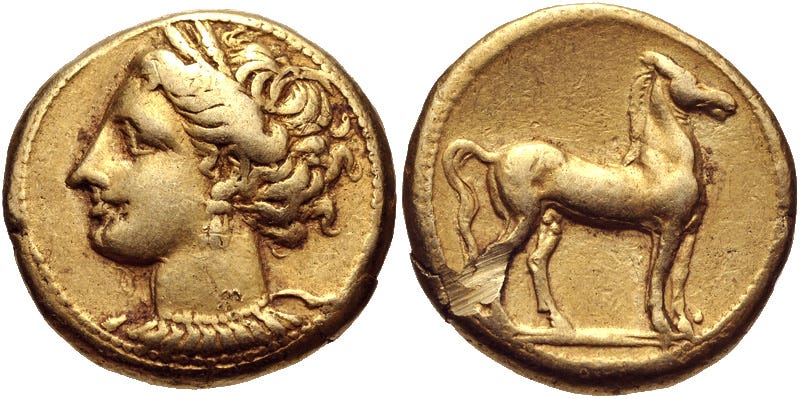
For Marx, commodity money was not merely a medium of circulation. Rather, it is the expression of socially necessary labor-time. In the Marxist view, money’s essential role is to serve as the “reification of universal labor-time” [5]. Since money serves as the reification of universal labor-time, it therefore serves as the only adequate form of exchange-value. Money is unique in the fact that it can measure the value of products precisely because it represents a purely quantitative measure—socially necessary labor-time—which is abstracted from all the qualitative aspects of the commodities and the concrete labor that produced them. Exchange-value is therefore quantitative and abstract, because it seeks a common measure for qualitatively completely different things.
For instance, the exchange-value implicit in “1 coat = 20 loaves of bread” finds its adequate form in “1 coat = 5 shekels” and “20 loaves = 5 shekels.” These 5 shekels materially represent the equivalent amount of abstract labor-time contained in both the coat and the bread. The shekel can serve this function because it, like all other commodities, possesses value, determined by the socially necessary labor-time required for its production—from mining and refining to minting. Marx explains this process:
“money does not serve as a circulating medium, as a mere transient agent in the interchange of products, but as the individual incarnation of social labour, as the independent form of existence of exchange-value, as the universal commodity.” [6]
With the passage of Executive Order 6102, the state supplanted commodity money—the universal equivalent for millennia—with its own non-convertible scrip, thereby replacing money itself and seizing the mantle of managing the national economy; for it now exclusively owns the very thing that capital requires to be set in motion, or as Marx explains:
“All new capital, to commence with, comes on the stage, that is, on the market, whether of commodities, labour, or money, even in our days, in the shape of money that by a definite process has to be transformed into capital.” [7]
However, this take over of the economy was something expected by Marx and Engels. In “Socialism: Utopia and Scientific”, Engels theorizes a highly advanced type of capitalism, described as the “national capitalist [8]” that continues the exploitation of the working class via wage slavery, directed not by private property owners but by the direction of the state. As we see, this process came to fruition via the removal of commodity money from circulation and set forward the devaluing of wages below their value through state policy to artificially raise the rate of surplus value. By raising the price of gold to $35 an ounce, the state had effectively devalued the value of labor-power by nearly half by devaluing the dollar.
For example, before Roosevelt’s action, the U.S. was on a gold standard where $20.67 was legally defined as the value of one troy ounce of gold. This means that $1 = 1/20.67 oz of gold, or approximately 0.0484 ounces of gold. Through the Gold Reserve Act of 1934, President Roosevelt changed this. He set a new official price: $35.00 for one troy ounce of gold. This meant that $1 was now redefined as 1/35 oz of gold, or approximately 0.0286 ounces of gold. This means that the government officially declared that a single dollar now represents 41% less gold than it did before. The dollar was literally made cheaper. In other words, the collective wages of the working class had been devalued by 41%~ overnight— this was a flat out major attack on our class.
Suppose a capitalist wanted to hire a worker for $4 a day (the general average in 1933). Previously, at $20.67 per ounce, that would have equaled around .193 ounces of gold ($4.00/$20.67). After the switch to $35 per ounce, that same $4 would now equal only .114 ounces of gold ($4.00/$35.00). Since this devaluation has occurred, a capitalist could now hire two workers for the price of about 1.5!
This represented a massive, state-engineered reduction in labor costs that directly boosted the rate of surplus value.
Marx had already explained why a change in the general price level (such as the devaluation of the dollar) has sharply different effects on constant capital and variable capital. In Capital Volume III, Chapter 1, he writes:
The difference between these various elements of the commodity-value, which together make up the cost-price, leaps to the eye whenever a change takes place in the size of the value of either the expended constant, or the expended variable, part of the capital. Let the price of the same means of production, or of the constant part of capital, rise from £400 to £600, or, conversely, let it fall to £200. In the first case it is not only the cost-price of the commodity which rises from £500 to 600c + 100v = £700, but also the value of the commodity which rises from £600 to 600c + 100v + 100s = £800. In the second case, it is not only the cost-price which falls from £500 to 200c+100v = £300, but also the value of the commodity which falls from £600 to 200c + 100v + 100s = £400. Since the expended constant capital transfers its own value to the product, the value of the product rises or falls with the absolute magnitude of that capital-value, other conditions remaining equal. Assume, on the other hand, that, other circumstances remaining unchanged, the price of the same amount of labour-power rises from £100 to £150, or, conversely, that it falls from £100 to £50. In the first case, the cost-price rises from £500 to 400c + 150v = £550, and falls in the second case from £500 to 400c + 50v = £450. But in either case the commodity-value remains unchanged = £600; one time it is 400c + 150v + 50s, and the other time, 400c + 50v + 150s. The advanced variable capital does not add its own value to the product. The place of its value is taken in the product rather by a new value created by labour. Therefore, a change in the absolute magnitude of the variable capital, so far as it expresses merely a change in the price of labour-power, does not in the least alter the absolute magnitude of the commodity-value, because it does not alter anything in the absolute magnitude of the new value created by living labour-power. Such a change rather affects only the relative proportion of the two component parts of the new value, of which one forms surplus-value and the other makes good the variable capital and therefore passes into the cost-price of the commodity. [9]
In plain terms, when the general price level rises (or the currency is devalued), the value of constant capital (raw materials, machinery, etc.) tends to increase because those inputs now cost more to replace. Variable capital (wages paid for labor-power), however, behaves differently. Since workers have no choice but to sell their labor-power daily simply to survive, a rise in prices can reduce the real purchasing power of wages, the actual “bundle of necessities” they can buy, without any change in the nominal wage. The new value created by living labor remains the same, but a larger share of it is now captured as surplus-value because the effective cost of reproducing labor-power has fallen. As Marx shows, the same amount of living labor still creates the same new value, but a larger portion of it becomes surplus-value for the capitalist. In contrast, changes in the cost of constant capital directly raise or lower both the cost-price and the total value of the commodity. The 1934 revaluation of gold from $20.67 to $35 per ounce was therefore a concealed mechanism that cheapened variable capital in real terms. It raised the rate of surplus-value and acted as a counteracting tendency to the falling rate of profit under conditions of absolute overaccumulation.
To prove mathematically how this raises the rate of surplus value (s’ = s / v, where s is surplus labor/surplus value and v is variable capital/labor power value paid), consider a simplified but rigorous model using Marx’s value categories and gold as the measure of value (the universal equivalent expressing socially necessary labor time).
Assume:
The value of labor power (v) is fixed in real terms before the revaluation: it costs the capitalist a certain quantity of gold to reproduce the worker’s labor power daily (food, shelter, etc., expressed in gold-equivalent SNLT).
Let v_gold = the gold-quantity required to buy labor power at value (pre-revaluation benchmark).
Pre-revaluation: nominal wage w_pre = $4 buys exactly v_gold ≈ 0.1935 oz (so w_pre in gold = v_gold).
Post-revaluation: the same nominal $4 now buys only 0.1143 oz of gold-equivalent value.
Thus, the real wage (in value terms) falls to w_post_gold = 0.1143 oz, while the physical/necessary reproduction requirements of labor power remain unchanged (v_gold still ≈ 0.1935 oz worth of commodities needed).
The capitalist still pays the nominal $4, but that $4 now commands only ~59.06% of its former gold/value equivalent (1/1.693 ≈ 0.5906, or a ~40.94% devaluation in purchasing power over gold/value). [10]
In the most fundamental terms, this intervention by the state definitively marked the early stages of breakdown of production based on exchange-value. The core presupposition of the system—that wages will be exchanged at their value—was decisively violated to resuscitate the process of capital accumulation.
In short, commodity money itself has become a fetter on the accumulation of capital.
The United States did not simply choose to leave the gold standard. In a more terrifying reality, the historical laws governing the capitalist mode of production forced the United States off the gold standard, independent of its policymakers’ will. The alternative is a catastrophic deflationary spiral and the total collapse of a profit-driven economy. One could say the system’s own logic acted as a blind, cybernetic intelligence. It “refined” its own operating parameters as the automatic subject, jettisoning the constraint of commodity money to adapt to the inexorable, growing demands of capital accumulation. The gold standard was, in essence, amputated by the system to ensure its own survival. The state had carried out the early stages of what Polish Marxist economist, Henryk Grossman, predicted in his text “Law of the Accumulation and Breakdown”, published just a few years before the great depression:
“Beyond a definite point of time the system cannot survive at the postulated rate of surplus value of 100 per cent. There is a growing shortage of surplus value and, under the given conditions, a continuous overaccumulation. The only alternative is to violate the conditions postulated. Wages have to be cut in order to push the rate of surplus value even higher. This cut in wages would not be a purely temporary phenomenon that vanishes once equilibrium is re-established; it will have to be continuous. After year 36 either wages have to be cut continually and periodically or a reserve army must come into being.” [11]
Grossman, using careful arithmetic, continues where Marx left off in Capital Volume III, Chapter 14 (“Counteracting Influences”), where Marx identifies one of the most pivotal counteracting tendencies to the falling rate of profit: “the depression of wages below the value of labour-power. [12]”
This is not a minor adjustment. It’s a structural necessity once accumulation reaches a point of over-accumulation and surplus value becomes insufficient to valorize the swollen mass of capital at the required rate. Under conditions of absolute over-accumulation of capital, the commodity labor power must be sold below its value in order for capital to realize a profit. In other words, the commodities consumed by the working class must be sold at a “markup” over the prices of production, which, per Marx, is a definite violation of the assumptions made by Marx so long as a commodity money standard is in place.
“Suppose then, that by some inexplicable privilege, the seller is enabled to sell his commodities above their value, what is worth 100 for 110, in which case the price is nominally raised 10%. The seller therefore pockets a surplus-value of 10. But after he has sold he becomes a buyer. A third owner of commodities comes to him now as seller, who in this capacity also enjoys the privilege of selling his commodities 10% too dear. Our friend gained 10 as a seller only to lose it again as a buyer. The net result is, that all owners of commodities sell their goods to one another at 10% above their value, which comes precisely to the same as if they sold them at their true value. Such a general and nominal rise of prices has the same effect as if the values had been expressed in weight of silver instead of in weight of gold. The nominal prices of commodities would rise, but the real relation between their values would remain unchanged. Let us make the opposite assumption, that the buyer has the privilege of purchasing commodities under their value. In this case it is no longer necessary to bear in mind that he in his turn will become a seller. He was so before he became buyer; he had already lost 10% in selling before he gained 10% as buyer. Everything is just as it was. The creation of surplus-value, and therefore the conversion of money into capital, can consequently be explained neither on the assumption that commodities are sold above their value, nor that they are bought below their value.” [13]
Here, Marx is debunking the vulgar, circulation based explanation that capitalists generate profit and surplus-value simply by marking up prices — i.e., selling commodities above their value (or buying them below value) in the market. This was a common idea at the time, and still is commonly held by leftist commentators (commonly suggesting that profits are capitalist greed rather than a historical product under specific conditions). Marx essentially gives five reasons as to why, under ordinary circumstances, cannot happen:
1. It cancels out completely. If every seller gets to sell 10% above value, then every buyer (who is also a seller in the circuit) pays 10% above value. The +10 gained as seller is lost as buyer. Net result for the whole class of commodity owners is ~zero. No extra value is created.
2. It doesn’t explain where the surplus comes from. Any “extra” money the capitalists pocket would have had to come from somewhere else in the system because it can’t be conjured out of thin air by price tricks. Circulation is a zero-sum game for value. What one gains, another loses. Surplus value, on the other hand, requires net creation of value and a material transformation of nature, not redistribution.
3. Most importantly, it contradicts the premise of equivalent exchange and the law of exchange-value. Marx’s whole analysis starts from the assumption that commodities exchange at their values (determined by socially necessary labor-time). If price markups were the source of profit, capitalism would rest on systematic “cheating” or unequal exchange, but then the law of value itself would collapse. Capitalism as a mode of production would collapse.
4. Capitalism is defined by valorization of value (M-C-M’): money advanced to produce more money via exploitation of wage-labor. If surplus-value came from circulation markups instead of production, then the circuit would no longer depend on the unique use-value of labor-power.
5. The drive to accumulate is undermined. Why invest in machinery, intensify labor, or expand markets if you can just markup prices forever?
This is precisely why the removal of commodity money (i.e., the gold standard) is so explosive.
Under commodity money, the law of value enforces itself with brutal mechanical necessity. Gold cannot be conjured from nothing, because its supply is constrained by the actual expenditure of abstract labor in mining, refining, and minting. Though, as a general rule, gold itself hardly circulated. Rather, the paper money or currency in circulation acted as a representation of gold. Currency in circulation was “insured” by a proportionate amount of gold in a central bank’s reserves, which prevented banks from arbitrarily creating money. Any attempt at a general markup, such as selling everything at 10% above value, collapses back into equivalence because the money commodity itself has value and cannot be inflated at will. The system self corrects because, despite nominal price increases, real value relations remain untouched. Prices are anchored to value because they fluctuate around the labor-time required to produce commodities, with gold serving as the objective measure. Per Marx, Gold serves this function because…
“Gold confronts the other commodities as money only because it previously confronted them as a commodity. Like all other commodities it also functioned as an equivalent, either as a single equivalent in isolated exchanges or as a particular equivalent alongside other commodity-equivalents. Gradually it began to serve as universal equivalent in narrower or wider fields. [14]”
Once the state supplants commodity money with its own inconvertible token, which is a scrap of paper whose “value” is decreed by sovereign command rather than socially necessary labor-time, the mechanical enforcer of equivalence disappears. The currency in circulation, now mostly created electronically via a keyboard, becomes a piece of debt issued by the government and banks. It is no longer a commodity money because it no longer has a cost of production, meaning money becomes purely debt. As MMT professor Larry Randall Wray explains, “use of currency and value of M are based on the power of the issuing authority, not on intrinsic value. [15]”
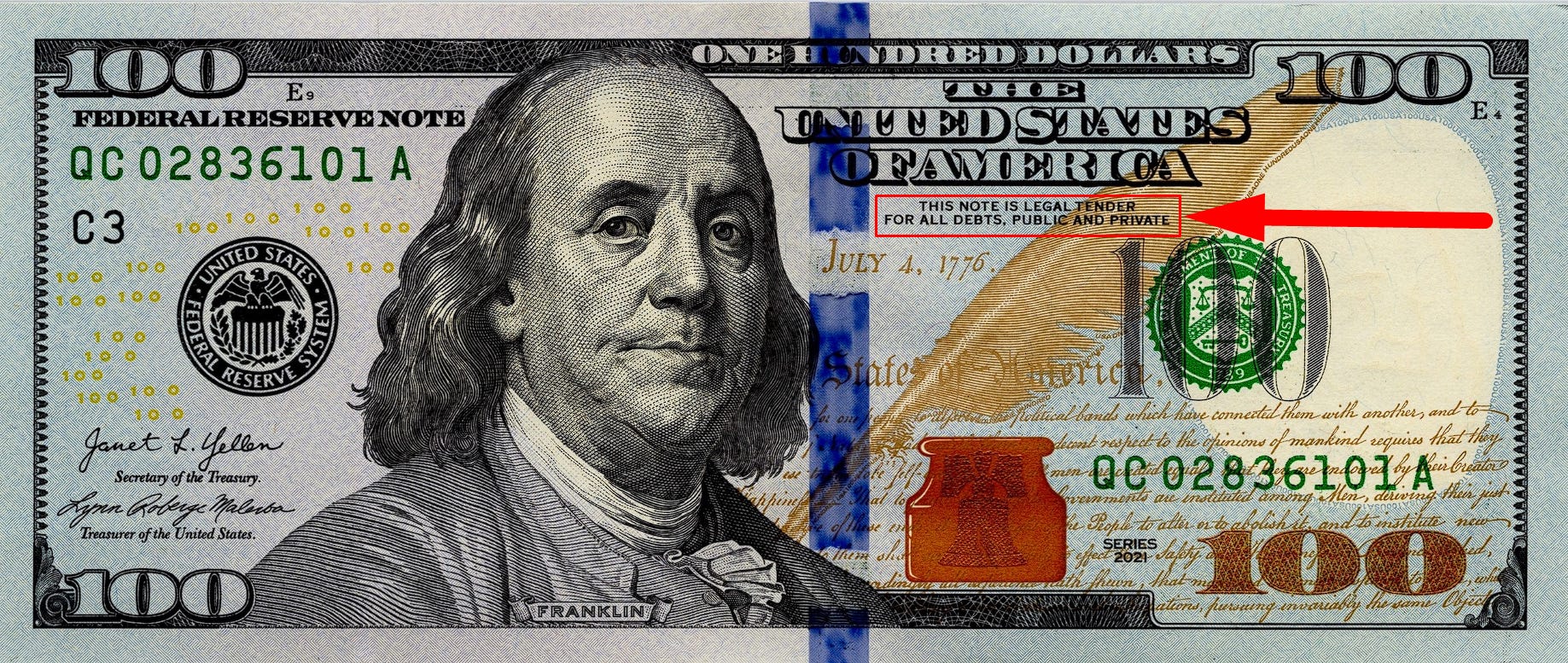
Though, labor-power is uniquely affected by this, because labor-power is sold by living human beings who have no other means of subsistence, and can be forced below its value continuously. A worker cannot declare bankruptcy and withdraw from the market because the result would be even more immiseration than what devaluing of currency already does. The obvious information from this fact can’t be ignored. Workers are being paid, in terms of exchange-value, nothing for their labor power, because the currency itself is no longer pegged to any definite quantity of commodity money (it floats). Yet, the exchange between employers and workers is still occurring, since workers are still dependent on the exchange so they can enter the market as consumers and provide themselves with articles required for reproduction. Moving forward, nominal wages do not directly amount to much besides the amount of paper you own, because the real power of your wage is actively being devalued against commodity money. Marx foresaw precisely this mechanism when he analyzed the consequences of inconvertible paper money that exceeds its proper limit:
“There would no longer be any standard. If the paper money exceed its proper limit, which is the amount in gold coins of the like denomination that can actually be current, it would, apart from the danger of falling into general disrepute, represent only that quantity of gold, which, in accordance with the laws of the circulation of commodities, is required, and is alone capable of being represented by paper. If the quantity of paper money issued be double what it ought to be, then, as a matter of fact, £1 would be the money-name not of 1/4 of an ounce, but of 1/8 of an ounce of gold. The effect would be the same as if an alteration had taken place in the function of gold as a standard of prices. Those values that were previously expressed by the price of £1 would now be expressed by the price of £2.” [16]
When the state over-issues fiat beyond the gold-equivalent that would circulate under commodity money rules, each unit of currency names less gold (less socially necessary labor-time) than before. The effect is identical to formally redefining the standard of prices against gold. Values previously expressed by $1 are now expressed by $2, $5, $10. Nominal wages can rise indefinitely while the real content of those wages (the quantity of gold-equivalent socially necessary labor-time they command) collapses.
To demonstrate this, let’s compare the minimum wage in 1964 to the minimum wage of today (2026).
The US federal minimum wage in 1964 was $1.25 per hour. The current federal minimum wage (as of 2026) is $7.25 per hour.
Average gold price in 1964: approximately $35.10–$35.35 per troy ounce (fixed under the Bretton Woods system at $35/oz official rate, thus market price hovered very close to this).
Current gold price (as of 03/18/2026): $4,874.30 per troy ounce.
We’ll calculate purchasing power in gold ounces per hour, meaning we are directly focusing on exchange-value against the historical money commodity.
1964 minimum wage: $1.25 per hour ÷ $35.10/oz ≈ 0.03561 ounces of gold per hour
Current minimum wage: $7.25 per hour ÷ $4,874.30/oz ≈ 0.001487 ounces of gold per hour.
Ratio (1964 vs. 2026): 0.03561 / 0.001487 ≈ 23.95 times more gold-buying power in 1964
(Exact: 0.035610 / 0.001487 ≈ 23.95)
Percentage decline: The real (gold-denominated) minimum wage has fallen by ~95.8% since 1964 (1 - 0.001487 / 0.035610 ≈ 0.958 or 95.8% drop).
To match 1964 purchasing power today: The federal minimum wage would need to be ~$175.40 per hour in 2026 dollars. (0.03561 oz/hr × $4,874.30/oz ≈ $173.60–$175.40/hr depending on rounding)
In nominal dollars, the minimum wage rose ~5.8× ($1.25 → $7.25), but in gold terms (a proxy for real exchange-value against the historical money commodity), it collapsed by nearly 96%. By replacing commodity money with an inconvertible fiat, prices (nominal dollar amounts) and purchasing power (real exchange-value) decouple dramatically. Labor-power and workers can see their nominal price rise steadily, while their real purchasing power, in exchange-value terms, collapses.
The left will continue to argue that we must fight for higher wages, despite the fact that higher wages are nominally possible under the fascist state, since the state can devalue them at will. The leftist cope that we face wage stagnation is a complete myth. The reality is far more alarming: wages have collapsed.
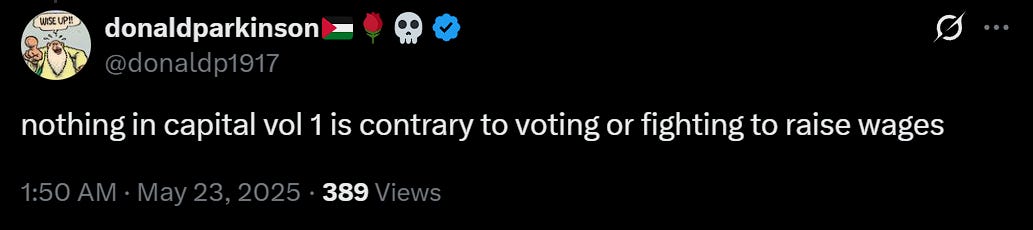
The fascist state (the national capitalist in its mature form per Engels) can raise nominal wages at will, which it does, in fits and starts, through minimum-wage hikes, “living wage” campaigns, union deals, or electoral bribery, because it can devalue the currency at will. The DSA (Democratic Socialists of America), PSL (Party for Socialism and Liberation), and CPUSA (Communist Party USA) position themselves as radical or revolutionary organizations, but their core economic demands, such as higher minimum wages, Medicare for All/single-payer healthcare, living wages, job guarantees, and expanded social programs, are outmoded and even counterproductive in the barbaric phase of capitalism that emerged after the 1930s gold seizure and was sealed by the 1971 Nixon shock. These demands assume a monetary regime still regulated by commodity money, where nominal wage increases translate into real gains in purchasing power and value. It is why these parties all default away from revolutionary theory and tactics and into open support to fascists like Zohran, lying to us all and claiming that “Zohran shifts the overtone window” towards more “progressive” politics. Yet as we have seen, this so-called “progressivism” runs counter for the underlying fact that our wages are being destroyed by the state. Even if DSA/PSL/ CPUSA “won” $25–$30 /hour nationally, fiat devaluation would erode it almost immediately — just as $7.25 today buys ~4% of what $1.25 did in 1964 gold terms, but these social fascists will never recognize this fact. Most importantly, these demands, according to Lenin “try to divide and deceive the workers, to divert them from the class struggle by petty concessions [18]”. These demands exist to run cover for the barbaric state by pushing nominal reforms that stabilize the system by channeling discontent into winnable-but-meaningless gains. These demands exist to hide the underlying power that the state has over workers. These demands exist to conceal the fact that the left completely lacks revolutionary theory and therefore has no chance at a revolutionary movement!
Frankly, the fascists in D.C. laugh at the left. These mother fuckers really think they have the empire out flanked by “hitting the streets” to chant for higher taxes and more valueless tokens.
Even as disgusting, and a more recent development, we have leftists openly coming to the defense of fired federal “workers”— the pencil pushing bureaucrats who have managed the very system that has made the majority of people in this country's lives worse.

Does the left not know that with the introduction of a valueless debt based currency, the state can now debase the currency systematically by expanding credit, expanding money supply, target inflation, manipulate interest rates, run perpetual deficits, and dramatically increase superfluous labor time, typically in the form of federal employment?
In the era of absolute overaccumulation, when capital has swollen beyond the mass of surplus-value that can be extracted at the required rate, the breakdown of production based on exchange-value does not trigger immediate collapse. Instead, the state, as national capitalist, absorbs and manages the excess through deficit spending and debt issuance, turning what would otherwise be idle capital into the ongoing reproduction of the system. Countries, out of pure necessity, “lend” their excess to the United States and, in return, receive U.S. debt. This excess is lent because, under ordinary circumstances, it cannot find productive investment for surplus-value production. The result is a mass of idle capital and, by extension, a deflationary pressure that capital must constantly attend to in order to avoid falling prices.
According to Marx, profit falls sharply (deflation) under conditions of absolute over-accumulation because existing capital stock cannot be valorized at the required rate of profit. Production is over-accumulated relative to effective demand:
“It is evident, however, that this actual depreciation of the old capital could not occur without a struggle, and that the additional capital ΔC could not assume the functions of capital without a struggle. The rate of profit would not fall under the effect of competition due to over-production of capital. It would rather be the reverse; it would be the competitive struggle which would begin because the fallen rate of profit and over-production of capital originate from the same conditions. The part of ΔC in the hands of old functioning capitalists would be allowed to remain more or less idle to prevent a depreciation of their own original capital and not to narrow its place in the field of production. Or they would employ it, even at a momentary loss, to shift the need of keeping additional capital idle on newcomers and on their competitors in general.” [20]
To understand how the fascist regime offsets this, let’s think of it in terms of Georges Bataille:
“I will begin with a basic fact: The living organism, in a situation determined by the play of energy on the surface of the globe, ordinarily receives more energy than is necessary for maintaining life; the excess energy (wealth) can be used for the growth of a system (e.g., an organism); if the system can no longer grow, or if the excess cannot be completely absorbed in its growth, it must necessarily be lost without profit; it must be spent, willingly or not, gloriously or catastrophically.” [21]
Capitalism, in its drive for accumulation, constantly produces excess energy (overaccumulation), that it cannot productively absorb. Unlike archaic societies that expended surplus through festival, sacrifice, or luxury, capitalism tries to reinvest it endlessly in growth, but this growth has limits. When those limits are reached, the surplus can no longer be contained productively, thus it must be expended non-productively through crisis, war, financial bubbles, ecological breakdown, and state-managed waste. Bataille would argue that the capitalist crisis is the catastrophic release of this valve. The state becomes the central mechanism for managing this waste by channeling excess into military destruction, administrative bloat, debt-financed make-work, and fictitious valorization. Yet, if this waste is, in a sense, a cosmic reality—governed by the laws of thermodynamics and the inescapable production of surplus energy—then it could be channeled into excess creativity: free disposable time for individual and social development!
As we know, though, the state has been able to forcefully keep capitalism afloat, because excess capital itself is used to expand the state. The state artificially inserts itself into the economy not as a neutral regulator or occasional stabilizer, but as the active, structural driver of what passes for “growth” once private capital accumulation hits its historical limit. Chronic deficits are the primary fuel that enables and accelerates state growth because they are the mechanism through which the state continuously expands its command over labor, capital, and resources without being constrained by tax revenue, private profitability, or commodity-money discipline.
This spending often takes the form of:
Direct federal employment (military, bureaucracy, civil service).
Contracts to private firms (defense, infrastructure, R&D, subsidies).
Transfer payments (social security, welfare, unemployment).
Grants/loans to states, universities, NGOs, corporations.
Direct lending through GSEs.
Media and cultural subsidies.
The Federal Reserve and other credit facilities.
In essence, a growing portion of society’s labor—when viewed from the perspective of social need and value creation—becomes superfluous; that is, it is no longer necessary for the production of surplus value, yet it continues to be expended under capitalism. The labor itself does not directly produce surplus value or valorize capital, but persists because the social relations of capitalism remain temporal—they are still organized around abstract labor time as the substance of value, even though labor itself is increasingly less a source of real material wealth. The material basis of wealth has shifted dramatically toward objectified, dead labor (machines, automation, science, general intellect), while the social form of capitalism (value as objectified labor time) continues to dominate and structure society as if nothing had changed. The result is a society that is hollowed out, rich in productive power and technological potential, yet increasingly empty of human meaning, purpose, and freedom because it is still forced to measure, organize, and valorize everything through the diminishing metric of living labor time.
Capitalism develops the productive forces to the point where immediate living labor (which is the direct, muscular, attentive expenditure of human effort in the production process) itself ceases to be the great well-spring of wealth. In other words, once labor itself is eclipsed by the “general intellect [22]”, production based on exchange-value must necessarily break down, because labor itself ceases to be the primary source of real material wealth.
As Marx writes in the Grundrisse:
“As soon as labour in the direct form has ceased to be the great well-spring of wealth, labour time ceases and must cease to be its measure, and hence exchange-value [must cease to be the measure] of use value. The surplus labour of the mass has ceased to be the condition for the development of general wealth, just as the non-labour of the few, for the development of the general powers of the human head. With that, production based on exchange-value breaks down, and the direct, material production process is stripped of the form of penury and antithesis.” [23]
Sadly, this eclipse of immediate living labor by the general intellect did not lead to the liberation of humanity from toil. Instead, the state intervened and evolved to resolve this contradiction in the only way still possible under capitalism, as a matter of “life or death” for the capital relation itself, by enabling and monetizing a mass of superfluous labor time.
Marx already foresaw this exact dynamic in the Grundrisse:
“Capital itself is the moving contradiction, [in] that it presses to reduce labour time to a minimum, while it posits labour time, on the other side, as sole measure and source of wealth. Hence it diminishes labour time in the necessary form so as to increase it in the superfluous form; hence posits the superfluous in growing measure as a condition — question of life or death — for the necessary.” [24]
Superfluous labor time, once exchange-value breaks down, becomes the new dominant temporal form of the entire barbaric phase of capitalism. It becomes the material expression of a society that has outgrown the need for mass human labor in production yet is compelled to keep expending it on pain of systemic collapse.
Though to understand it fully, we need to distinguish three interlocking historical categories of labor time that Marx implicitly traces:
1. Necessary labor time: The socially necessary labor time required to reproduce the worker’s labor-power (subsistence goods, historically determined needs). This is paid as variable capital (v) in the form of wages.
2. Surplus labor time: The excess labor time beyond necessary labor, which produces surplus-value (s) — the driving aim of capitalist production. This is the classical exploitation relation: the worker labors longer than needed to reproduce herself, and the capitalist appropriates the difference. The worker produces more value than that his labor itself is worth in terms of socially necessary labor time.
3. Superfluous labor time: The third, historically new category that only emerges when the productive forces have advanced to the point where direct human labor time is no longer the decisive source of material wealth. This is labor that is superfluous both to the reproduction of wealth, yet is enforced because the capital relation still requires that labor time remain the measure and condition of valorization.
Fiat comes into play in the age of breakdown of production based on exchange-value because commodity money is structurally constrained to only the first two categories of labor time, necessary labor time and surplus labor time, and cannot systematically sustain the third category, superfluous labor time, at scale. Only fiat money, aka, an inconvertible state-issued currency with no labor-value anchor, can make superfluous labor time a dominant, structural, and permanent feature of the mode of production, because it allows for the great expansion of credit is the central mechanism that enables and sustains this dominance. GDP disguises superfluous labor time by counting nominal spending as economic output, regardless of whether that spending corresponds to the creation of value, surplus-value, or even material wealth.
The Agricultural Adjustment Act (AAA) of 1933 serves as the paradigmatic, concrete historical example of how fiat money structurally enables and institutionalizes superfluous labor time once production based on exchange-value breaks, which occurs during the Great Depression. Before the passage of AAA, agricultural overproduction, due to technological/productivity advances, like the widespread introduction of the gasoline powered tractor, meant huge portions of farm labor time were superfluous because crops produced exceeded what the market (exchange-value) could absorb at prices covering costs + profit. In other words, as comrade Jehu explains:
“The labor is physically performed, but it produces no value in a Marxian sense because there is no buyer willing to exchange money for the excess commodity. This superfluous labor is wasted from the standpoint of value production, yet it still lingers in the system, and threatens the existence of the mode of production.” [25]
As historian Jean Edward Smith points out, not only did this occur, but the consequences were dire:
“Gross farm income had declined from $12 billion in 1929 to $5 billion in 1932. At the same time, agricultural surpluses—crops and livestock that farmers could not sell— rotted on farms or were plowed under. Wheat for December delivery dropped to twenty-three cents a bushel, the lowest since the reign of Queen Elizabeth I three hundred years earlier. In Iowa, a bushel of corn was worth less than a package of chewing gum. In the South, thousands of acres of fine, long-staple cotton stood in the field unpicked, the cost of ginning exceeding any possible return.” [26]
As a result, more than 10 million acres of already-planted cotton were removed from production (plowed under/destroyed), which meant labor time had already been expended to plant and grow the crop, but the output was superfluous (excess beyond what the market could absorb at profitable prices). For this reason, prices and income rose:
“Through the removal of more than 10,000,000 acres from production, the crop was reduced by about 4,000,000 bales. This reduction caused the price of American cotton to be materially higher than it otherwise would have been and substantially increased the total income received by cotton farmers, despite the smaller quantity of cotton they had to market.” [27]
Not only did farming notice a sharp decline in prices and profits, but so did cattle:
“Heavy cattle slaughter and supplies of beef available for consumption have been coming at a time when consumer purchasing power is still at a low level. As a result, the average price of cattle slaughtered under inspection from January to September 1933 was $4.27 per hundredweight, compared with $5.16 for the corresponding months in 1932 and with $6.48 in that period in 1931.” [28]
Thus, the government stepped in, bought and slaughtered 6.4 million pigs and sows that were already produced/raised. This was emergency action because hog prices had collapsed so low that farmers could not sell at a profit.
“The first step toward alleviating the immediate price situation was the emergency purchase of approximately 6,400,000 pigs and sows to effect prompt reduction in hog supplies. This emergency program reduced supplies of hogs for the 1933-34 season by from 1,000,000,000 to 1,200,000,000 pounds, an amount equivalent to about 10 percent of the annual federally inspected slaughter. It was a boon to corn and hog farmers, particularly in drought areas, because it returned on the sale of the pigs and sows at least $10,000,000 more than otherwise would have been obtained from sale at prevailing prices. It also meant that the gross return from the hog crop from which reduction was made eventually could amount to as much as $100,000,000 more than would otherwise have been obtained, and it provided a large quantity of cured hog products for distribution to unemployed families.” [29]
Other commodities would meet the same fate. As a result, the Agricultural Adjustment Act identified a host of commodities that would qualify for subsidies—hogs and cotton being major ones, as we already discussed—along with milk, rice, tobacco, corn, and wheat. These particular commodities were being overproduced and were exceeding demand in terms of exchange-value. Therefore, the government had to step in and effectively monetize superfluous labor time by converting this excess surplus into something that could be exchanged for money. Although the commodities had no demand, they were still assigned a price and purchased with debt by the government. In doing so, the government found a way to inject fiat currency into the system, offset the consequences of overproduction, and counter the tendency for the rate of profit to fall.
This logic does not stop at agriculture.
The state generalizes the same logic across the entire economy, transforming the reserve army of labor itself into a permanent, subsidized sink for superfluous labor time. The reserve army of labor—the mass of unemployed and underemployed workers that Marx identified as a structural necessity of capitalism—is supposed to serve two functions: exert downward pressure on wages and provide a flexible pool of labor for capital to draw on during expansion. However, once exchange-value no longer regulates production effectively and direct living labor is eclipsed by general intellect, the reserve army no longer functions as a mere “reserve.” It becomes excess population, superfluous to capital’s valorization needs on a chronic, systemic basis.
This excess becomes absolute.
As the working day becomes “hollowed out” and a growing population becomes more and more superfluous as workers, they themselves as people also become superfluous. The human being as a worker becomes more and more vestigial. Once the worker becomes vestigial in the circuit of valorization, the human biomass is revealed as redundant overhead, not merely economically redundant, but also ontologically redundant— a surplus of meat that the machine process no longer requires to reproduce its own conditions. The reserve army is not held in waiting, rather, it is held in abeyance. The state, now fused with finance capital as the terminal organ of the system, pumps fiat into the void to keep the bodies breathing, moving, consuming just enough to prevent the circuit from flatlining. If they had it their way, just as machines live solely on electricity, they would, as Marx suggests, maximize profits by making humans “live on air… [30]”
Finance capital accelerates the write-down. It strips real industrial output—living factories, living labor, living value, and reroutes the flows into pure liquidity games, rent-extraction loops, and asset price inflation. The physical plant rots or stands idle while the ledger grows tumors of fictitious capital. Real output is sacrificed to maintain nominal valuations. The human being, once the source of surplus value, is now the sink for surplus liquidity. A costly legacy system kept online at ever-lower utilization rates. The state becomes the department of legacy maintenance, by paying pensions to ghosts, wages to shadows, benefits to redundancies, all while the general intellect quietly deletes the need for bodies altogether. We could all be collectively working less, but they have us working for profits. We could all be living in abundance made possible by the general intellect, but they have us trapped in scarcity enforced by superfluous labor time.
Conclusion
Capital has already made its choice, and it chose itself. The barbaric phase is the stable, institutionalized form of capitalism once exchange-value loses its regulatory power and the general intellect eclipses immediate living labor.
Ninety years ago, the historical laws of the mode of production forced the amputation of commodity money, the continuous devaluation of labor-power below its value, and the institutionalization of superfluous labor time as the condition for continued valorization.
The state, as national capitalist, became the terminal organ by absorbing excess capital, monetizing superfluity, subsidizing the absolute reserve army, and managing the slow depreciation of humanity.
The question is no longer socialism or barbarism.
Barbarism has already won.
With the historical developments laid out above, I urge all Communists to urgently reorient our entire strategy. The development of the capitalist mode of production has dramatically simplified the central problem facing the working class. It has done so by violently socializing world capital as a whole under the command of Washington D.C. and the almighty dollar. In this new barbaric phase, the fascist state stands as the concentrated expression of capital’s terminal power. Any and all forces that position themselves against the United States government must therefore unite. Communists must adopt the principle of full spectrum RESISTANCE and direct it ruthlessly against the fascist state itself. There can be no half-measures, no scattered reformist campaigns, and no illusions about “progressive” pressure within the system.
The enemy is centralized, global, and total.
Our response must be the same.
References
[1] Jehu, Society chose Barbarism and it has its own peculiar political economy, The Real Movement
[2] [3] Federal Reserve, history
[4] David Graeber, Debt: The First 5,000 Years.
[5] [6] [7] [13] [14] [16] Karl Marx, Capital, Volume I.
[8] Friedrich Engels, Socialism: Utopian and Scientific.
[10] My Mathematical Proof of the Rise in the Rate of Surplus Value (s’):
Pre-revaluation equilibrium (wages at value):
v_paid = v ≈ 0.193517 oz
s = v (s’ = 100%) ≈ 0.193517 oz
Total value product = v + s ≈ 0.387034 oz
s’ = s / v = 100%
Post-revaluation (wages forced below value):
Devaluation factor d = 20.67 / 35 ≈ 0.590571
v_paid = d × v ≈ 0.590571 × 0.193517 ≈ 0.114286 oz
s_new = total value product − v_paid ≈ 0.387034 − 0.114286 ≈ 0.272748 oz
s’_new = s_new / v_paid ≈ 0.272748 / 0.114286 ≈ 2.3866 or 238.66%
Closed-form:
s’_new = [original s’ + (1 − d)] / d
With original s’ = 1 and d ≈ 0.590571:
s’_new = [1 + (1 − 0.590571)] / 0.590571 = 1.409429 / 0.590571 ≈ 2.3866 (238.66%)
Conclusion:
The rate of surplus value rises from 100% to ~239% through monetary devaluation alone. No change in working day length, labor intensity, or productivity. This demonstrates the state imposed super exploitation mechanism that sustains accumulation once the breakdown of exchange-value production occurs.
[11] Henryk Grossman, The Law of Accumulation and Breakdown.
[9] [12] [20] [30] Karl Marx, Capital, Volume III.
[15] Larry Randall Wray, Deficit Owls, MMT: What Is Money And What Gives It Value?
[17] Donald Parkinson, x.com
[18] Vladimir Lenin, Marxism and Reformism
[19] Party for Socialism and Liberation, x.com
[21] Georges Bataille, The Accursed Share, Volume 1
[22] [23] [24] Karl Marx, Grundrisse
(22) By “general intellect”, Marx refers to the socially accumulated knowledge, science, technology, and collective intelligence of humanity that becomes objectified in the productive forces and increasingly functions as a direct force of production, independent of, and overshadowing, the immediate, living labor of individual workers. This knowledge is general because it is social rather than a private skill of one worker, but the shared, historical achievement of humanity. With this, Marx theorizes that “the human being comes to relate more as watchman and regulator to the production process itself.”
[25] Jehu, rethinking Inflation: A Marxian Perspective on Overproduction and Superfluous Labor, substack
[26] Jean Edward Smith, FDR
[27] [28] [29] United States Department Of Agriculture, Agricultural Adjustment, A report of administration of the agricultural adjustment act May 1933 to February 1934.
Articulates Jehu’s arguments more clearly than Jehu usually manages.