
Marine Corps Maoism
How "Maoist" Military Doctrine Would Influence the USMC

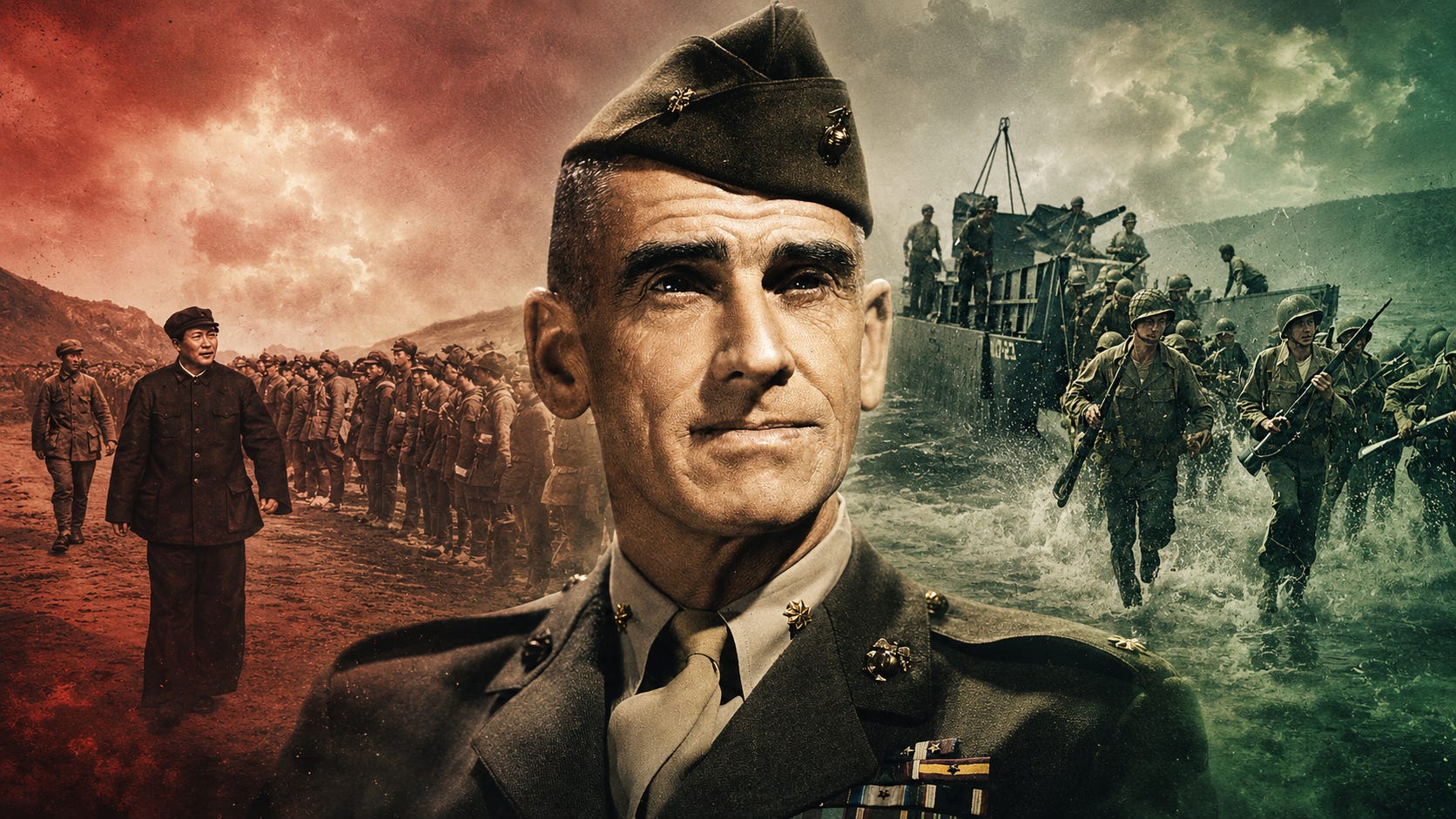
Introduction: The Relevance of Small-Unit Tactics and Early-PLA Military Doctrine
On today’s drone-dominated battlefield, one thing has become self-evident for those who watch warfare closely: the infantryman, driven by his own two legs, representing the culmination of war’s entire history, is the loneliest he has ever been. The proliferation of drone technology as part of a revolution in ISR has rendered large groupings of infantrymen evermore superfluous, with frontlines degraded into gray zones, ensuring that small-unit tactics have become doctrinal gospel for tomorrow’s warfighter.
Long before this necessity of small-unit tactics in an era dominated by open, large-scale maneuvers, and long before the era of warfare being a constant stream of men slaughtered under the eyes of cameras suspended by plastic wings and high-speed propellers, one U.S. Marine in the midst of the Second-Sino Japanese War, would walk thousands of miles embedded with communists that would one day sweep through and unify China and return with a revolution in warfare. That man was Evans F. Carlson.
So what does the Marine Corps have to do with China? When one imagines the USMC, one imagines the expeditionary soldier fighting on foreign land—from the “halls of Montezuma to the shores of Tripoli,” black sand beaches of Iwo Jima, tropical jungles of Vietnam, and desert sands of Iraq and Afghanistan: the harbinger of US imperialism, sent from shore to shore to wreak havoc on the enemies of the United States.
This image stands in stark contrast to the image of the traditional PLA: an army of light infantrymen, wearing green sneakers, propelled by foot, and fed by grain, fighting over land to wage revolution. Though stark these images may be, one fact remains, though shrouded in esoterica: the tactical influence of the early People’s Liberation Army over the United States Marine Corps and the US military.
This may come as a surprise to some readers, since the common perception of Asiatic enemies is often seen through the lens of poorly trained and zealously suicidal soldiers who use their raw mass in numbers in human wave attacks as a means to overcome barriers in technology and combat power. After all, how could an inferior enemy be the ones to teach their superiors?
Logically, it doesn’t add up. But the notion of general inferiority is a disservice to men of both sides of wars fought between Asian armies and their Western enemies (e.g., Korea and Vietnam), born of falsehood. By depicting these wars as simplistic cowboys-and-Indians-esque campaigns, one undermines the complexity of success and disrespects the sacrifices made by both sides in battle.
Casualties are primarily determined by firepower disparity, and “winning” is relative to that disparity. For instance, during the Korean War, when the PVA first counterattacked in the Second Phase Offensive and sent the US into its longest retreat in history, despite taking considerably more casualties, at a relative scale, the fact a force comprised almost entirely of leg infantry, lacking artillery and air support was able to route a mechanized force with those very assets speaks to the validity of doctrine developed by those inferiors disadvantaged in armor, artillery, and aircraft.
What’s more, the fact that these doctrines were absorbed into the entirety of the Marine Corps by the end of the island-hopping campaign at the end of the Pacific War speaks to the validity of Chinese military thinking through the evolution of Small-unit tactics in the USMC.
As this article will demonstrate, Major Evans F. Carlson’s 1937–1938 embedment with Communist Chinese forces and tactics (as formulated by Lin Biao) would provide the genesis for a reshaping of American infantry doctrine, challenge entrenched rank-and-officer hierarchies, and prove effective across the Pacific Theater.
Part Two: Who is Evans F. Carlson?
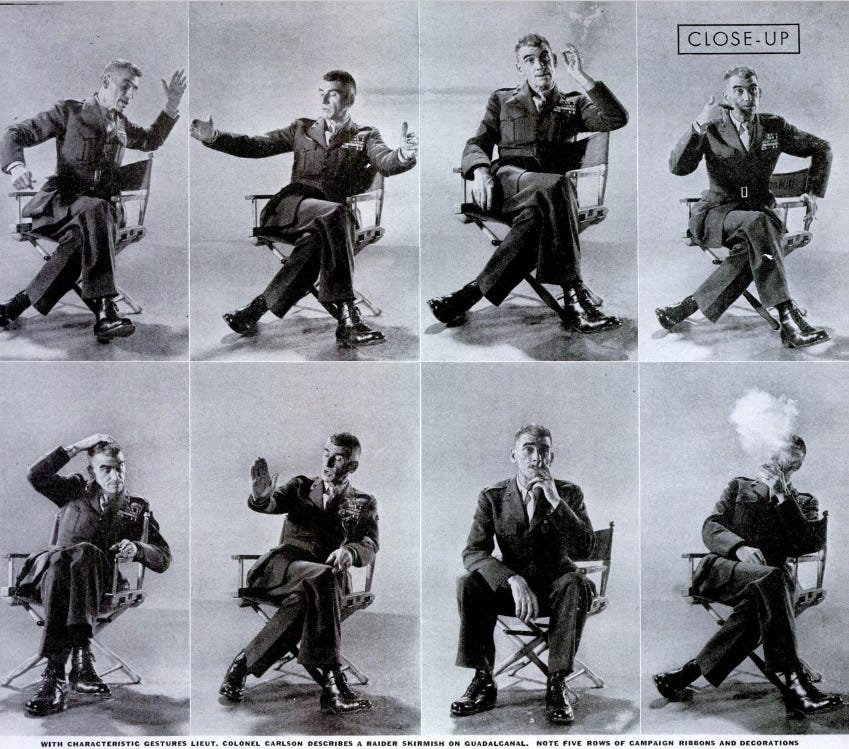
Born on February 26, 1896, in Sidney, New York, Evans F. Carlson was the son of a Congregationalist minister. He spent his formative years in Vermont before enlisting in the army at the age of 16, lying about his age. His first enlistment took him to the Philippines and Hawaii, where he rose to the rank of First Sergeant.
He re-enlisted in 1916 to participate in the Pancho Villa punitive expedition and engaged in combat in France during World War I, receiving a wound badge for his service. In May 1917, he was commissioned as a second lieutenant. After five years in the army, ending his service as a commissioned officer, Carlson re-enlisted in the U.S. Marine Corps in 1922, this time as a private first class.
He earned his commission as a Marine second lieutenant in 1923 and took shore duty in Shanghai and Puerto Rico, alongside participation in the U.S. Marine Corps occupation of Nicaragua. Here, Carlson saw guerrilla tactics in display for the first time—the tendency of native “bandits” he was fighting against to travel during the night and ambush during the day. Learning of their tactics after a “few brushes with them he improved on their methods and not only traveled at night but ambushed at night, where, “Leading a detachment of 15 Marines on horseback,“ he would rout “100 Nicaraguans,” for which he would be awarded the Navy Cross. (1943 LIFE MAGAZINE: CARLSON OF THE RAIDERS—A student of Chinese Guerrilla Fighting Teaches his Men How to Fight and What they Fight For by Don Burke)
Subsequently, Carlson established relationships with the Roosevelt family and studied international law and politics at George Washington University in Washington, D.C., which would facilitate his future military experiments.
Of particular importance to this story, in 1927, Carlson and his unit shipped to China to protect American interests:
“For much of their time, they did little besides parading and standing by. Carlson received a promotion to first lieutenant and was appointed as a regimental intelligence officer. He worked closely with Naval Intelligence officers to learn about China. The most influential of which was Admiral Bristol, whose ideas of racial equality and demand for the truth would leave a lasting impact on Carlson (Blankfort, 1947). Additionally, while an intelligence officer, Carlson published articles designed to educate his men on the history and current political situation in China. These articles were so popular, his men and fellow officers asked for more when Carlson finished his initial four articles (Blankfort, 1947).” (Gung Ho, Marine! Servant Leadership, Evans Carlson, and the 2nd Marine Raider Battalion)
This interest in China would lead Carlson to pursue a second and third tour in China with the Fourth Marines in Beijing, studying Chinese and eventually being among the first foreign military officers embedded with Mao Zedong’s Eighth Route Army. His path to Yan’an began unexpectedly:
“One day in September 1937, Edgar Snow returned to Shanghai after a secret visit to Yan’an and encountered Carlson, who was investigating the Battle of Shanghai. Carlson snatched the first draft of Red Star Over China, deeply moved by its contents, and conceived the idea of going to Yan’an.” (在这里我看到了中国的希望)
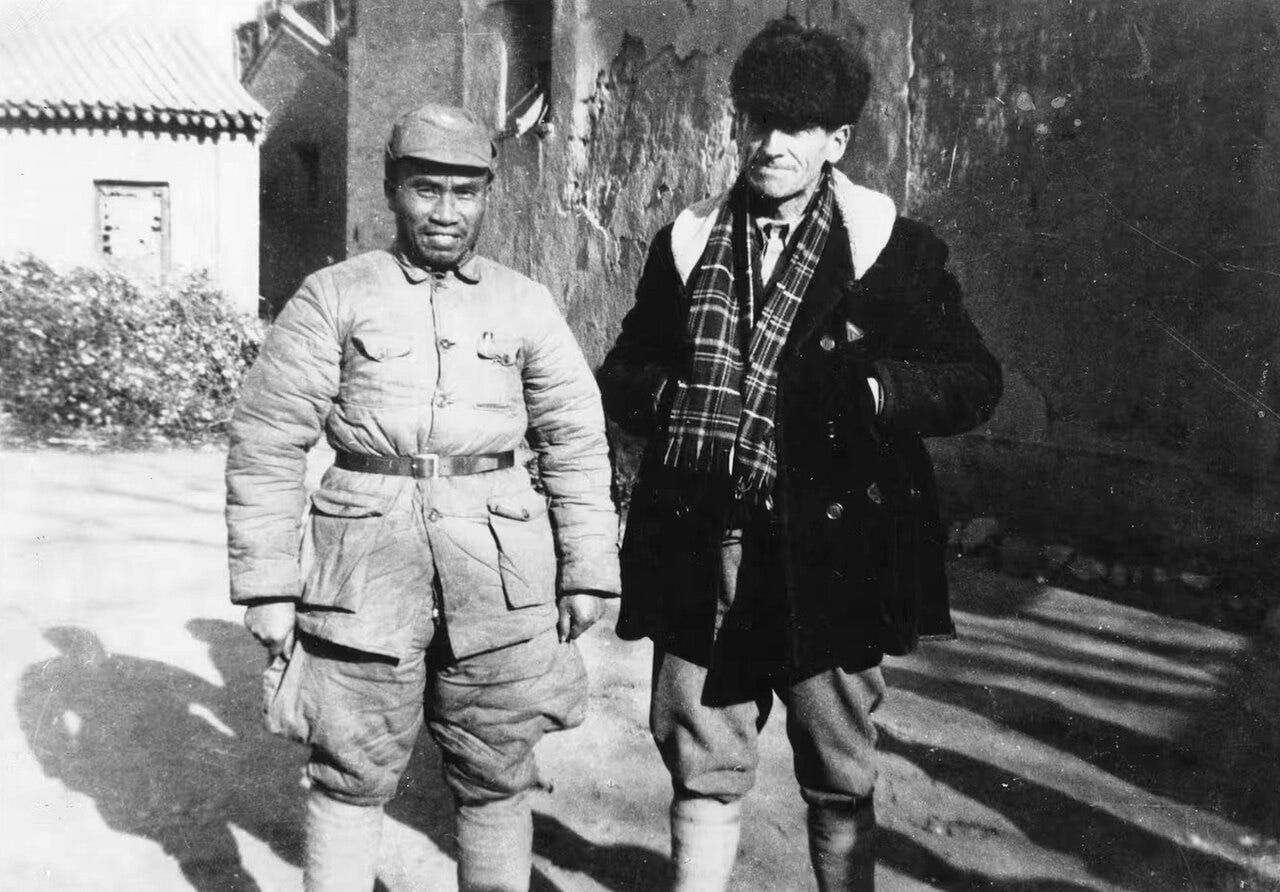
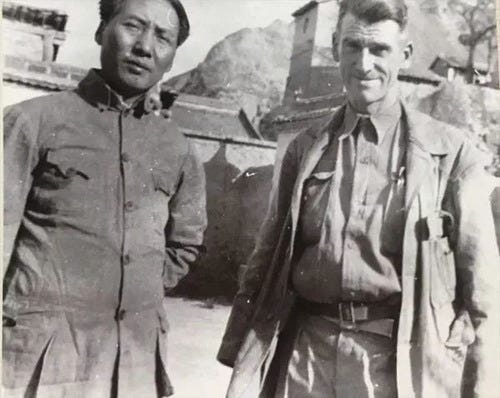
Later, Carlson went to the Eighth Route Army headquarters in Shanxi, where he had in-depth conversations with the Commander-in-Chief, Zhu De, and established a close relationship. Unlike ordinary journalists, Carlson paid particular attention to how the Communist Party commanded and trained its troops, living, marching, and fighting alongside the Eighth Route Army soldiers as an observer to learn from them. (Blankfort, 1947)
During this time, he discovered the allure of guerrilla tactics—of using mastery of terrain, concealment, ethos, people, and dispersion to attrit adversaries. As one article from the Ministry of Foreign Affairs of the People’s Republic of China recounts:
“During this time, he discovered and deeply appreciated the allure of guerrilla tactics characterized by dispersion and concealment… Carlson followed the guerrillas through the mountains and valleys of western China, relying on intelligence from the local people to flexibly maneuver against the Japanese invaders. On one occasion, the Japanese army sent a 700-man special task force to secretly infiltrate the anti-Japanese base area. The Eighth Route Army squad followed them until they entered a valley. Utilizing the favorable terrain, the Eighth Route Army sent 500 men to ambush the Japanese. After a day and a night of fierce fighting, the Japanese fled in panic, leaving behind 90 corpses, while the Eighth Route Army suffered no casualties.” (在这里我看到了中国的希望)
He would come to understand the importance of political work for the soldiers of the Eighth Route Army, a concept he later referred to as “ethical indoctrination.” Here, an anecdote about a guerrilla soldier’s capacity for marching highlights the significance of a strong ethos as follows:
“On one occasion, Carlson accompanied a small detachment on a mission to intercept Japanese troops. The unit carried 32 pounds of equipment and marched over 90 kilometers at night, facing considerable intensity. After a grueling 32 hours, they finally reached their destination and successfully completed their mission. Carlson, relying on his professional training from the U.S. Marine Corps, struggled to keep up, while the soldiers of the Eighth Route Army, despite their exhaustion, maintained their pace without faltering. Deeply impressed, Carlson asked one of the soldiers, ‘How do you manage not to fall behind?’ The young soldier replied, ‘If a person only has two legs, he will fall behind. But besides two legs, I also have a mind. I understand the significance of the War of Resistance against Japan, and I know what this operation means for the entire battle.’” (在这里我看到了中国的希望)
In the Eighth Route Army, the rigid caste system that defined almost all other conventional armies between officers and soldiers was reduced to the mutuality of respect between “cadres and soldiers,” based on the life and death reliance soldiers and leaders had on each other. Before each battle, the troops would hold meetings to discuss the purpose and nature of the military operation, the tasks assigned to each person, and potential problems. After each battle, they would analyze the reasons for victory or defeat and their relationship to the overall goal of the War of Resistance. (在这里我看到了中国的希望)
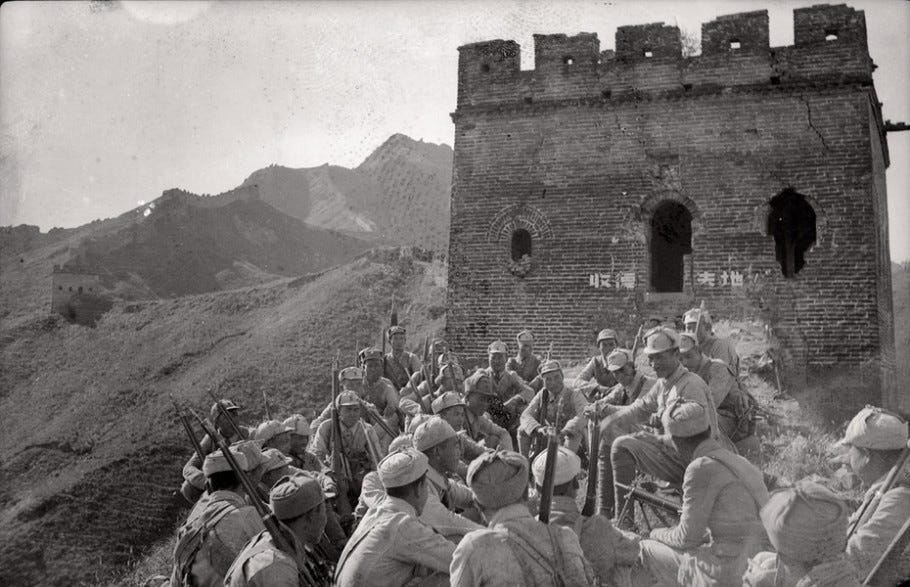
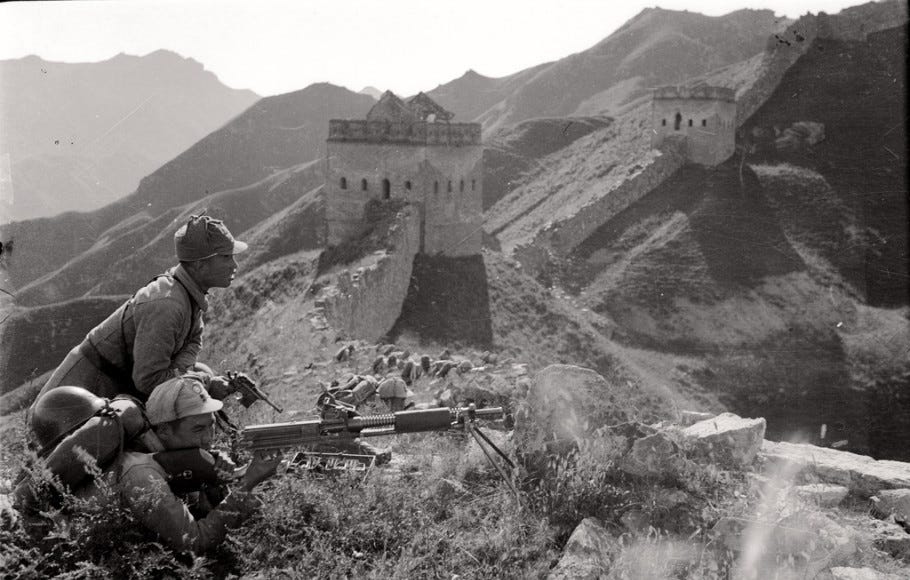
All of this was completely different from the rigid hierarchy and clear distinction between superiors and subordinates in the US military—something Carlson would adopt as part of what he would come to call the “Gung Ho” spirit—a term that would eventually become synonymous as a mantra of the entire Marine Corps.
The term ‘Gung Ho’, originating from Rewi Alley’s Chinese Industrial Cooperatives (shortened to 工合), was utilized by Carlson to promote an esprit de corps among his Marines. Carlson would explain in a 1943 LIFE Magazine interview:
“I was trying to build up the same sort of working spirit I had seen in China, where all the soldiers dedicated themselves to one idea and worked together to put that idea over,” and that he “told the boys about it again and again. I told them of the motto of the Chinese Cooperatives, gung ho. It means work together—work in harmony.” (1943 LIFE MAGAZINE: CARLSON OF THE RAIDERS—A student of Chinese Guerrilla Fighting Teaches his Men How to Fight and What they Fight For by Don Burke)
According to the official history of the U.S. Marine Corps, Carlson observed:
“Guerrillas move into a village and leave it better off than when they arrived, paying for the food and shelter they used. He saw officers and men sharing conditions and the work. He saw the guerrillas march 43 miles in 32 hours without complaint and with very little food or water. He saw how every man understood the importance of the mission and how that understanding inspired them to go on. Perhaps just as importantly, he saw the brutality of the Japanese. He wrote it all down. He sent letters to President Roosevelt and told him what he knew.” (GUNG HO, RAIDER! THE PHILOSOPHY AND METHODS OF BRIG GEN EVANS F. CARLSON, MARINE CORPS RAIDER)
The endurance and capability of communist guerrillas inspired Carlson to push for the very things that created their strength; in his view, “Ethical Indoctrination,” to which Carlson would write and later explain to his Marines:
“That day in China…I saw in practice the secret of the Chinese Eighth Route Army. Two words—‘ethical indoctrination.’ Those are big words, boys, but let me tell you simply what they mean. The reason those 600 men were able to endure such hardship was because they knew why it was necessary for them to complete that march. But more important than that, they knew why that march was important to the whole series of battles they were fighting; and they knew why these battles were important to the whole war against the Japs. And the war against the Japs was one they understood and believed in. In short, they understood why the efforts of every single one of them was necessary for the victory of the whole Chinese people. That’s ethical indoctrination” (GUNG HO, RAIDER! THE PHILOSOPHY AND METHODS OF BRIG GEN EVANS F. CARLSON, MARINE CORPS RAIDER).
He met “Mao Tse-tung and wrote of him, ‘the vision of him that would remain with me was this picture of a humble, kindly, lonely genius, striving here in the darkness of the night to find a peaceful and an equitable way of life for his people.’” And his embedment with Chinese forces would influence him on a political level; Carlson having left-leaning views, prompting General David M. Shoup, who would later serve as the Commandant of the Marine Corps to say of him, “He may be red, but he’s not yellow.” (GUNG HO, RAIDER! THE PHILOSOPHY AND METHODS OF BRIG GEN EVANS F. CARLSON, MARINE CORPS RAIDER).
He said that the Eighth Route Army and their Cooperatives were the “best-organized, best-led fighting force in the world... for its size and purpose”—In other words, the “hope of China” and that the U.S. was undermining China by supplying Japan with “scrap, oil, and other material.” For this, he was officially censured by the traditional-minded conservative Marine Corps, costing Carlson his commission in May 1939 after almost two decades of continual service. (1943 LIFE MAGAZINE: CARLSON OF THE RAIDERS—A student of Chinese Guerrilla Fighting Teaches his Men How to Fight and What they Fight For by Don Burke)
Now a civilian, Carlson “kept up his fight for China” by joining Henry Stimson’s American Committee for Non-Participation in Japanese Aggression as a lecturer, writing two books, Twin Stars of China and The Chinese Army, and visiting China again from 1940-1941 as a civilian, where he would he became convinced in 1941 before Pearl Harbor that “Japan would attack the U.S.” (1943 LIFE MAGAZINE: CARLSON OF THE RAIDERS—A student of Chinese Guerrilla Fighting Teaches his Men How to Fight and What they Fight For by Don Burke)
With this information, he would immediately contact Douglas MacArthur to suggest that the mountain area in Luzon North of Manila (Japan would first invade the Philippines one day after Pearl Harbor on December 8, 1941), be set up as a guerrilla base of operations, something which was not done. After speaking to MacArthur, he “hurried on to Washington and reported what he knew” and was given a commission as a lieutenant colonel, a grade higher than the one he resigned. (1943 LIFE MAGAZINE: CARLSON OF THE RAIDERS—A student of Chinese Guerrilla Fighting Teaches his Men How to Fight and What they Fight For by Don Burke)
Part Three: Formation and Basis of the Raiders
Given Carlson’s inspiration from the 8th Route Army, influence in DC, newly commissioned rank in the Marine Corps, and mounting amphibious operations against Japan imminent, it is likely that Carlson influenced FDR’s son, James Roosevelt, to write “The Major General Commandant, Headquarters, U. S. Marine Corps, Washington, D. C. The Commanding General, Second Joint Training Force,” a letter with the subject: “Development within the Marine Corps of a unit for purposes similar to the British Commandos and the Chinese Guerrillas.” (Special Marine Units of World War II)
This proposal was initially met with opposition; Commandant of the Marine Corps General Thomas Holcomb of the opinion that “the term ‘Marine’ is sufficient to indicate a man ready for duty at any time, and the injection of a special name, such as ‘Commando,’ would be undesirable and superfluous.” (Special Marine Units of World War II)
However, the need for light units in leading amphibious invasions of Japanese-held islands and a request from Admiral Nimitz for Commando units would prompt the creation of the 1st and 2nd Marine Raider Battalions in February 1942. The 1st Raider Battalion would be led by Lt. Col. (later, Major General) Merritt A. “Red Mike” Edson, and the 2nd by Carlson, who was promoted to Lt. Col. for the position. Edson’s 1st Marine Raiders retained the table of organization (not dissimilar from the rest of the Marine Corps except for armament) he had designed: “It was based on an eight-man squad, with a leader, two BAR men, four riflemen armed with the M-1903 Springfield bolt-operated rifle, and a sniper carrying a Springfield mounting a telescopic sight.” with “three rifle platoons and a weapons platoon” per company. The concept of a highly trained, lightly equipped force using conventional tactics to accomplish special missions or to fill in for a line battalion the crux of Edson’s innovations.
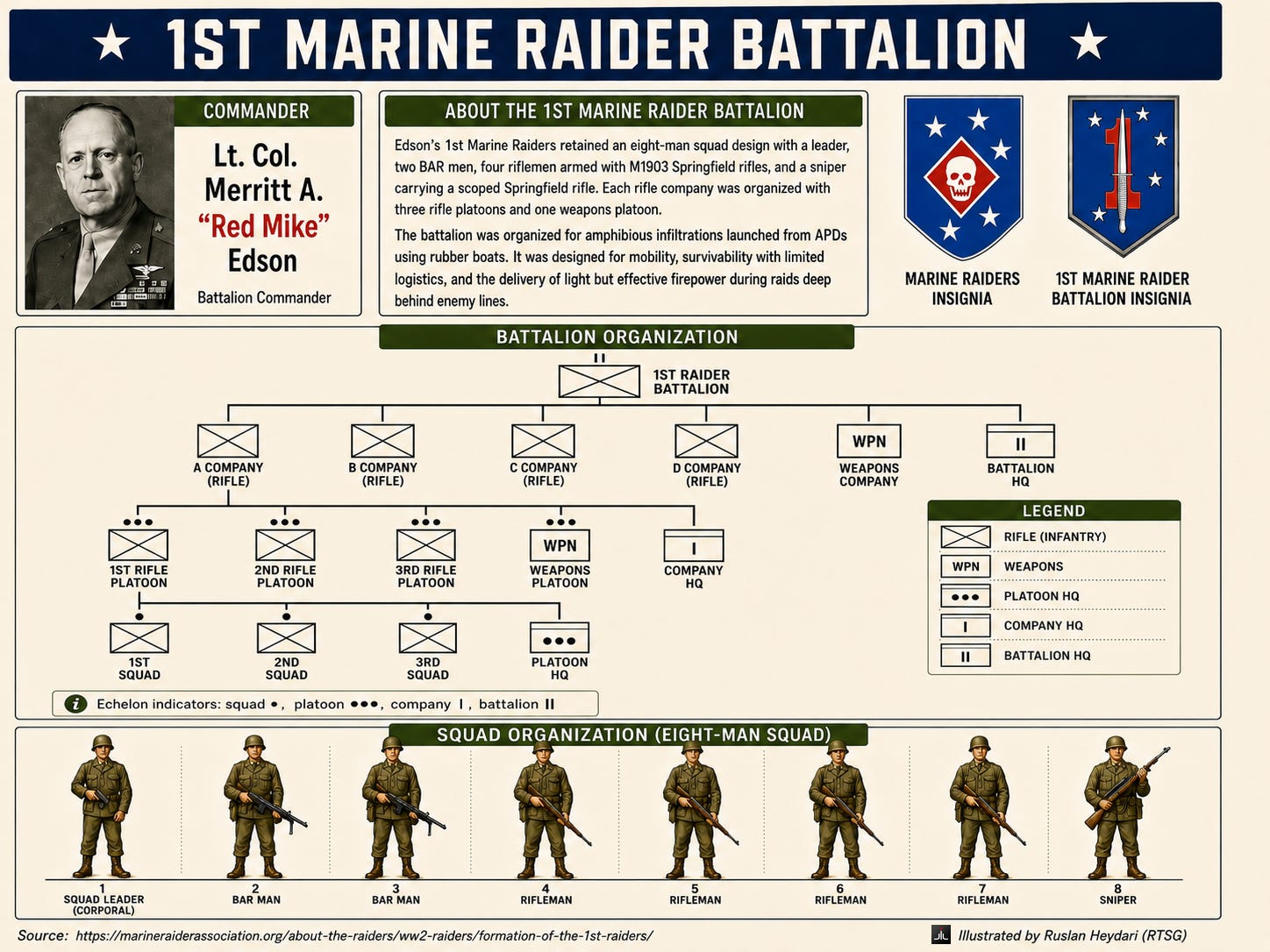
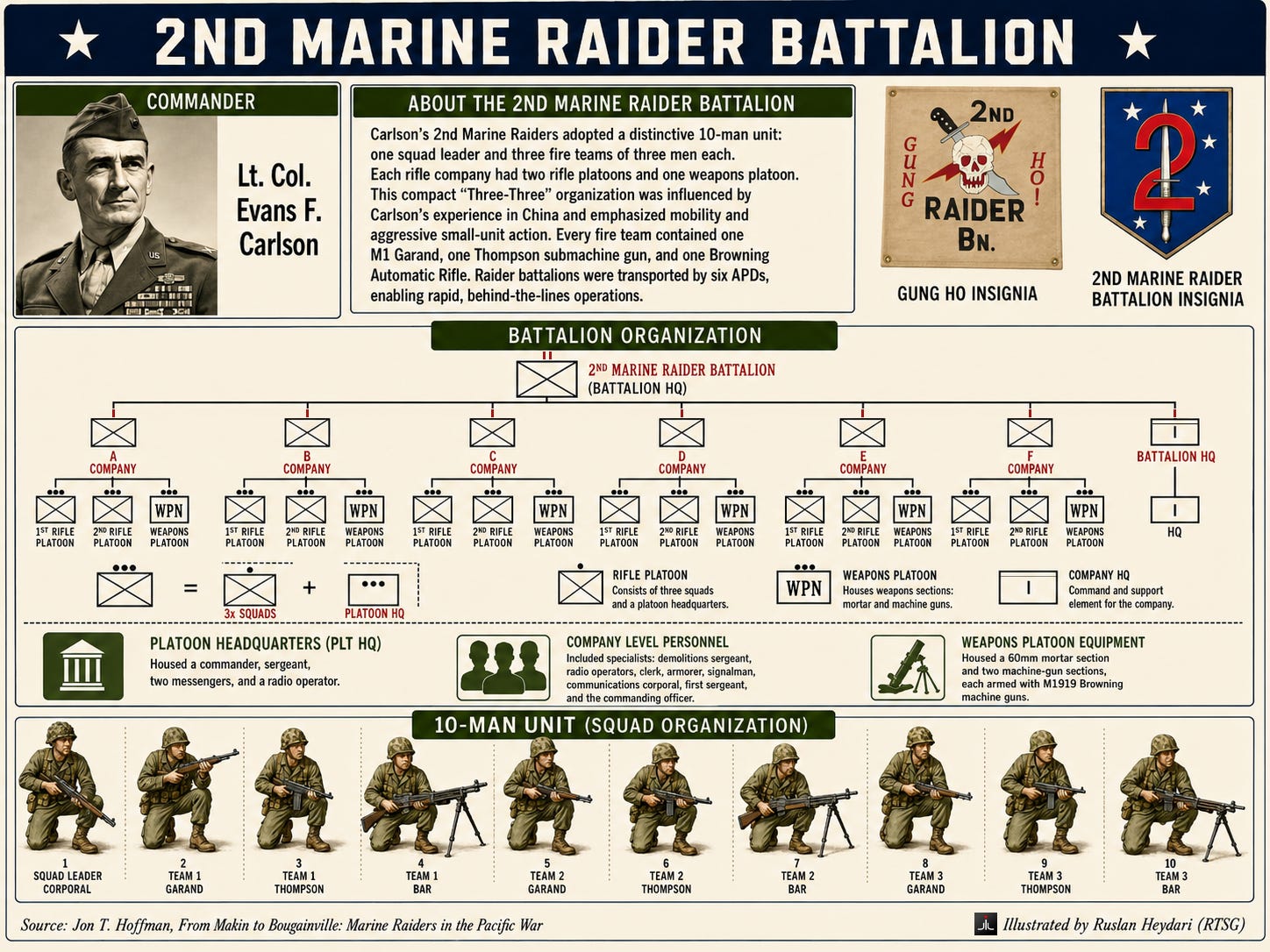
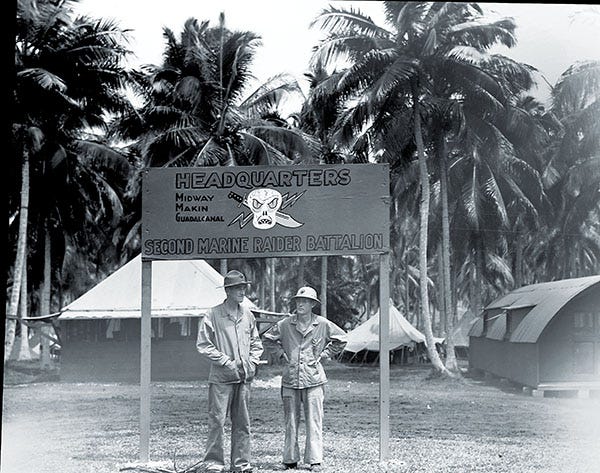
Carlson’s Raiders, on the other hand, adopted a uniquely “Chinese” approach to small-unit organization with a “10-man unit composed of a squad leader and three fire teams of three men each,” where “each rifle company had just two rifle platoons and a weapons platoon.” This ‘Three-Three’ style of organization was exactly the design of the PLA, with units split into three from the squad to the company level. In contrast to the early PLA, Carlson ensured his units were incredibly well-armed, with every fireteam being composed of three weapons: the new self-loading M1 Garand, Thompson submachine gun, and Browning Automatic Rifle. Such capacity in automatic firepower in levels exceeding the norms of the rest of the Corps (primarily armed by the bolt-action Springfield 1903, interspersed with fewer BARs) would give the Raiders a significant advantage in battles ahead. (FROM MAKIN TO BOUGAINVILLE: Marine Raiders in the Pacific War by Major Jon T Hoffman, USMCR)
Alongside first-choice in arms procurement, the Raiders picked only the best of the best, from hunters, outdoorsmen, those with strong aquatic ability, and the fittest. In the 2nd Battalion, Carlson
“had the luxury of choosing his own men based on his own criteria. He did not have to seek approval from any higher headquarters or justify refusals in response to congressional inquiries. He was able to disqualify men who had families and couldn’t devote all of their attention to training. He disqualified men that were eager for a perceived “quick tour” with a ‘glory’ unit. He disqualified men if he felt they just didn’t have the heart to complete a 50-mile hike. He remembered the faces he saw in China, and he looked for those faces.” (GUNG HO, RAIDER! THE PHILOSOPHY AND METHODS OF BRIG GEN EVANS F. CARLSON, MARINE CORPS RAIDER).
Carlson took inspiration from the 8th Route Army and abolished traditional privileges for officers. He required that officers eat the same food, endure the same burdens, and carry the same equipment willingly as the enlisted men. He fully implemented military democracy by installing a public address system, where he said, “I told the boys everything we were doing and invited criticism and suggestions. And we got them.” (1943 LIFE MAGAZINE: CARLSON OF THE RAIDERS—A student of Chinese Guerrilla Fighting Teaches his Men How to Fight and What they Fight For by Don Burke)
Most importantly, Carlson looked for the ideologically motivated, envisioning a unit where ethos triumphed over arms, and every man knew what he was fighting for—fighting against the Axis powers and proving the effectiveness and practicality of military democracy. According to USAF historian Major Kathleen M. Gomrick,
“He wanted to train a fighting force that could answer the call and complete any mission assigned. What made him different was his approach. He envisioned a force that fought because it had an obligation to fight. He wanted a unit where every man was as committed to the cause as the next, and every man worked together because that was the right thing to do. He wanted Gung Ho Raiders.” (GUNG HO, RAIDER! THE PHILOSOPHY AND METHODS OF BRIG GEN EVANS F. CARLSON, MARINE CORPS RAIDER).
Part Four: Who Is Lin Biao? An Introduction to the Classic PLA
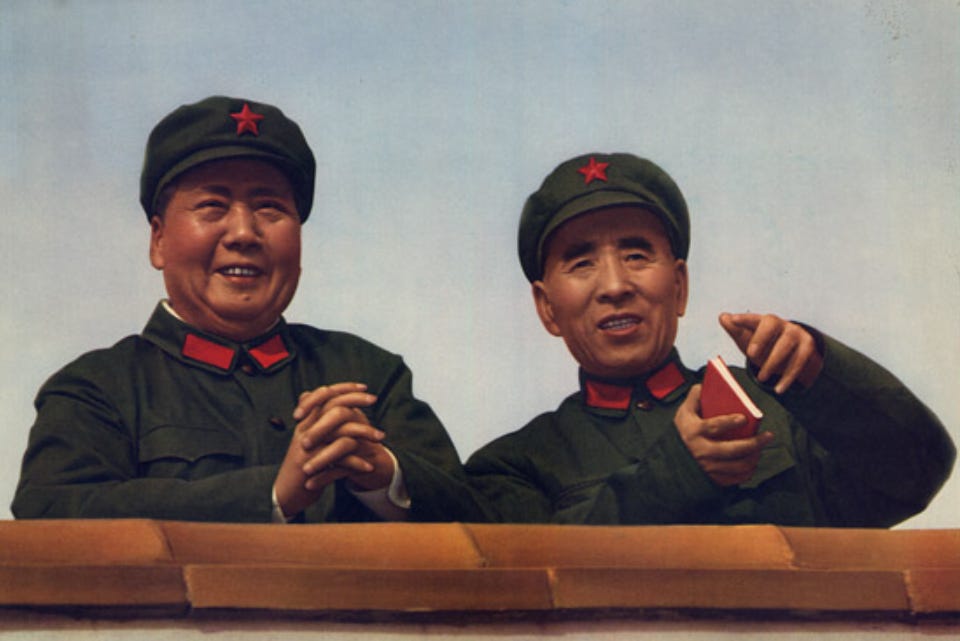
To fully understand the source of Carlson’s inspiration, it is essential to analyze the source material—the doctrine of the Eighth Route Army that influenced him directly. In this context, Lin Biao, an early leader in the development of the People’s Liberation Army (PLA) doctrine, is key to understanding Carlson’s perspective; what “Maoist” doctrine he saw in practice long before Lin Biao formalized these strategies in writing.
Lin Biao was born on December 5th, 1907, in Huanggang County, Hubei Province, to a modest landholding family. He would later become one of the People’s Liberation Army’s (PLA) most gifted military minds. His political career began as a leftist while he was involved in the China Socialist Youth League and the May Thirtieth Movement. Lin then enrolled in the renowned Whampoa (Huangpu) Military Academy in Guangzhou, which was founded by Sun Yat-sen and associated with the Nationalist Party, led by Chiang Kai-shek (Jiang Jieshi). Whampoa served as the equivalent of West Point for China, providing military talent for both sides of respective civil wars, including notable communists like Zhou Enlai among its graduates. (《林彪》)
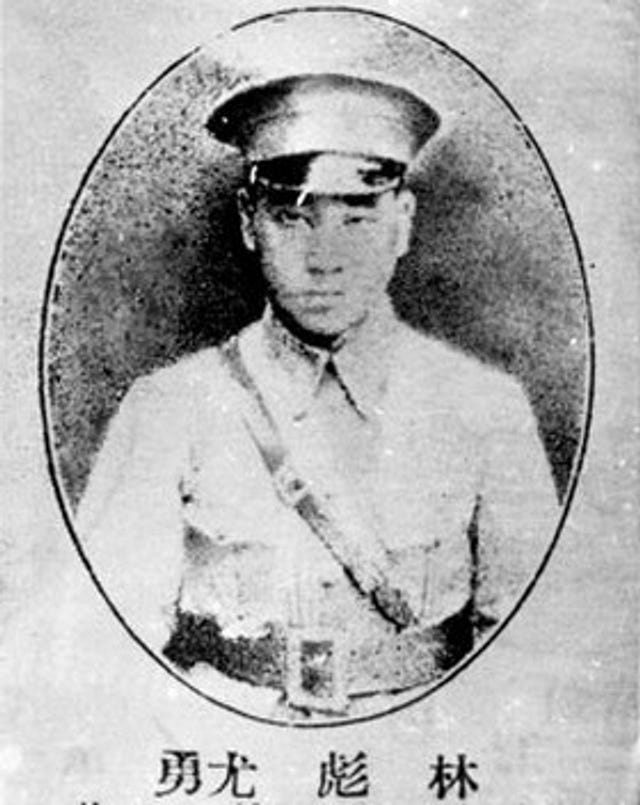
At Whampoa, Lin would absorb conventional military doctrine and revolutionary politics within the radical crucible among the Left-KMT. Militarily, being influenced by the Prussian, Japanese, and Soviet influences present at the academy.
When Chiang purged Communists in 1927, Lin defected to the Red Army, beginning a meteoric rise that would see him command the 1st Corps during the Long March and 115th Division of the 8th Route Army during the United Front against japan, become educated at the Soviet Frunze Military Academy, and later orchestrate the PLA’s decisive conquest of Northeastern China (1945–1948)—a campaign that broke Nationalist power and sealed Communist victory in the continuation of the Civil War. (Communist Party of China 《林彪》 ,People’s Daily Online)
Lin Biao’s brilliance lay in the manner in which he organized his troops, given the material restraints of the war he initially fought. Without the material resources to wage a conventional war with favorable attrition and results in an era of modern firepower, Lin Biao focused on ethos over arms: strict drilling in small-unit maneuvers and tactics that would give the early PLA an edge over greater opponents.
With only infantrymen available to him, and the most casualty-inducing weapon available to Communist forces limited by infantry and horse transport (practically speaking Machine Guns and Lighter forms of artillery/mortars with very poor logistics), the best course of action was remolding soldiers that would otherwise be wasted fighting conventionally (as practiced by the Soviet-influenced 28 Bolsheviks headed by figures like Otto Braun which would militarily force the Communists into conducting the Long March after the Fifth Encirclement Campaign) into well-disciplined and flexible guerrilla soldiers that would utilize terrain effectively, concentrate their forces onto the weakest points of a front to maximize the effectiveness of limited firepower, using feints, distractions, and concealment to achieve these goals for the purpose of creating breakthroughs and attriting the enemy.
These new strategies would prove decisively effective during the first stage of the Civil War: between 1930 and 1933, Lin’s forces captured twice the number of prisoners of war and military equipment as the Third and Fifth Army Groups of the Chinese Workers’ and Peasants’ Red Army combined. For Lin Biao, the small-unit organization of the PLA was termed the “three-three” system, named after the splitting of units from the company down into detachments of three from fireteams to platoons, and the optimal method for attacking enemies referred to as “One Point, Two Faces.” (Hu, Chi-hsi. Mao, Lin Biao and the Fifth Encirclement Campaign)
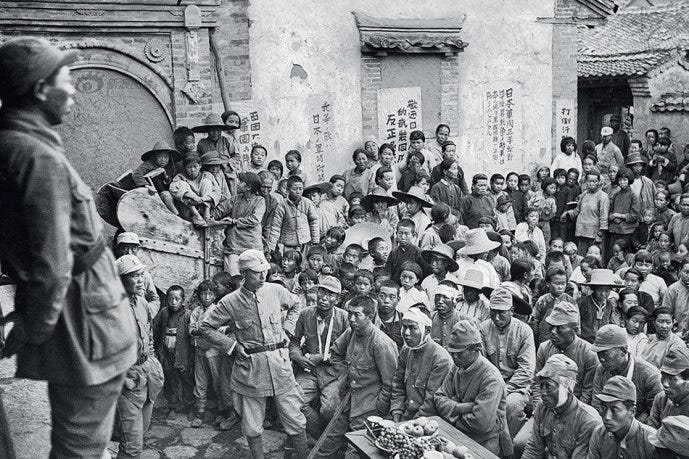
By the latter stage of the Civil War, following the Japanese surrender, although the initial asymmetric disparity that made guerrilla tactics worthwhile would subside, advances in firepower still necessitated the use of tactics developed by Lin Biao; only at a scale measured in frontlines of hundreds of thousands of soldiers rather than dispersed commandos fighting more as insurgents than professional soldiers. Though the second stage of the Civil War differed from the first in this regard, Lin’s martial prowess crystallized with sweeping victories in the Northeast, first during the Liaoshen campaign, which effectively conquered Manchuria through the capture of Liaoning and Shenyang, and secondly during the Pingjin campaign where Lin commanded over a million men to encircle Chiang Kai-Shek’s forces taking Beijing and Tianjin within a period of two months, with General Fu Zuoyi agreeing to surrender 400,000 KMT soldiers in the Beijing area to Lin without a fight (many of whom would defect). (Communist Party of China 《林彪》, People’s Daily Online)
On the influence of modern firepower necessitating small-unit tactics, force concentration, and feinting, Lin would espouse systematized battlefield lessons forged against the Japanese and earlier experience with the nationalists.
On the importance of dispersal and small-unit detachments of three up to the company level, Lin would write in Conclusions from the Military Cadres Conference in February 1947:
“The ‘three-three’ system tactic is a matter of deploying tactical maneuvers… Battle formations have evolved from dense to dispersed due to advances in firepower. Strategically, forces should be concentrated, and in campaigns, they should be deployed at one point and on two sides. However, in tactics and combat maneuvers, forces are dispersed and sparsely distributed. Concentrating forces does not require us to form dense formations when attacking, but requires that when one part of the troops charges, there must be sufficient firepower cover and cooperation with the charging troops and the second echelon. Therefore, if there are many soldiers, they should not all attack at once, but must use a formation of threes.” (在军事干部会议上的结论)
Lin emphasized the importance of concentrating forces and firepower onto specific points in a front as part of “One Point, Two Faces” attacks—something that “three-three” tactics synergized with at lower levels of organization. In his December 1947 directive, “One Point, Two Faces: Three-Three Tactics,” Lin outlined the fundamentals of what defines “Maoist” military doctrine. He explains the goal of a One Point, Two Faces attack: the concentration of forces and outmaneuvering of enemies, aiming to achieve favorable attrition by destroying enemy manpower through feinting and outmaneuvering an enemy–something achievable within the microcosm of warfare through synergizing small-unit tactics led by fireteams as part of squads to pin enemies and strike them at their weakest or the grandiosity of divisional level warfare. Lin would write:
“When facing a superior enemy, our operational methods particularly emphasize defeating the enemy piecemeal, eliminating them one by one. This means we shouldn’t be overly ambitious, nor should we try to devour the enemy in one fell swoop. We must assess the conditions. If conditions allow, a decisive victory is desirable, but we must avoid overextending ourselves, as we risk breaking our teeth trying to chew the enemy whole.… Tactically, we should choose the enemy’s weaknesses for resolute attacks. For example, breakthrough points should generally be chosen at enemy protrusions, junctions, the flanks or rear of enemy positions, or points where the terrain facilitates our approach. We should concentrate our forces and firepower to break through these points, rather than launching indiscriminate attacks and blindly running into the enemy’s defenses. This refers to choosing a single point of attack against the enemy… we must absolutely concentrate our forces and firepower to annihilate one enemy, rather than distributing our strength evenly and ineffectively striking several enemies… If I fight an enemy company with only one company of troops, I am inferior to the enemy in terms of firepower, military technology, and command ability, making victory difficult. However, if I concentrate a battalion, or even more, to attack an enemy company, my firepower and manpower will overwhelm the enemy. Three or more men against one enemy will surely win… To completely annihilate an enemy, it is impossible to achieve the objective without launching attacks from two or more fronts… This tactic of attacking from one front can be implemented at any level, from divisions and brigades down to platoons and squads. For example, a platoon might attack an enemy strongpoint, aiming for one squad to attack from the front while two other squads flank and attack from the rear.” (一点两面与班组的三三制战术)
Lin consistently emphasized the importance of mastering the One Point, Two Faces, and Three-Three organizational strategies, as well as the value of ideological training, or what Carlson referred to as “ethical indoctrination.” In a January 1947 essay titled “The Mission of 1947,” Lin articulated his vision for what the People’s Liberation Army (PLA) should aspire to be. He wrote:
“Intensify military training, master the tactics of the ‘Three-Three System’ and ‘One Point, Two Faces’ strategy, establish the concept of mobile warfare and annihilation warfare, and promote a fighting style of fierce attack, fierce charge, and fierce pursuit. Intensify political work so that all officers and soldiers understand why they are fighting, build confidence in the victory of an army fighting for the people, strengthen military-civilian relations and mass discipline, strengthen unity between officers and soldiers, and between veterans and newcomers, to ensure the accomplishment of all tasks. The main corps is our assault force. Victory in the war is impossible without it. We must cultivate a sense of cherishing the main corps throughout the Party and the people. We must continue to train and expand the local armed forces and the People’s Self-Defense Force, purge bad elements, and reorganize unreliable units, ensuring that the armed forces are truly in the hands of reliable elements. Improve the combat effectiveness and political awareness of the local armed forces, ensure that they take on the task of maintaining public order among landlords and eliminating bandits, and continuously promote them to the main forces. And third, develop production, ensure supplies, and improve people’s living standards.” (一九四七年的任务)
As formulated by Lin, it is evident that early People’s Liberation Army (PLA) doctrines clearly show that Carlson was directly inspired by the Eighth-Route Army (which Lin would lead its 115th Division). This influence is evident in several ways: organizationally, it can be seen in the structure from fireteams to companies; ideologically, there is a strong emphasis on esprit de corps, ideological conditioning, and military democracy; and tactically via focus on dispersion, synergizing concentrated attacks with enveloping an enemy as part of a One Point Two Faces attack—In Carlson’s context a commando force that would spearhead amphibious landings on Japanese held islands—in Lin’s an army that would fight as guerrillas or professional soldiers as necessary. But the effectiveness of Carlson’s innovations remained untested. How would such radical change in doctrine actually manifest on the battlefield?
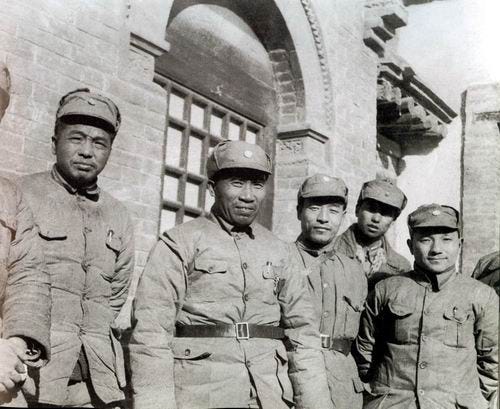
Part Five: Raid on Makin Island—Gung Ho Praxis
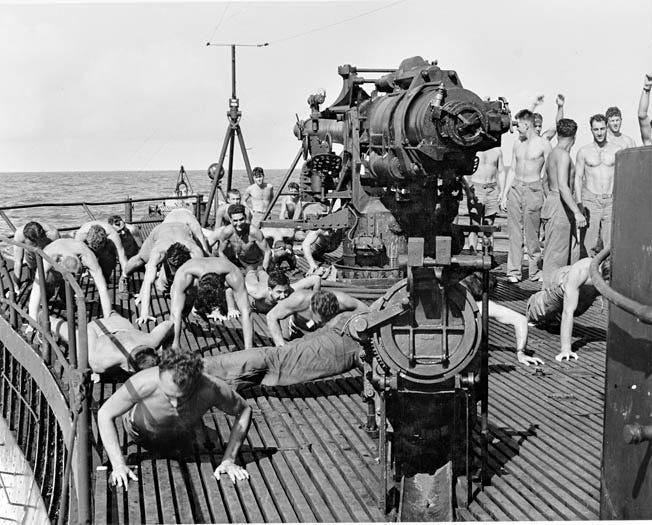
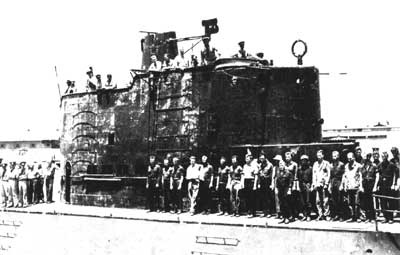
August 17, 1942: 211 raiders from Alpha and Bravo Companies of the 2nd Marine Raider Battalion set forth on their baptism by fire, setting off on rubber landing boats shortly after 0000 after being aboard the Nautilus and Argonaut; submarines hastily converted into covert troop transports for a mission that would begin just ten days after the start of the Guadalcanal Campaign—among these men, James Roosevelt and Evans Carlson himself. What these Marines would take part in would be among the earliest offensive ground operations conducted by the United States against the Empire of Japan: The Makin Island Raid. Here, Carlson would execute America’s first amphibious raid of the Pacific War—a direct application of the principles he found in China, adapted for tip-of-the-spear amphibious operations.
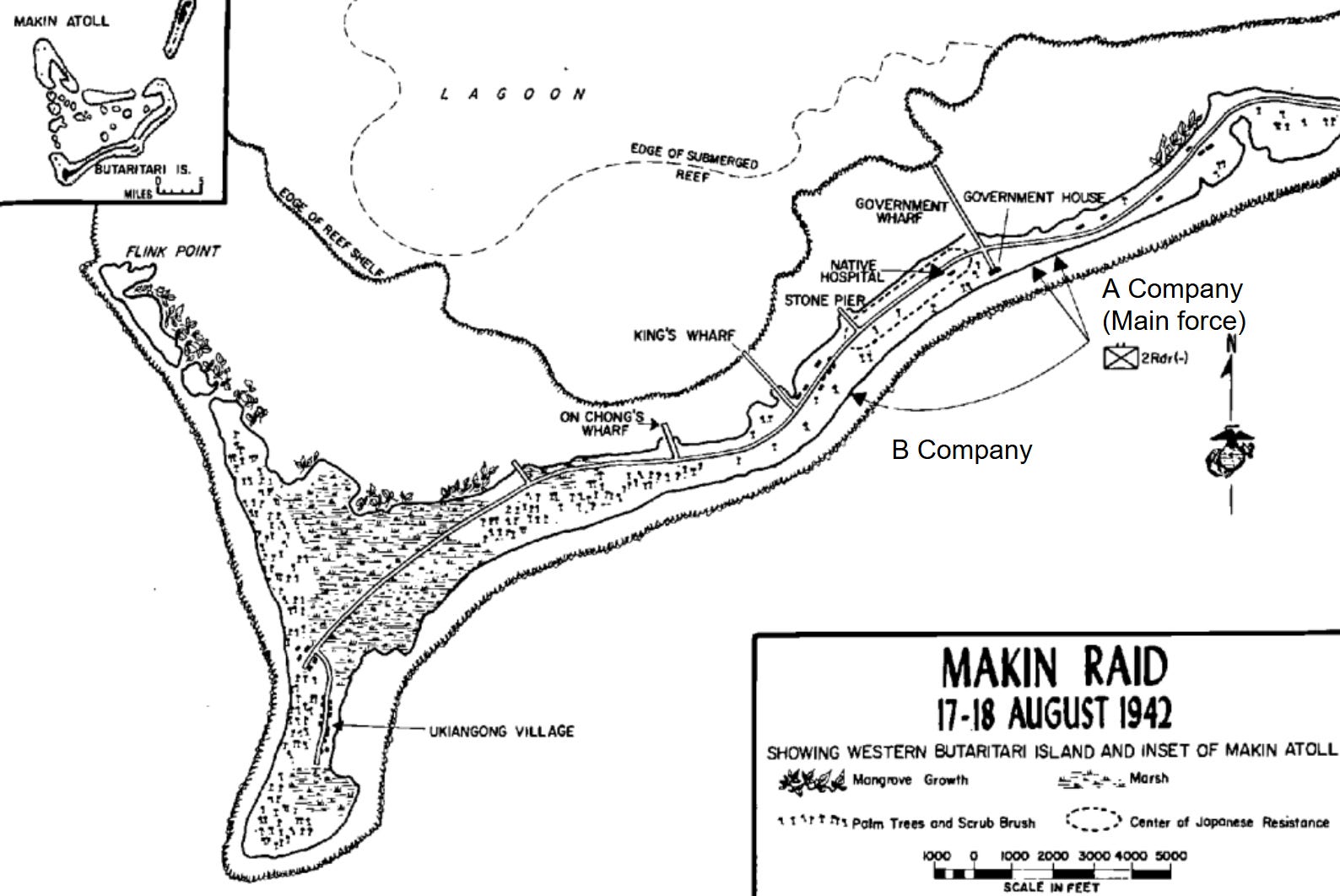
At 0513, under the cover of darkness, the main force of the 2nd Raider Battalion (from Company A) landed on the shores of Makin Island, followed by a smaller element led by Company B. The landing faced difficulties, which prevented a unitary landing; however, once ashore, the main force quickly dispersed and held the center of the island; as Official Marine Corps historiography, as part of From Makin to Bougainville-Marine Raiders in the Pacific War, denotes:
“First Lieutenant Merwyn C. Plumley’s Company A quickly crossed the narrow island and turned southwest toward the known enemy positions. Company B, commanded by Captain Ralph H. Coyt, followed in trace as the reserve. Soon thereafter, the raiders were engaged in a firefight with the Japanese.” (From Makin to Bougainville-Marine Raiders in the Pacific War)
The Japanese garrison responded with an immediate counterattack, and the Marines found themselves facing off against well-prepared snipers, machine gun positions, and two banzai charges. Marine fire would cut down these charging soldiers called by the bugle. Unbeknownst to the raiders, “they had nearly wiped out the Japanese garrison at that point in the battle.” (From Makin to Bougainville-Marine Raiders in the Pacific War)
Here, the first action to award a Medal of Honor to an enlisted Marine occurred. As From Makin to Bougainville-Marine Raiders in the Pacific War, denotes:
“Sergeant Clyde Thomason died in this initial action while courageously exposing himself in order to direct the fire of his platoon. He later was awarded the Medal of Honor, the first enlisted Marine so decorated in World War II.” (From Makin to Bougainville-Marine Raiders in the Pacific War)
At 1130, following an initial exchange of fire, the Japanese called for close air support using bombs dropped from two aircraft. Carlson had trained his men to remain motionless and not to fire at the planes, concealing the location of the raiders from Alpha Company. As a result, none of the bombs landed near the Marine positions.
Two hours after the attempt to subdue the raiders with close air support, twelve planes were spotted on the horizon. Among them, two seaplanes attempting to deliver reinforcements to the Japanese garrison that was engaged in combat with the Marines. These planes were immediately fired upon. Official historiography tells:
“Raider machine guns and Boys antitank rifles fired at them. One burst into flame, and the other crashed on takeoff after receiving numerous hits. The remaining aircraft bombed and strafed the island for an hour, again with most of the ordnance hitting enemy-occupied territory. Another air attack came late in the afternoon.” (From Makin to Bougainville-Marine Raiders in the Pacific War)
As dusk settled, the indigenous population emerged as collaborators:
“The natives on the island willingly assisted the Americans throughout the day. They carried ammunition and provided intelligence. The latter reports suggested that enemy reinforcements had come ashore from the seaplanes and from two small ships in the lagoon. (The submarines later took the boats under indirect fire with their deck guns and miraculously sunk both.)” (From Makin to Bougainville-Marine Raiders in the Pacific War).
Interpreting this intelligence as confirmation of a persistent threat, Carlson was convinced that a substantial Japanese force not only remained, but was reinforced with fresh soldiers—a threat to his logistically strained infantrymen who could only muster onto the battlefield what they carried on their backs and moved with their legs. At 1700, he convened a council of war, or in other words, a “Gung Ho meeting.” Major James Roosevelt and the battalion operations officer advocated strict adherence to the original withdrawal plan to preserve forces for the scheduled Little Makin landing. Concerned about overextension, Carlson endorsed withdrawal.
The retrograde disengagement initially proceeded with discipline: “The force broke contact in good order, and a group of 20 men covered the rest of the raiders as they readied their rubber boats and shoved off.” (From Makin to Bougainville-Marine Raiders in the Pacific War) However, unaware that the rear guard remained ashore, Carlson departed at 1930, believing his craft carried the final contingent.
Catastrophe ensued: “Disaster then struck in the form of heavy surf. The outboard engines did not work and the men soon grew exhausted trying to paddle against the breakers. Boats capsized and equipment disappeared.” (From Makin to Bougainville-Marine Raiders in the Pacific War). Though several boatloads reached the submarines Nautilus and Argonaut, Carlson and approximately 120 raiders were stranded. Only the forgotten covering force and a handful of others retained functional weapons.
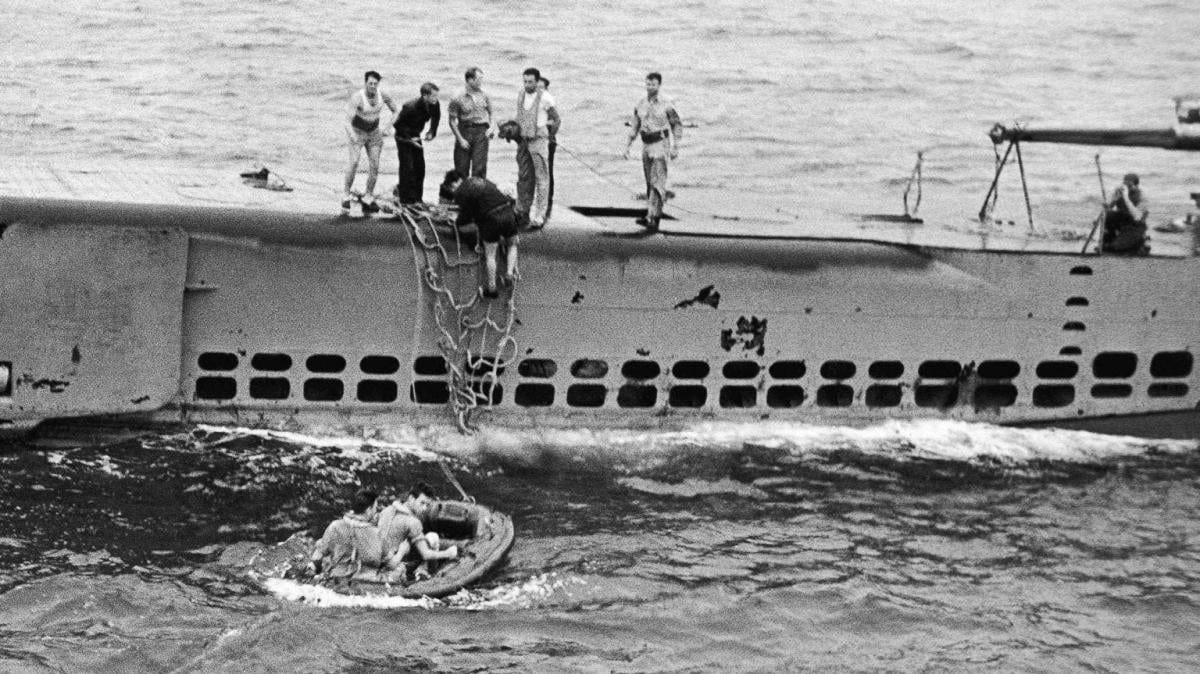
As midnight came and passed and the pre-dawn hours of the next day, August 18th, emerged, a Japanese patrol infiltrated the raiders’ perimeter, leading to a sentry killing three Japanese at the cost of himself getting wounded. Confronted with exhaustion, chaos, and concern for casualties—and citing anxiety over the President’s son’s safety due to his absence from Carlson’s abrupt war council—Carlson reconvened his officers. “Without much input from the others, he decided to surrender. His stated reasons were concern for the wounded, and for the possible fate of the president’s son.” (From Makin to Bougainville-Marine Raiders in the Pacific War)
At 0330, he dispatched his operations officer and another Raider to deliver terms to the enemy: “They found one Japanese soldier and eventually succeeded in giving him a note offering surrender.” (From Makin to Bougainville-Marine Raiders in the Pacific War) Simultaneously, Carlson authorized all personnel to “fend for themselves” in renewed attempts to reach the submarines as part of the withdrawal process.
Despite these bleak conditions, dawn reversed the situation to one of hope. As it turned out, additional boatloads, including one carrying Major Roosevelt, successfully navigated the surf. Additionally, reconnaissance parties of raiders on patrol found out that the Japanese presence was “negligible,” alongside killing several additional enemy combatants—likely including the Japanese soldier with Carlson’s surrender terms—completely changing the situation as the Raiders remained in the fight. The emissaries returned reporting “there appeared to be no organized enemy force left on the island.” (From Makin to Bougainville-Marine Raiders in the Pacific War)
With roughly 70 raiders ashore, Carlson rapidly reorganized. Able-bodied Marines armed themselves with captured weapons scattered on the battlefield—effectively buttressing their depleted ammunition. Systematic patrols continued and confirmed security, killing two more Japanese stragglers.
Carlson personally led a patrol to demolish installations and tally losses: “He counted 83 dead Japanese and 14 of his own killed in action. Based on native reports, Carlson thought his force had accounted for more than 160 Japanese.” (From Makin to Bougainville-Marine Raiders in the Pacific War) Despite four Japanese air raids during the day, the Raiders sustained no further casualties, and the battle ended with an extremely favorable rate of attrition with over half the Japanese garrison dead—19 dead Marines in exchange for 160 Japanese who had access to air support with the raiders utilizing practically only small arms to inflict enemy casualties: a ratio of roughly 1:8 (9 Marines were captured and would be beheaded additionally weeks later on Kwajalein Atoll) in favor of the Raiders despite a disadvantage in firepower assets (e.g. air power).
Coordinating via radio, the Marines arranged an evening rendezvous at the lagoon entrance, where calm waters eliminated surf hazards. “The men hauled four rubber boats across the island and arranged for the use of a native outrigger. By 2300, the remainder of the landing force was back on board the Nautilus and Argonaut.” (From Makin to Bougainville-Marine Raiders in the Pacific War) The chaotic withdrawal had intermingled Alpha and Bravo Companies; precise accounting awaited Pearl Harbor.
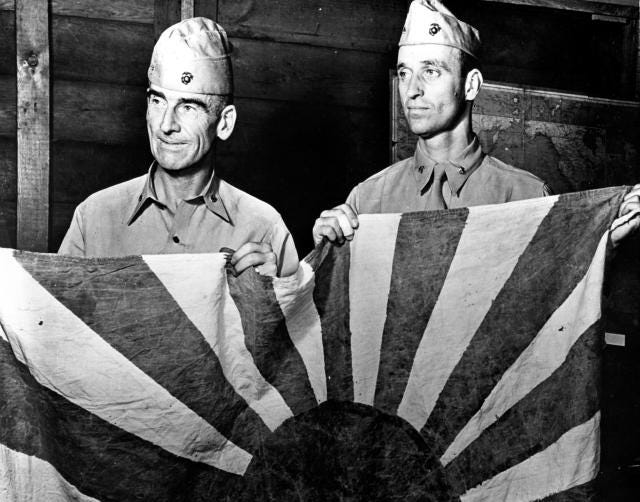
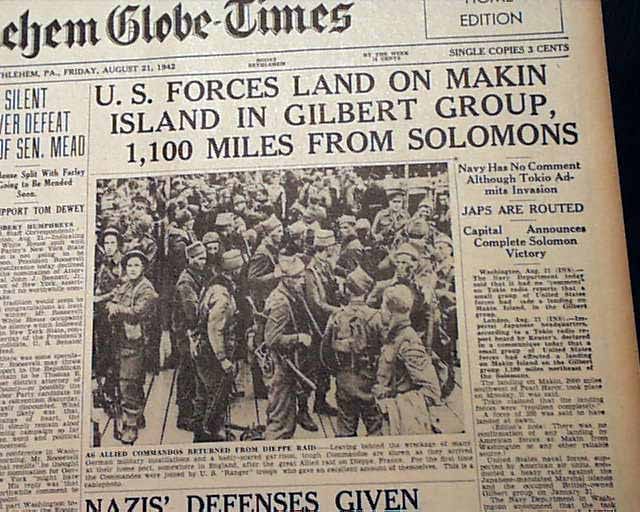
Despite imperfections at the operational level caused by the rains and surf, the raid was publicly heralded as a morale-boosting victory, and the operation “did cause the enemy to worry about the potential for other such raids on rear area installations,” potentially influencing Japan’s decision to heavily fortify atolls like Tarawa. (From Makin to Bougainville-Marine Raiders in the Pacific War)
Makin Island validated the combat efficacy of Carlson’s radical approach, as the raiders, at a disadvantage in firepower assets, managed to achieve favorable attrition whilst being logistically strained—over half the Japanese garrison at Makin killed in action—the only issues emerging from poor equipment and rough seas that made withdrawal chaotic with a planned surrender foiled only by the raiders suffering from their own success and saving the operation by unknowingly killing the Japanese soldier carrying Carlson’s surrender terms. Official Marine historiography concludes: “their greatest difficulties had involved rough seas and poor equipment; bravery could not fix those limitations.” (From Makin to Bougainville-Marine Raiders in the Pacific War)
During the entire raid, the 2nd Battalion demonstrated several qualities inherited from the Eighth Route Army, as part of Carlson’s approach. This is evident in their organizational structure, where small-unit “three-three” fireteam tactics were effectively used to maneuver and surround enemies; concentrating their forces appropriately on superior terrain (mangrove groves) which provided concealment, enveloping enemies, and annihilating them—a direct embodiment of Lin Biao’s dictum that forces must be “dispersed and sparsely distributed” tactically while concentrating “at one point” for annihilation.
Alongside organizational structure leading to the proper result of One Point Two Sides, the raiders paralleled their guerrilla inspiration in another two key ways: working with the local populace to gather intelligence and support the raiders logistically (via ammunition transportation), and proper use of concealment, which undoubtedly saved many Raider lives when the Japanese called air support on several occasions.
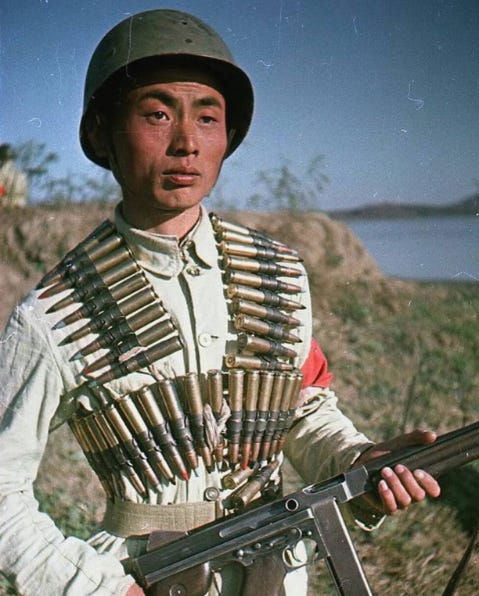
Another characteristic, although not strictly connected by any written doctrine, which parallels the Chinese guerrillas, is the use of captured weapons that occurred when ammunition reserves were exhausted a day into the raid. Chinese forces would be motivated to do this for similar material reasons—the PLA, using a myriad of captured weapons for its entire early history up until the Korean War—subsequent conflicts being dominated by the Type 56 series of weapons (the SKS, RPD, and Kalashnikov assault rifle) as China was able to set up a functioning, relatively stable military industrial complex.
Overall, the Raid on Makin Island did prove the efficacy of Carlson’s experimental thinking; however, it was mired in an operational fiasco, and perception among the Marine Corps was mixed. For instance, Lieutenant Colonel Alan Shapley, who would later take over command of the 2nd Raider Battalion a year later on March 22, 1943, was an orthodox line officer who had earned a Navy Cross on board the Arizona (BB 39) on 7 December 1941, thought the Makin Raid had been a “fiasco,” and he had no interest in “Gung Ho.” Shapley, once in charge, wasted no time in turning the unit into “a regular battalion.” Though this reshaping into a “regular” battalion still retained Carlson’s organizational structure, and resulted in a mixture of the 1st and 2nd Raider Battalion’s ideas (from Edson and Carlson). (From Makin to Bougainville-Marine Raiders in the Pacific War)
Yet, before this happened, Carlson and his 2nd Raider Battalion would engage in their magnum opus before the Pacific Theater turned to amphibious landings on heavily fortified small islands held by the Japanese, removing the conditions that made guerrilla tactics viable later in the war (starting roughly in 1943).
Here, Carlson’s Raiders would stun the command of the Marine Corps and establish that, given the right conditions (i.e., a larger frontline where Raiders could attack from the rear to support a main force; something geographically limited on the small island landings that defined the war later on), Carlson’s ideas were absolutely effective. Indeed, this happened only three months after the mixed results of Makin during the Guadalcanal Campaign on a patrol to support a larger force of Marines, so infamous it was dubbed “Carlson’s Patrol.”
Part Six: Gung Ho Magnum Opus—Carlson’s Patrol
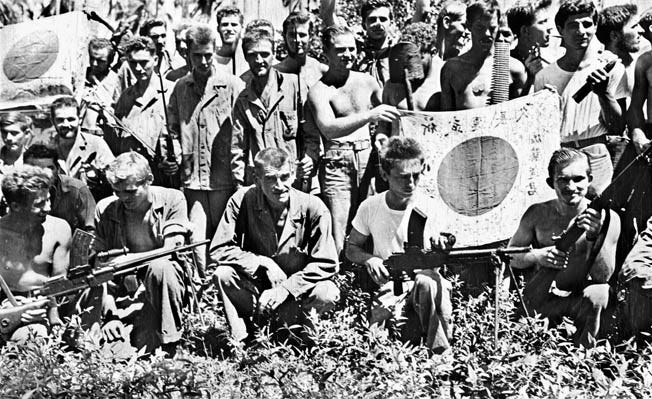
Fresh from refit after a stay in Pearl Harbor following the Makin raid, 2nd Battalion would be deployed to Guadalcanal, an island captured by the Japanese earlier in 1942, chosen to be among the first spot (New Guinea and the Solomon Islands) of major land offensives via amphibious assaults by the allies.
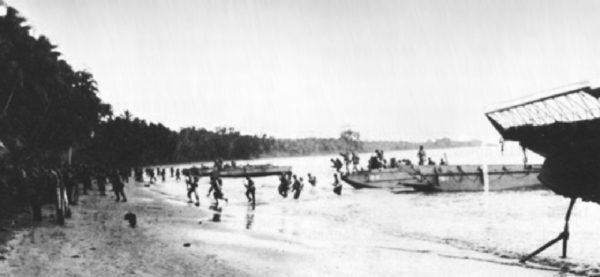
Supporting a larger contingent of forces: the Marines of the 1st Marine Division situated 40km West, Charlie and Echo companies of the 2nd Battalion would land by boat at Aola Bay, 64 km east of Lunga Point on the island on November 4, 1942, at 0530. The purpose of their operation was simple: to capture land for the creation of an airfield—a goal that would not come to fruition given the swampy and muddy conditions on the island. The next day, an aidropped message from Major General Alexander Vandegrift, leading the 1st Division, redirected the mission.
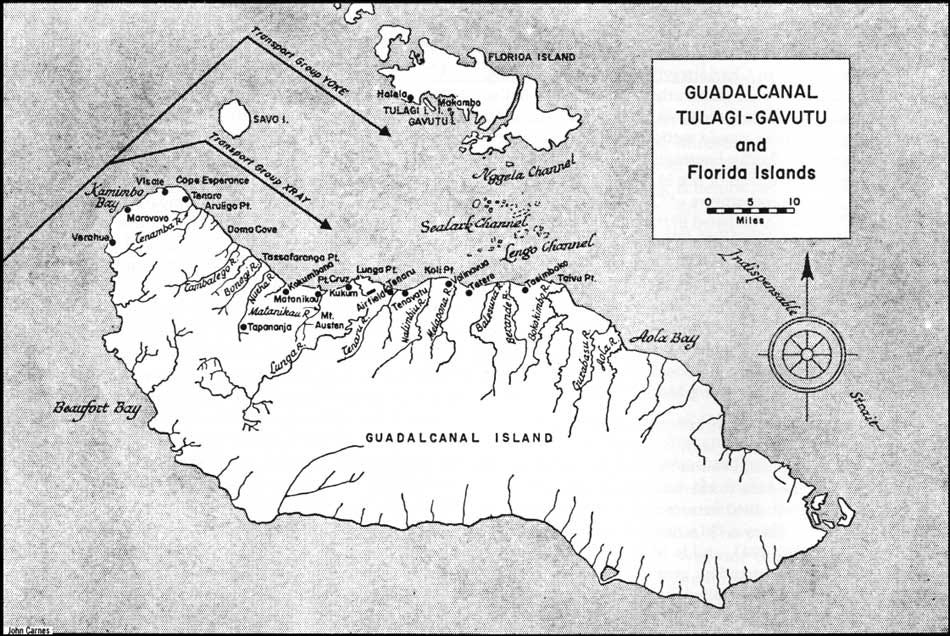
The Japanese 230th Infantry Regiment, commanded by Toshinari Shōji, reinforced by a battalion of the 228th Regiment, had broken their encirclement by a perimeter in the settlement of Tetere manned by Marines of the 164th Regiment and 7th Marines, some 20km West of Carlson’s companies. Carlson was ordered to march inland and harass them from the rear.
At dawn on November 6, Carlson led his force westward, guided by coastwatchers and native scouts, carrying four days of rations over undeveloped jungle trails. After two days of marching, by November 8, the column composed of Charlie and Echo companies would march Northwest, striking the coast at the Kena River, and made camp at the village of Tasimboko, roughly 24km away from Aola Bay.
On November 8, the Charlie and Echo Companies would move Northwest, first camping at the village of Tasimboko—crossing the Berande and Balasuna rivers and reaching the village of Binu in the afternoon of the next day, where Carlson established his forward patrol base.
The other three Raider companies arrived at Aola later by November 8, and by November 9, they moved by landing craft to Tasimboko and on 10 November were guided by native scouts to Carlson’s patrol base at Binu. On the way, Raider pointmen encountered a small group of Japanese soldiers on Patrol and killed three of them before entering Binu.
Simultaneously, Japanese command ordered Colonel Toshinari Shōji to abandon his positions and rejoin Japanese forces at Kokumbona in the Matanikau area. Although American forces had encircled Shōji’s troops at Koli, Shōji took advantage of a gap in the southern perimeter and began to escape Tetere. By November 11, 3000 of Shōji’s men had escaped into the jungle in a southward direction.
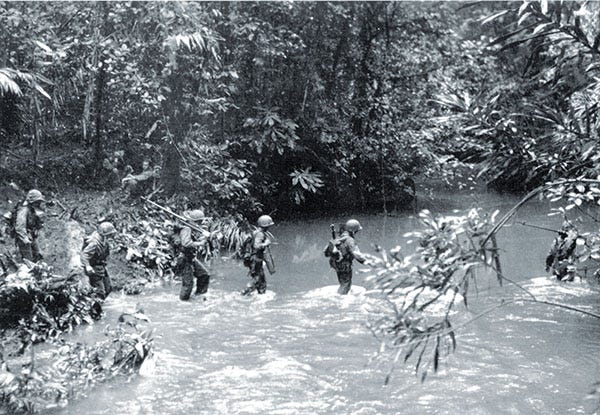
On November 11, Carlson sent Charlie, Echo, Delta, and Foxtrot companies to fan out and patrol the area to the North and West of his Patrol Base at Binu, with the remaining company, Bravo, staying behind to provide security for Carlson’s camp.
At 1000, Charlie Company, which marched directly West, encountered a large body of Shōji’s troops near the Metapona River. They would soon be in a firefight, with soldiers of Charlie Company suppressed by rifle, machine gun, and mortar fire. Carlson responded by directing Delta and Echo Companies to come to Charlie’s assistance, attacking from two different directions and enveloping the enemy to force them to withdraw in an attempt to save Charlie Company.
As Delta and Echo Companies reinforced Charlie, they joined the intense firefight Charlie Company was in by 1230. At 1500, Captain Charles McAuliffe of Delta Company, along with nine men, retreated to Binu base camp, reporting to Carlson that, soon after he had initial contact with Shōji’s soldiers, he and one of his squads became isolated from the rest of his company, which, according to him, got thoroughly annihilated after contact.
However, the rest of Delta Company, led by Gunnery Sergeant George Schrier, arrived at the base camp shortly afterward, revealing that McAuliffe had lied. Carlson summarily relieved McAuliffe for what he later described as “total ineptitude for leadership in battle” and placed Captain Joe Griffith in command of Delta Company to replace McAuliffe.
Carlson proceeded to the area where Charlie Company was engaged along with Foxtrot Company, which had returned to the Binu patrol base earlier, arriving personally at 1630. Here, Carlson ordered Foxtrot Company to attack the Japanese positions facing Charlie Company at 1715, leading to the Japanese soldiers’ withdrawal.
Leaving Foxtrot Company at the scene, Carlson returned to Binu with Charlie Company, arriving at 2200. Echo Company arrived at Binu about the same time and reported that they had caught a Japanese company crossing a river in the open and killed many of them before withdrawing.
Carlson then took Bravo Company and returned to the area that Foxtrot Company was guarding, arriving at daybreak on 12 November. The Marines had suffered 10 killed estimated that they had killed 120 of Shōji’s men at a ratio of 1:12.
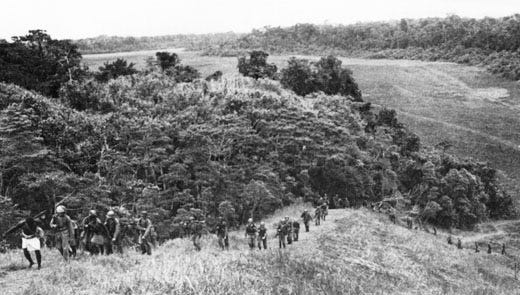
With Bravo Company on point, Carlson, along with two other companies, marched west towards the village of Asamana on the Metapona River, where Shōji’s men had held their positions. While crossing the river, the Marines captured two Japanese soldiers and killed a third on a boat. They then proceeded to occupy Asamana, killing the remaining Japanese stragglers caught off guard at the presence of the Raiders and killing 25 more Japanese soldiers while later holding defensive positions in the Village.
Still holding positions in Asamana, the next day, a company-sized element of Japanese soldiers approached. The raiders’ response: calling in 75mm artillery fire from the Marines of 1st Battalion, 10th Regiment, killing many Japanese soldiers and forcing a retreat.
Carlson returned to Binu on November 14 to rest and resupply, and on the same day, a patrol from Foxtrot Company annihilated an encampment of 15 discovered by native scouts. By November 15, Carlson moved his patrol base to Asamana, and by then Shōji’s units were not present in the area, having continued their withdrawal to the interior of Guadalcanal to Mataniku at Command’s request. In the next two days, patrols would kill only a few more stragglers.
After these days at Asamana, Carlson’s battalion was contacted via TBX radio to move to the upper Tenaru River and patrol south of the Lunga perimeter held by the 1st Marine Division, originally 40km away from Aola Bay, setting up a patrol base roughly 3km southeast of the Lunga Perimeter and receiving reinforcement via Alpha Company, arriving and joining the Battalion by November 25. Their objective: to locate the trails the Japanese had been using for logistics and lodging during the earlier Battle of Henderson Field in October, where up to 3000 Japanese had been killed in a decisive land, air, and sea battle with one IJN cruiser sunk and 14 aircraft destroyed in a decisive American victory. Additionally, Carlson was ordered to seek out and destroy Japanese artillery positions that were delivering fire inside the perimeter established by the 1st Division.
By November 28, Bravo and Delta companies were patrolling south of the Lunga perimeter, near Mount Austen, while Foxtrot and Alpha companies patrolled even further south. Two days of patrolling later, the Raiders found Japanese artillery pieces—a 37mm anti-tank and 75mm mountain gun. A single squad of six soldiers of Foxtrot company patrolling the area where these guns were discovered would soon find an encampment of a company-sized element of Japanese soldiers, numbering 100 soldiers with their weapons stacked against trees instead of immediately on person. The resulting ambush would be a massacre: 75 dead Japanese for 0 American losses, with the stragglers of the company retreating into the jungle. Carlson’s troops would fall back to the Lunga perimeter, with 1st Division Commander Alexander Vandegrift calling off Carlson’s patrols by December 1.
Carlson, eager to continue the successful patrol, requested a few more days from Vandegrift, who agreed to a two-day extension. The Raiders then held an impromptu Gung Ho Meeting to plan their next steps. Afterward, they received supplies via airdrop. By December 2, patrols resumed, and the Raiders of Bravo Company engaged in combat near the Lunga River, killing ten Japanese soldiers that same day and discovering another 75mm gun.
On December 3, Carlson would split his forces—sending Charlie, Delta, and Echo companies to fan out east of the Lunga Perimeter toward the Tenaru River, whilst Alpha, Bravo, and Foxtrot headed west toward Mount Austen. The eastern patrol would reach the Tenaru and return to the Lunga perimeter without incident, while the western patrol, made up of Alpha, Bravo, and Foxtrot companies, would encounter another Japanese patrol, killing 25 at the cost of four wounded (one would die from their injuries).
The three companies that had been sent to Mount Austen would soon return to the Lunga perimeter, only to be ambushed by a Japanese machine gun team. This ambush resulted in the deaths of four raiders, while seven Japanese soldiers were killed in the subsequent skirmish. After encountering no further resistance, Carlson’s patrol concluded its mission after 29 days. The detachment of three companies made its way back to Lunga Point by the afternoon of the same day. (FROM MAKIN TO BOUGAINVILLE: Marine Raiders in the Pacific War by Major Jon T Hoffman, USMCR)
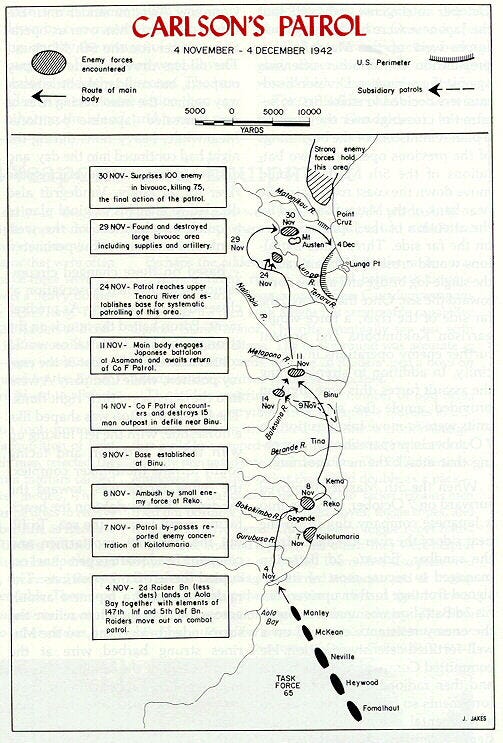
Over a period of 29 days from November 4 to December 4, Carlson’s Raiders hiked over 240km from Aola Bay to the Matanikau River, killed 488 Japanese soldiers, and captured or destroyed enemy equipment, including two howitzers and various small arms and ammunition, suffering 16 KIA and 17 WIA in terms of battle casualties. Non-battle casualties totaled 225, of which 125 suffered from malaria, 29 from dysentery, and 71 from ringworm or jungle rot. (Invictus: The Long Patrol and the Indomitable 2nd Marine Raider Battalion )
Despite these hardships, Major General Vandegrift formally cited the battalion for “the consummate skill displayed in the conduct of operations, for the training, stamina, and fortitude displayed by all members of the battalion, and for its commendable aggressive spirit and high morale.” The patrol validated Carlson’s adapted guerrilla doctrine—mobility, surprise, decentralized initiative, and ideological cohesion. (The 2nd Raiders Long Patrol)
Carlson’s Patrol on Guadalcanal represented the operational culmination of principles Carlson had witnessed in China and sought to transplant into the United States Marine Corps. The patrol’s structure, execution, and outcomes reflected three core elements of Lin Biao’s early PLA doctrine: organizational architecture, tactical methodology, and ideological conditioning.
Carlson’s “Three-Three” organizational philosophy structured the Raiders from fireteam to company level in tripartite formations designed for maximum flexibility and decentralized command, with every unit from fireteam to company capable of acting as a semi-autonomous entity capable of independent action, with radio communication linking the decentralized structure for optimal coordination.
On the Patrol, this system’s effectiveness manifested repeatedly. For instance, when Charlie Company encountered the Japanese bivouac at Asamana on November 11, Carlson could simultaneously vector Echo and Foxtrot toward the engagement while maintaining independent patrols elsewhere. The operational elasticity of such maneuvers—concentrating forces at decisive points while maintaining dispersed pressure across a broad front—precisely what Lin Biao had designed the three-three system to achieve.
The principle of attacking using “One Point Two Faces”—the demand for concentration of a superior force at a single weak/favorable point while simultaneously threatening the enemy’s flanks for annihilation, designed to achieve local superiority even when outnumbered, as formulated by Lin Biao, was executed across many other engagements during the 29-day patrol.
At Asamana, Charlie Company engaged the Japanese forces to pin them down, while Foxtrot carried out a flanking maneuver to exert additional pressure, ultimately forcing the enemy to withdraw using a One Point Two Faces attack—where one group fixes the enemy in one location while others attack from different directions to achieve complete annihilation—was employed on smaller scales in various ambush operations. On November 30, a group of six soldiers from Foxtrot Company, in a singular squad, managed to kill 75 Japanese soldiers and rout a company-sized unit that was bivouacking in an open area. They achieved this by executing an ambush, utilizing superior local firepower, taking advantage of the terrain, and exploiting the vulnerabilities of the unprepared soldiers.
Lin Biao’s tactical philosophy emphasized precisely this approach: “Tactically, we should choose the enemy’s weaknesses for resolute attacks... We should concentrate our forces and firepower to break through these points, rather than launching indiscriminate attacks.” The Raiders’ consistent success in achieving favorable casualty ratios—488 Japanese killed versus 16 Raiders—validated the effectiveness of concentrating superior force against vulnerable points rather than engaging in frontal assaults. (From Makin to Bougainville-Marine Raiders in the Pacific War)
Alongside organizational doctrine and frameworks to engage enemies, Carlson’s patrol emulated Chinese Guerilla tactics in another way: “Gung Ho” meetings, where he gathered his exhausted men to explain their mission’s purpose and reinforce collective commitment to a shared goal. The practice paralleled the PLA’s political officer system, where officers ensured soldiers understood the significance of their struggle. As Lin Biao emphasized: “Intensify political work so that all officers and soldiers understand why they are fighting, build confidence in the victory of an army fighting for the people.” (《一九四七年的任务》 )
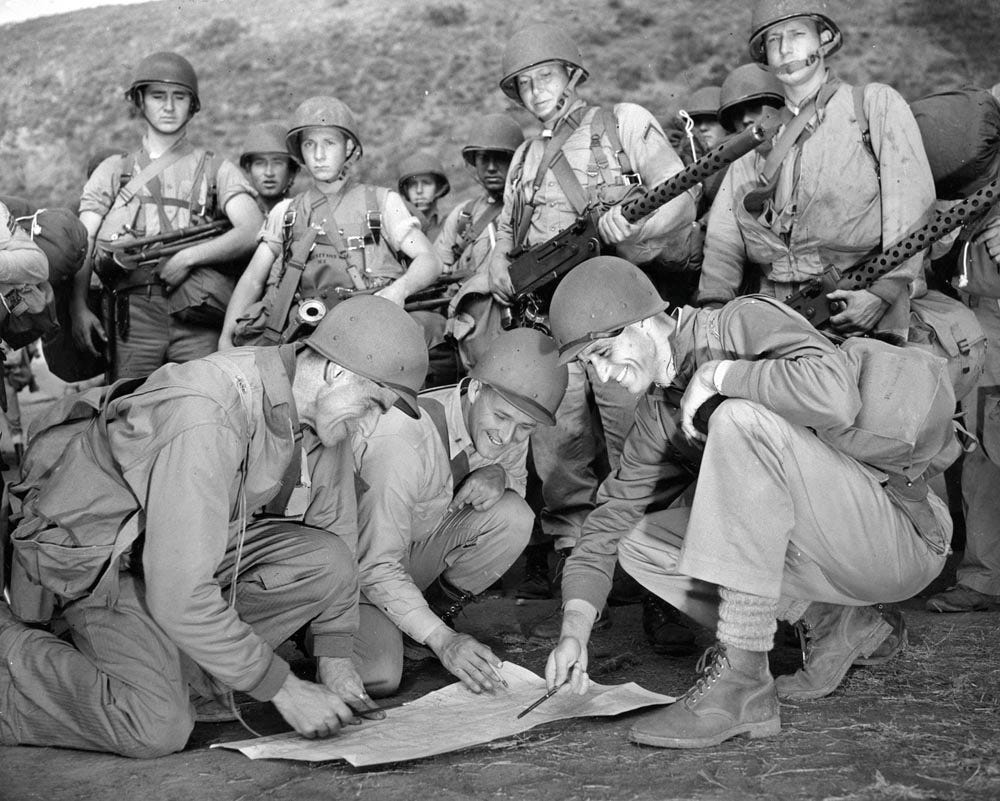
The results of this conditioning were evident in the patrol’s aftermath. Despite suffering 225 non-battle casualties from disease and operating under conditions that would have broken conventional units (Over 1/3rd of the Raiders contracting illnesses), the Raiders maintained high morale. As Lieutenant Cleland E. Early of Company E observed: “My platoon went in with 30 men, one corpsman, and one officer. When we came out we had one officer, one corpsman, and 18 enlisted, all of whom had malaria, worms, diarrhea, jungle rot and high morale.” (Invictus: The Long Patrol and the Indomitable 2nd Marine Raider Battalion )
Though Carlson’s 29-day patrol killed 488 Japanese at a ratio of 30:1 and validated principles of dispersion, concentration, and ideological cohesion, which he learned in China, the battalion was severely weakened by disease. As a Harvard study later noted, inadequate field hygiene and inconsistent use of anti-malarial prophylaxis undermined force preservation. Carlson himself acknowledged these failures in after-action reports, recommending stricter sanitation protocols for future jungle operations.
Yet even with this medical toll, General Vandegrift’s final assessment remained unequivocal:
“This was a remarkable performance even for fresh, well-trained troops and the methods employed are worthy of study... any troops operating in jungle warfare would be well advised to adopt many of the practices and methods employed by this battalion.” (Invictus: The Long Patrol and the Indomitable 2nd Marine Raider Battalion )
Carlson’s reliance on native scouts and carriers represented another direct adaptation of what he learned from Chinese Guerrillas. The Eighth Route Army’s survival and effectiveness rested on local support networks that provided intelligence, logistics, and sanctuary. Carlson replicated this model on Guadalcanal, employing Solomon Islanders as guides, intelligence gatherers, and supply carriers, making the over 200km odyssey the raiders would partake in possible.
Carlson’s Patrol solidified the transposition of guerrilla doctrine into the American military context after what many had considered to be a fiasco at Makin Island. The three-three organizational structure provided operational flexibility. The One Point, Two Faces tactical approach achieved disproportionate effects against superior numbers. Ethical indoctrination maintained morale under extreme conditions. Native support networks enabled sustained operations in hostile terrain. The patrol’s success—488 enemy killed for 16 Raiders in combat—demonstrated that principles developed in the Chinese context could be applied to America’s Pacific campaign.
Part Seven: The Dissolution of the Raiders and Impact on the USMC
There is a distinct irony in the history of armies and empires—oftentimes, the most effective practitioners of new doctrine, visionaries, and heroes are discarded by the very power they helped build. Such was the case with Lin Biao, who died after an alleged coup plot to oust Mao Zedong during the latter stage of the Cultural Revolution, boarding a flight to Mongolia and dying in a plane crash with his entire family.
Lin’s story reflects so many others in the sea that is this history. He mirrors heroic generals like Han Xin, who helped start the Han Dynasty—brilliant at warfare, terrible at politics, both crossing those they served under, costing them their lives. Perhaps Carlson was too visionary for his time. No one saw the “Gung Ho” vision the same way he did. The tactics worked. The institution, however, had other priorities.
On March 15, 1943, the Marine Corps consolidated its four raider battalions into the 1st Raider Regiment under Colonel Harry B. Liversedge. One week later, Carlson was relieved of command of the 2nd Raiders by Lieutenant Colonel Alan Shapley, the same officer who, as mentioned previously, did not want to do with anything gung ho, representing the orthodoxy of the USMC.
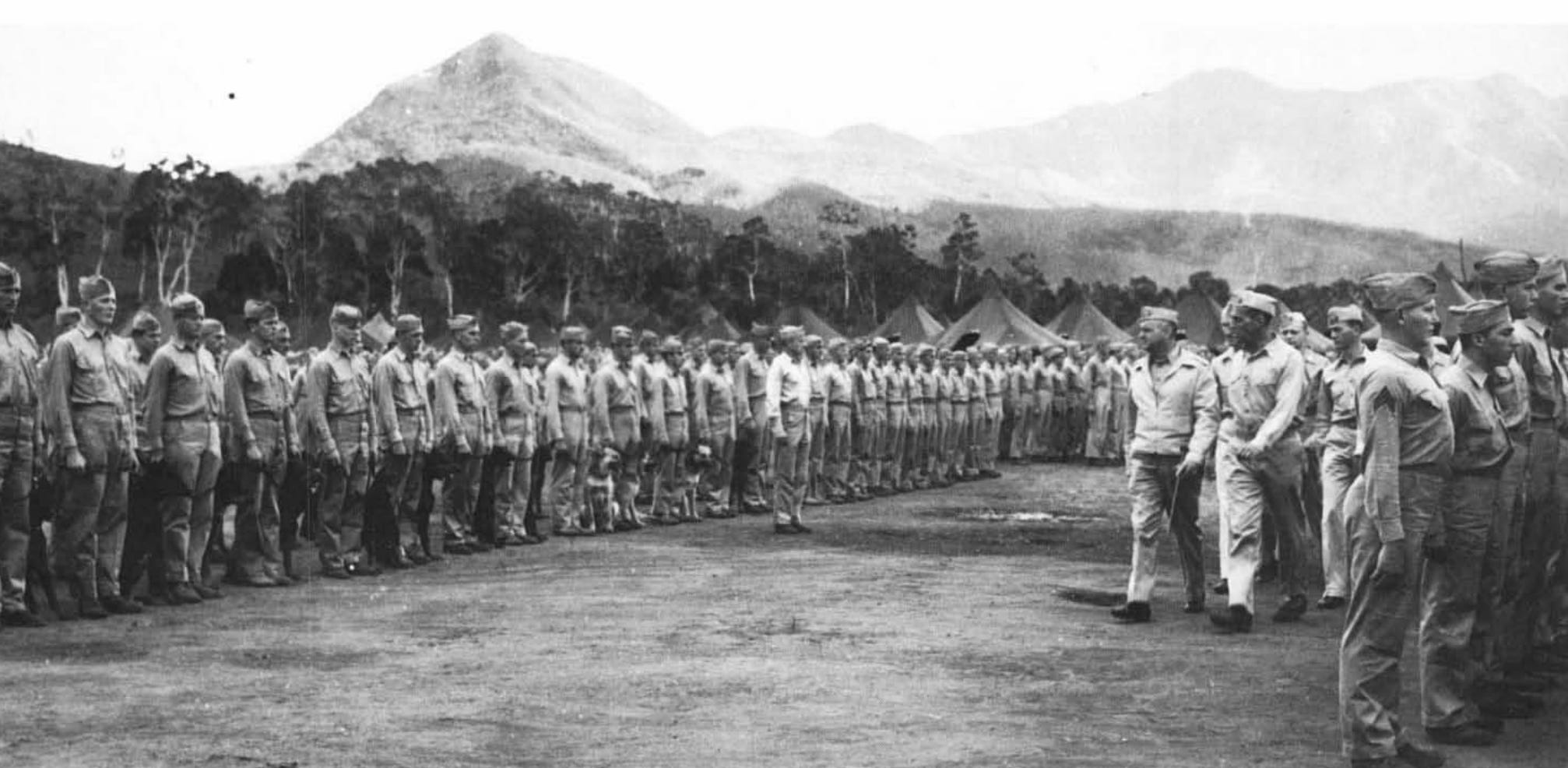
Within a month, he dismantled Carlson’s egalitarian structure: officers resumed separate mess facilities, rank insignia reappeared on uniforms, and gung ho sessions ceased as part of returning to a standard organization. The battalion reverted to conventional hierarchy while retaining only one of Carlson’s innovations: the three-man fireteam. (From Makin to Bougainville-Marine Raiders in the Pacific War)
As From Makin to Bougainville documents, the regiment standardized a hybrid organization blending Edson’s conventional discipline with Carlson’s cellular structure: four rifle companies per battalion, each built around squads divided into three fireteams. The fireteam survived because small-unit tactics worked for the warfare that would define the latter stages of the war—decentralization as part of auftragstaktik proving itself viable in battle.
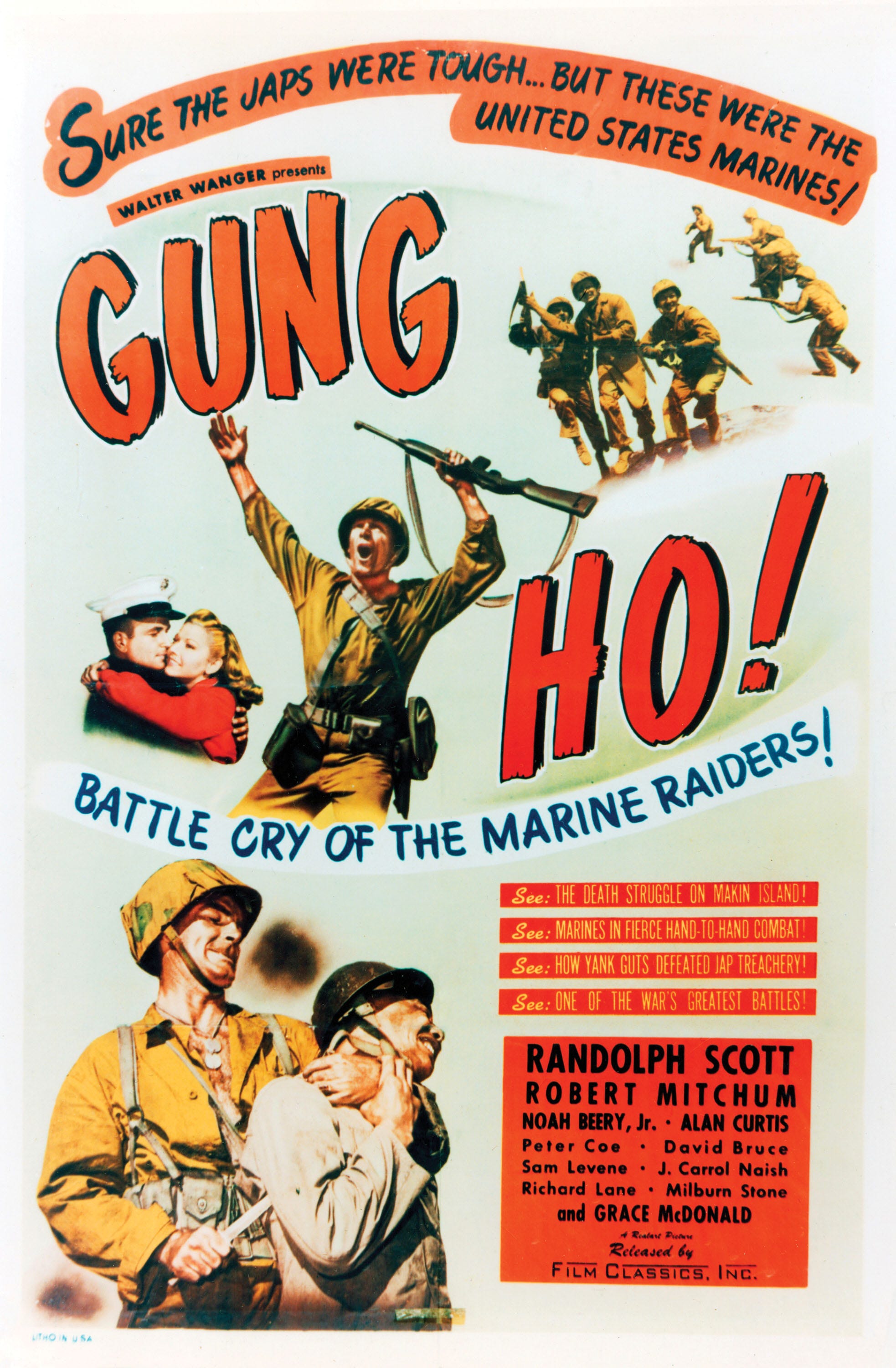
Carlson, weakened by Malaria on campaign, would eventually depart for the United States. In April 1943, he’d serve as technical advisor for Universal Pictures’ Gung Ho!: The Story of Carlson’s Makin Island Raiders, released in December 1943. The film would popularize the motto of Gung Ho across American society and make the Marine Raiders a household name. Though Carlson returned to the Pacific as an observer at Tarawa and earned a second Purple Heart rescuing a wounded radioman at Saipan, he never again commanded troops.
The Raiders were eventually dissolved on February 1, 1944, and redesignated as the 4th Marines—the Corps was expanding from 19,000 to nearly 500,000 men, straining manpower for two new divisions (the 5th and 6th), and manpower was reorganized from existing units to meet the demand. With no prospect of further growth, Commandant Alexander Vandegrift and Director of Plans Gerald Thomas—both longtime skeptics of “elite” units—redirected Raider personnel to fill conventional battalions as the tempo of war in-theater had shifted—amphibious tractors the main means to conduct landings on heavily fortified island bastions like Tarawa and Iwo Jima with a massive firepower superiority eliminating the early use case for lightly armed spearheads raiding lightly fortified garrisons envisioned early in the war in 1942. As the war progressed, the raiders increasingly fought as standard infantry, as their usage in raids diminished—suffering disproportionate casualties when ordered to assault fortified positions without adequate support—as at Bairoko, where 200 Raiders fell in a single day against entrenched Japanese. (History of U.S. Marine Corps Operations in World War II)
![Primary view of object titled '[Lieutenant Colonel Evans F. Carlson and Naval Officers]'.](https://substackcdn.com/image/fetch/$s_!QSdF!,f_auto,q_auto:good,fl_progressive:steep/https%3A%2F%2Fsubstack-post-media.s3.amazonaws.com%2Fpublic%2Fimages%2Ff2b35158-7578-4d72-bfe2-eb006ae43c21_700x892.jpeg "Primary view of object titled '[Lieutenant Colonel Evans F. Carlson and Naval Officers]'.")
Despite the use case of the Raiders subsiding by the latter stages of the war, their ultimate performance was remarkable. Comprising less than 2% of the Corps’ wartime strength, they earned 8% of Medals of Honor, 12% of Navy Crosses, and 8% of Silver Stars. More telling of the Gung Ho spirit was the 2nd Battalion’s psychological resilience, born of a unique level of motivation. During Guadalcanal—where 40% of conventional Marine casualties were psychological evacuations—the 2nd Raiders suffered zero battle fatigue cases despite starvation, disease, and constant combat. As documented in supplemental sources, this stemmed from “group cohesion and esprit de corps... encouraged by shared hardships amongst all members, and the Gung Ho sessions which encouraged a sense of equality.” (Gung Ho, Marine! Servant Leadership, Evans Carlson, and the 2nd Marine Raider Battalion)
Nonetheless, the dissolution and integration of the Raiders did not kill their influence; rather, it spread their doctrine throughout the Marine Corps, many core elements introduced by Carlson becoming a new standard across the entire USMC. Notably, decentralization into fireteams and the breakdown of firepower to lower levels of command. The spread of Raider innovations led to Carlson receiving letters from his former subordinates thanking him for the tactic and informing him of their use of the fire team to save lives and exercise greater initiative in their new units. (Gung Ho, Marine! Servant Leadership, Evans Carlson, and the 2nd Marine Raider Battalion)
Regarding fireteams specifically, Carlson’s innovation, splitting the nine-man squad into three fireteams led by the most capable junior Marines regardless of their rank, was adopted into the structure of the entire Marine Corps, albeit blended with the organization of the 1st Marine Raider Battalion—By 1943, Gen. Thomas Holcomb, commandant of the Marine Corps, convened Marine Officers on finding an ideal for the organization of Marine infantry: settling on the benefits of both Carlson’s squad design split into Three Fireteams but adopting the larger four-man fireteam for a squad of 12 to enjoy the benefits of greater flexibility with three subdivisions, whilst enjoying the greater margin of error provided by a fourth man. From thereon, the previous monopoly of automatic firepower being situated at the Platoon level was broken, with each fireteam, led by a Corporal, gaining an automatic weapon, decentralizing automatic firepower at lower levels of organization. This new system empowered lower levels of organization to be more flexible in the midst of combat, decentralizing command and allowing more men to become NCOs, giving the reins of leadership to junior leaders to create a dynamic and tight-knit squad with greater access to firepower, which acted more independently and more efficiently.
At a larger scale, another of Carlson’s innovations that became popularized throughout the Marine Corps was his dismantling of battalion-level weapons companies to the platoon level—moving machine guns and lower caliber mortars to lower levels of organization to equalize access to firepower, where they had previously been under a weapons company, which a battalion commander had to micromanage, creating tactical rigidity that prevented initiative from the lower ranks. The previous system also had the disadvantage of putting too many eggs in one basket—a centralized weapons company grouped in a landing ship, if lost, destroying a battalion’s fires capacity, whereas if spread out was more robust to attrition. By 1943, only 81mm mortars were consolidated above the rifle company level. (Developing the Fire Team)
At a broader and less direct level, perhaps the most enduring of Carlson’s innovations was what he left on military culture as a whole—the relations between officers and their subordinates over time becoming less rigid, and his “Gung Ho” sessions, where lower ranks could participate in openly and honestly speaking their minds to develop new strategies, reflecting today’s after-action reviews, where soldiers of all rank discuss the results of battle to improve as the aristocratically rigid nature of military institutions faded away to greater levels of professionalism.
Ultimately, Carlson’s vision outlived his command and the raiders themselves—their innovations becoming a new standard as military organization and culture shifted over time—decentralized fireteams, distributed firepower, and unit cohesion built on mutual trust based on a strong esprit de corps, a new standard tested by the crucible of modern war. Although the institution he devoted his life to had cast him aside, and was later buried for his red sympathies as part of McCarthyism, the innovations he imported, tested by baptism by fire, that later became widely adopted, stand as a testament to not only himself, but the very guerrillas he was inspired by; the Korean War between the later evolution of the same peasant army that inspired Carlson and the US, only three years after Carlson’s passing, resulting in a stalemate despite the severe material disadvantage of the Chinese further vindication of the efficacy of the very things Carlson vouched for.
“In the years to come you members of this battalion who pioneered the work of streamlining an organization with a view to out-hiking, outmaneuvering, out-witting and out-fighting the troops of the Axis powers; you who proved to the world the value of democratic practices in connection with military operations, and who further gave proof of the practicability and deep significance of what we are pleased to call the Gung Ho spirit; you men will tell with pride of your part in this great work”
- Evans Carlson
Bibliography
Scholarly Articles and Theses
Gomrick, Kathleen M. GUNG HO, RAIDER! THE PHILOSOPHY AND METHODS OF BRIG GEN EVANS F. CARLSON, MARINE CORPS RAIDER. 1999. AIR COMMAND AND STAFF COLLEGE AIR UNIVERSITY. DTIC, apps.dtic.mil/sti/tr/pdf/ADA396537.pdf.
Houseknecht, Stephen Mark. The Elite of the Elites: the U.S. Marine Raider Battalions, 1942-1944: A Case Study in Elite Military Organizations. 2015. Missouri State University, Master’s Thesis. BearWorks, bearworks.missouristate.edu/theses/1173/.
Updegraph, Jr., Charles L. SPECIAL MARINE CORPS UNITS OF WORLD WAR II. 1972 Naval War College. DTIC, apps.dtic.mil/sti/tr/pdf/ADA637300.pdf.
Midshipman First Class Tesluk, Michael. “The Raiders’ Commando Experiment.” Naval History Magazine, vol. 28, no. 4, July 2014, www.usni.org/magazines/naval-history-magazine/2014/july/marines-commando-experiment.
Major Mattingly, Robert E. Herringbone Cloak—GI Dagger: Marines of the OSS. Marine Corps History and Museums Division, 1989, www.usmcu.edu/Portals/218/Herringbone%20Cloak%20-%20GI%20Dagger%20Marines%20Of%20The%20OSS.pdf.
Duffy, Michael. Gung Ho, Marine! Servant Leadership, Evans Carlson, and the 2nd Marine Raider Battalion. Student Library Thesis Project, Columbus State University, 2016, csuepress.columbusstate.edu/cgi/viewcontent.cgi?article=1011&context=sltp.
White, Doughlas. Invictus: The Long Patrol and the Indomitable 2nd Marine Raider Battalion. 2024. Harvard University, Doctoral Dissertation. DASH, dash.harvard.edu/server/api/core/bitstreams/2e077ef8-449a-40de-850d-2a395f6979f8/content.
Gudmundsson, Bruce I. Developing the Fire Team. MHQ: The Quarterly Journal of Military History 21, no. 1 (2008): 92-7,
https://historynet.com/developing-fire-teamHu, Chi-hsi. Mao, Lin Biao and the Fifth Encirclement Campaign. The China Quarterly, no. 82, 1980, pp. 250–80. JSTOR,
http://www.jstor.org/stable/653064.
Government and Institutional Historical Reports
Major Hoffman, Jon T. From Makin to Bougainville: Marine Raiders in the Pacific War. Marine Corps Historical Center, 1995. USMCU, www.usmcu.edu/Portals/218/From%20Makin%20to%20Bougainville-Marine%20Raiders%20in%20the%20Pacific%20War%20PCN%2019000313000.pdf.
Shaw, Henry I., and Douglas T. Kane. “Isolation of Rabaul.” History of U.S. Marine Corps Operations in World War II, vol. 2, Historical Branch, G-3 Division, Headquarters, U.S. Marine Corps, 1963. HyperWar Foundation, https://www.ibiblio.org/hyperwar/USMC/II/index.htmlwww.ibiblio.org/hyperwar/USMC/II/index.html.
Communist Party of China. 《林彪》. People’s Daily Online, cpc.people.com.cn/GB/64162/126778/126780/7490123.html.
Ministry of Foreign Affairs of the People’s Republic of China. 《在这里我看到了中国的希望》. 24 Aug. 2022, www.mfa.gov.cn/web//ziliao_674904/zt_674979/dnzt_674981/qtzt/zggcddwjw100ggs/gmqtjygml/202208/t20220824_10750330.shtml.
Lin, Biao. 《在军事干部会议上的结论》 [Conclusions from the Military Cadres Conference]. Feb. 1947. Marxists Internet Archive, www.marxists.org/chinese/linbiao/mia-chinese-linbiao-194702b.htm.
Lin, Biao.《一九四七年的任务》 [The Mission of 1947]. 1 Jan. 1947. Marxists Internet Archive, www.marxists.org/chinese/linbiao/mia-chinese-linbiao-19470101.htm.
Lin, Biao.《一点两面战术》 [One Point Two Side Tactics]. Dec. 1947–1948. Marxists Internet Archive, www.marxists.org/chinese/linbiao/mia-chinese-linbiao-194712-1948.htm.
News, Media, and International Sources
China.org.cn. Evans Carlson: A Friend of the Chinese People. 16 May 2005, http://www.china.org.cn/english/features/124893.htm.
LIFE. “Evans Carlson.” Life, vol. 15, no. 12, 20 Sept. 1943, pp. 58-64. Google Books, books.google.com/books?id=UlAEAAAAMBAJ.
Blankfort, Michael. The Big Yankee: The Life of Carlson of the Raiders. Little, Brown and Company, 1947. Internet Archive, archive.org/details/in.ernet.dli.2015.58879.
“The 2nd Raiders Long Patrol.” U.S. Marine Raider Association, marineraiderassociation.org/about-the-raiders/ww2-raiders/the-2nd-raiders-long-patrol/.